Suomi
 Svenska
 Polski
 Čeština
 Slovenčina
 Norsk
 Dansk
Cretzschmar's Bunting
Emberiza caesia
Identify the Cretzschmar's Bunting by sound or photo and log your sightings with Birdpass.


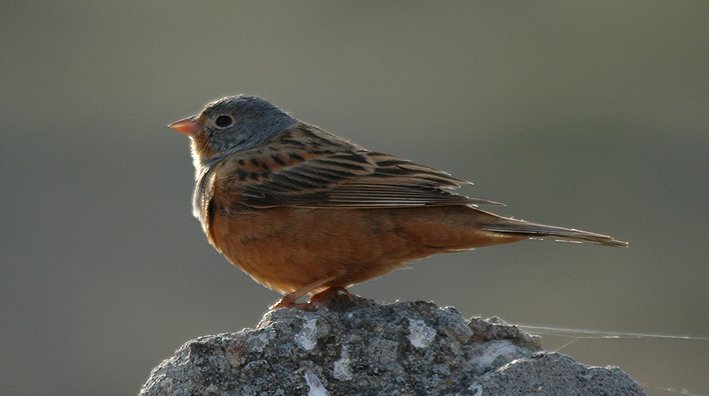
Cretzschmar's Bunting is a small bunting of the eastern Mediterranean and Near East. Breeding males have a blue-grey head with orange moustaches, rusty-orange underparts and a stout pink bill, while females and juveniles are plainer, with a white eye-ring and warm brown rump. It breeds on sunny, open hillsides with scattered bushes, mainly near coasts and on islands, and winters in north-east Africa.
Did you know?
- Its English name honours the German naturalist Philipp Jakob Cretzschmar, and caesia is Latin for “bluish-grey”.
- It is monotypic – no subspecies are recognised.
About the species
Identification
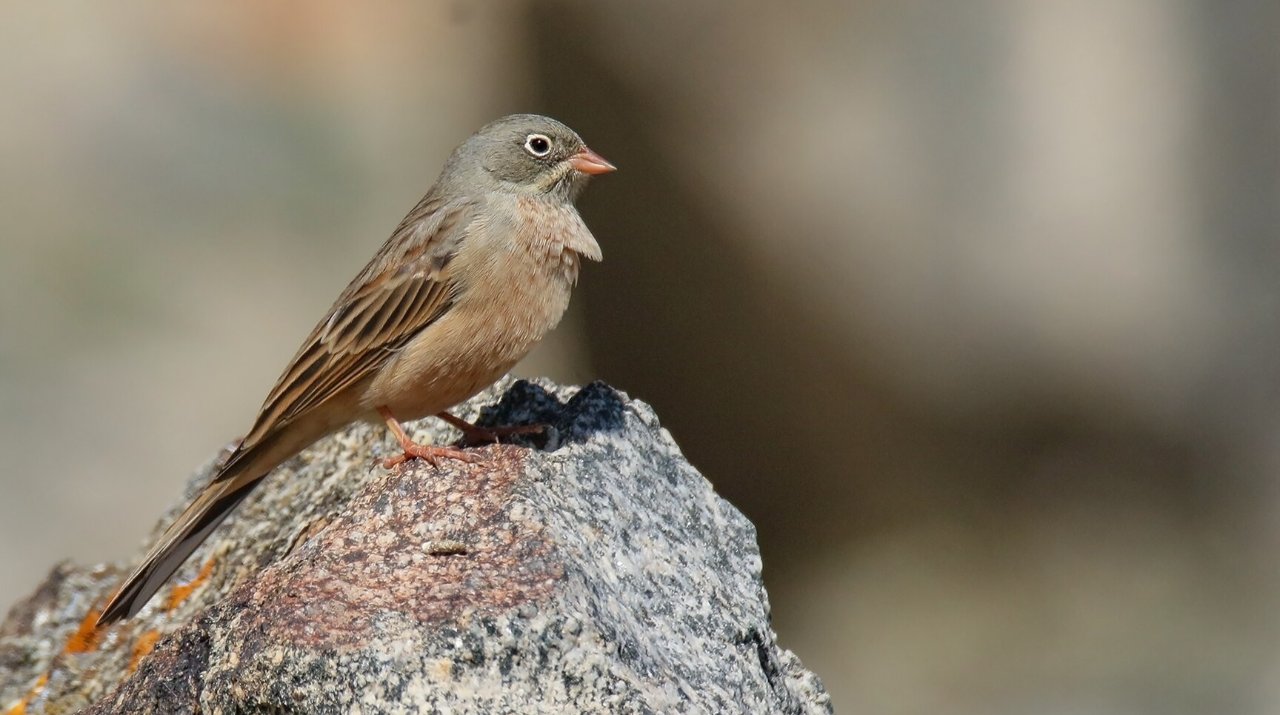
Smaller than Ortolan Bunting. The breeding male has a grey head with distinctly orange moustachial stripes, a brown, heavily streaked back and rusty-brown underparts; the bill is stout and pink. Females and young have a weaker head pattern; their warm brown rump and white eye-ring stand out. The call resembles Ortolan's.
Family
Emberizidae
Size
Small (sparrow)
Colours
grey, orange, brown
About the habitat
Sunny, open, rocky hillsides with some bushes, mainly in coastal or island settings, in Greece, Turkey, Cyprus and the Levant; winters in Sudan and Eritrea.
Diet
Mainly small seeds, especially of grasses, taken almost entirely on the ground; also small invertebrates, particularly ants. Chicks are fed mostly insects.
Behaviour
A ground-feeding bunting that walks and picks seeds and small invertebrates. It nests on the ground, usually laying 4–6 eggs. A migrant, it moves from the eastern Mediterranean to wintering grounds in north-east Africa.
Sources
Photo: Jan Svetlík, CC BY 2.0 https://commons.wikimedia.org/wiki/File:Emberiza caesia.jpg
Text: Wikipedia (English), CC BY-SA 4.0 https://en.wikipedia.org/wiki/Cretzschmar%27s_bunting