Suomi
 Svenska
 Polski
 Čeština
 Slovenčina
 Norsk
 Dansk
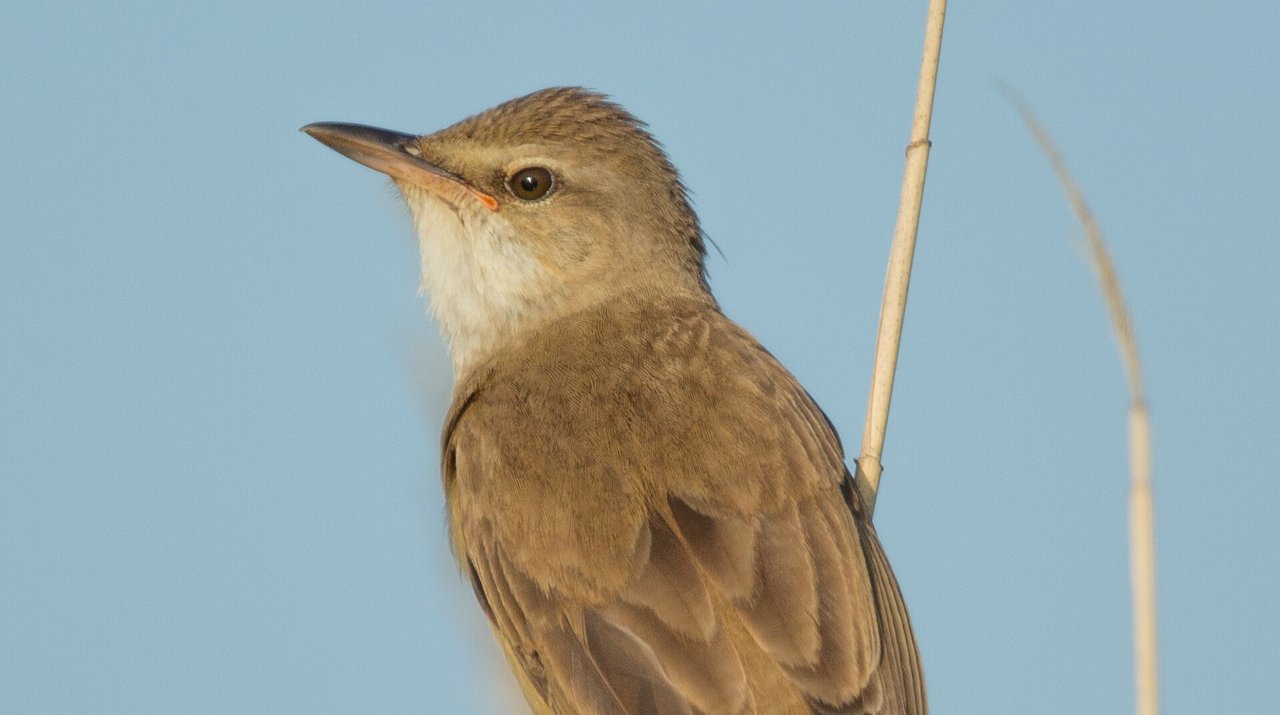
Great Reed Warbler
Acrocephalus arundinaceus
Identify the Great Reed Warbler by sound or photo and log your sightings with Birdpass.


The Great Reed Warbler is the largest European warbler, a robust reedbed specialist with a loud, far-carrying, harsh song. It breeds widely across mainland Europe and the western Palearctic and migrates to sub-Saharan Africa for the winter. The sexes look alike, and the species may be monogamous or polygynous.
Did you know?
- When crossing the Sahara, some Great Reed Warblers climb to over 6,000 m – the highest recorded flights of any songbird.
- The nest is a woven cup suspended between upright reed stems, so it stays above the water.
Voice
About the species
Identification
A large, sturdy reed warbler, clearly bigger than Eurasian Reed Warbler, with a heavy bill. Warm brown above and pale below, with a distinct pale supercilium and a slight greyish wash on the breast. The song is harsh and powerful – clearer, slower and coarser than a Reed Warbler's, with notes like “krek-krek” and “kraak”.
Family
Acrocephalidae
Size
Small (sparrow)
Colours
brown, white, grey
About the habitat
Extensive, mature reedbeds along lakes, bays, ponds and slow rivers, preferably with some bushes; in winter also bushy thickets, rice fields and forest clearings in Africa.
Diet
Mainly insects and spiders: larvae, moths, dragonflies, damselflies and beetles; it also snaps up small vertebrates such as tadpoles, small fish and frogs, and eats berries and fruit outside the breeding season.
Behaviour
Keeps to dense reedbeds, climbing and clinging to stems, but often sings conspicuously from reed tops. Males use long, elaborate songs to attract females and shorter, simpler songs in territorial encounters. The nest is a deep woven cup suspended between reed stems above water; the female incubates and both parents feed the young. Territorial on the breeding grounds, but can gather in large numbers in winter.
Sources
Photo: Andreas Trepte, CC BY-SA 2.5 https://commons.wikimedia.org/wiki/File:Drosselrohrsänger Great reed warbler.jpg
Sound: Sonothèque ADVL, XC1137579, CC0 1.0 https://xeno-canto.org/1137579
Text: Wikipedia (English) + FinBIF species descriptions + Wikipedia (Finnish), CC BY-SA 4.0; FinBIF: CC BY 4.0; Wikipedia: CC BY-SA 4.0 https://en.wikipedia.org/wiki/Great_reed_warbler