
 Suomi
 Svenska
 Polski
 Čeština
 Slovenčina
 Norsk
 Dansk
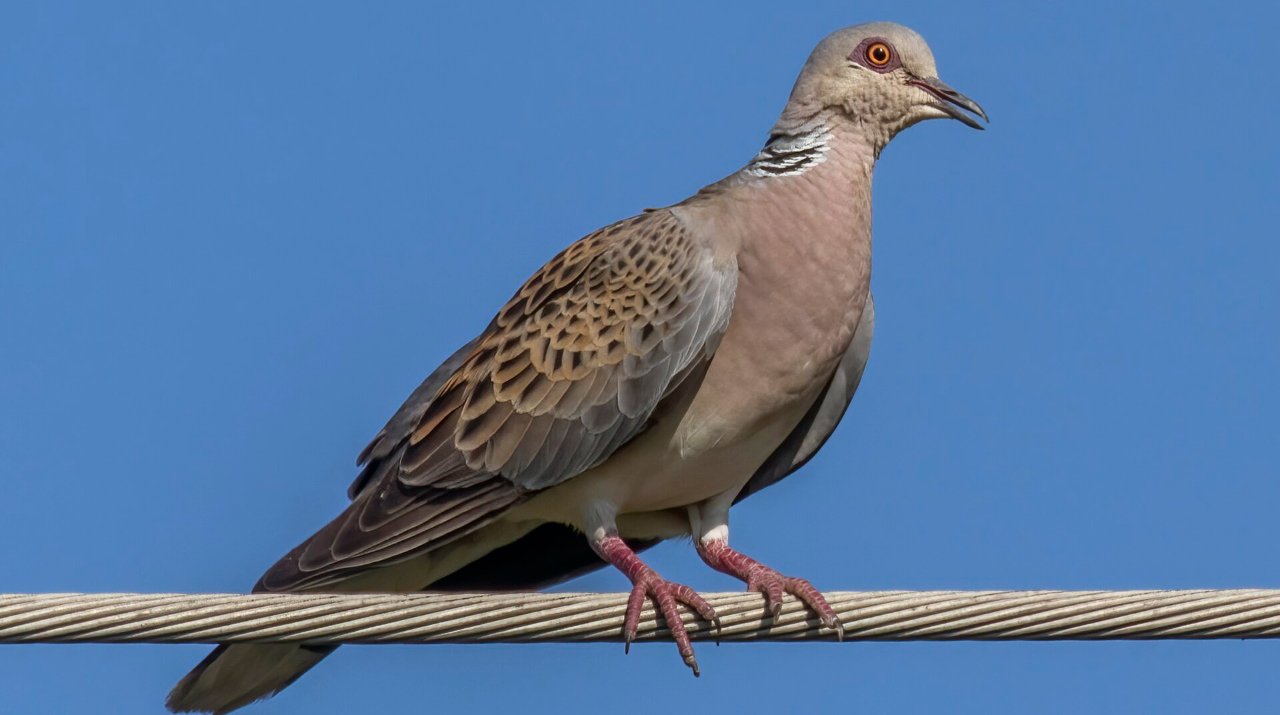
European Turtle Dove
Streptopelia turtur
Identify the European Turtle Dove by sound or photo and log your sightings with Birdpass.


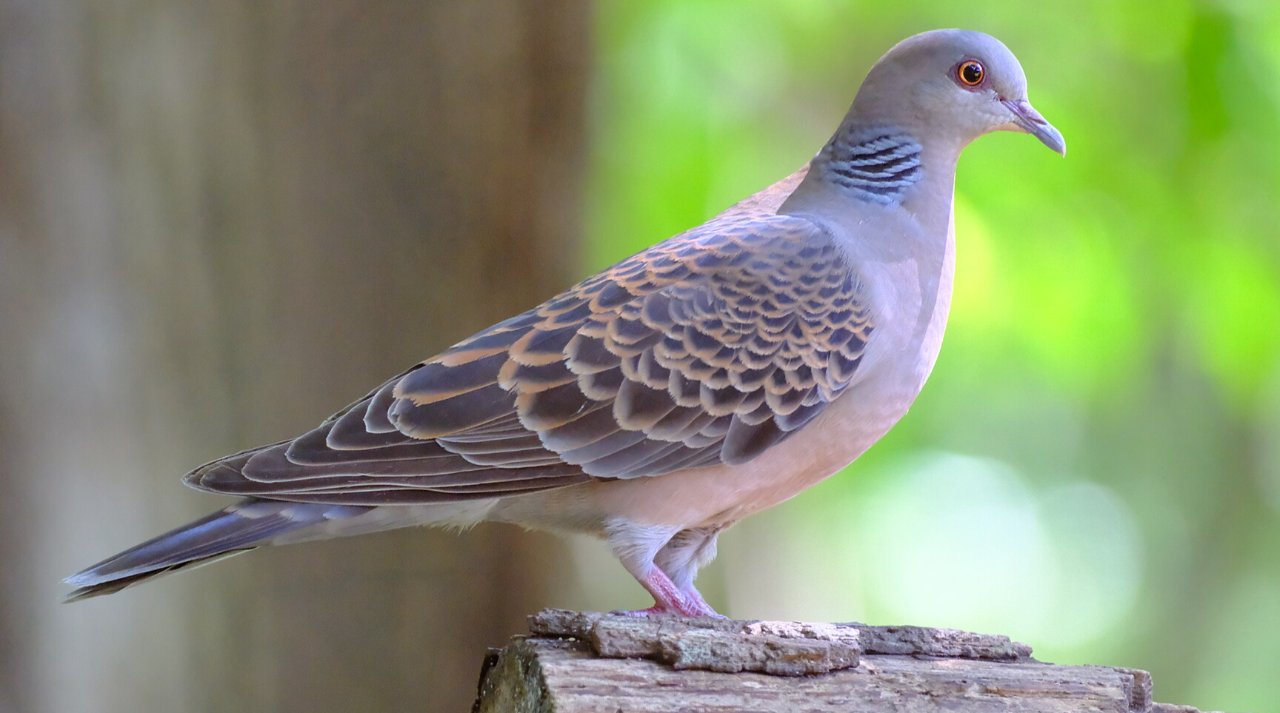
The European Turtle Dove is a slim, migratory dove that breeds across Europe, North Africa and western Asia and winters in the Sahel. It has warm, black-scaled wings, a blue-grey head, a black-and-white striped neck patch and a white-edged tail. Its soft, purring “turrr” song has long symbolised love. It has declined steeply because of agricultural change and hunting on migration and is listed as Vulnerable.
Did you know?
- “Turtle” comes from the Latin turtur, imitating its purring song.
- It has long symbolised faithful love in European folklore.
Voice
About the species
Identification
A small, slim dove resembling a Collared Dove. The upperparts are scaly: the scapulars and wing coverts have dark centres and rufous fringes; the head is grey, the breast pinkish and the belly pale. A black-and-white striped patch shows on the side of the neck; the wings are pointed and the dark tail has white edges and tip. The voice is a soft, purring “turrr, turrr”.
Family
Columbidae
Size
Medium (thrush)
Colours
brown, grey, orange, black, white
About the habitat
Mosaics of open farmland with hedgerows and scrub, woodland edges, thickets, orchards and shelterbelts; winters in dry savanna.
Diet
Mainly small seeds of wild plants such as fumitory, as well as cereal grain and shoots, taken on the ground.
Behaviour
A wary, ground-feeding dove that forages quietly along field edges, then retreats to trees and hedges. It is a long-distance migrant that arrives late in spring and leaves early. Its flight is fast and direct, and display flights are high and circling with wing-claps. It builds a flimsy nest in bushes or trees.
Sources
Photo: Charles J. Sharp, CC BY-SA 4.0 https://commons.wikimedia.org/wiki/File:Turtle dove (Streptopelia turtur turtur) Hungary.jpg
Sound: Sonothèque ADVL, XC730609, CC0 1.0 https://xeno-canto.org/730609
Text: Wikipedia (English) + FinBIF species descriptions, CC BY-SA 4.0; FinBIF: CC BY 4.0 https://en.wikipedia.org/wiki/European_turtle_dove
 Hungary.jpg)