Suomi
 Svenska
 Polski
 Čeština
 Slovenčina
 Norsk
 Dansk
Oriental Turtle Dove
Streptopelia orientalis
Identify the Oriental Turtle Dove by sound or photo and log your sightings with Birdpass.


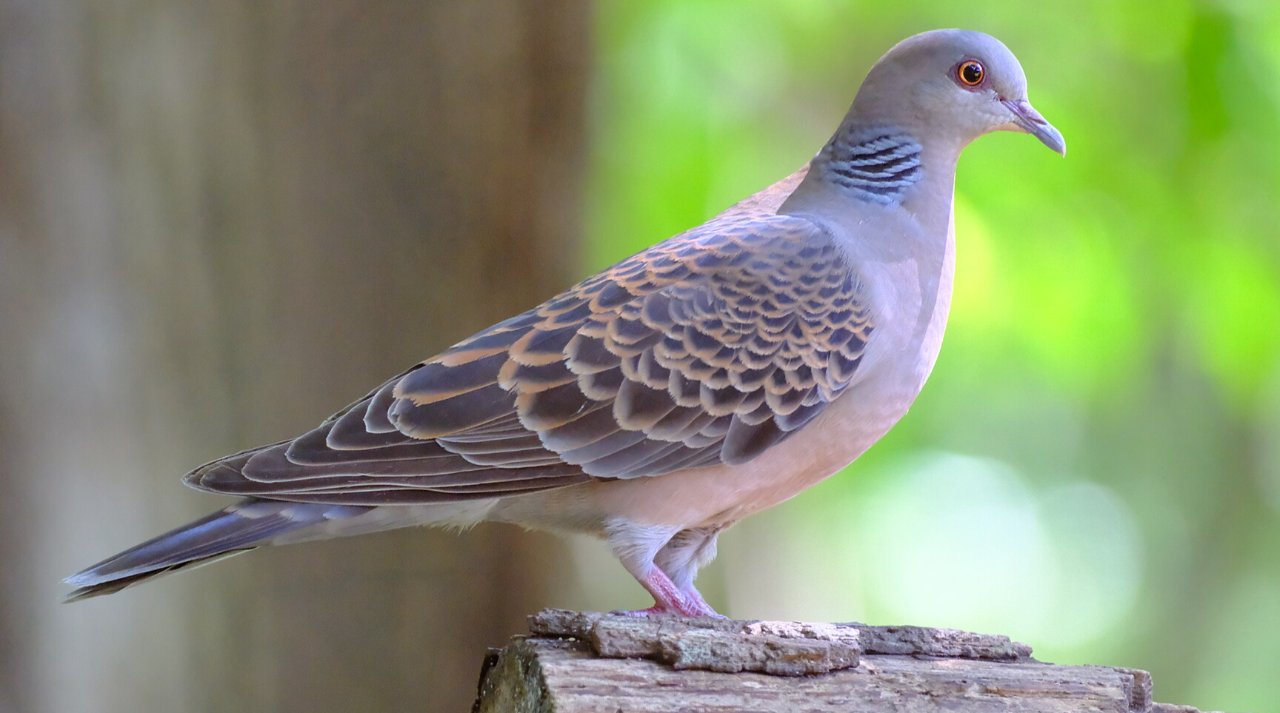
The Oriental Turtle Dove is a sturdy dove of open woodland across Asia from the Urals to Japan. Slightly larger and darker than the European Turtle Dove, it has scaly brown wings and a black-and-white barred neck patch. Northern birds migrate south to South and Southeast Asia, while tropical populations are resident. It is a rare vagrant to Europe, usually in late autumn.
Did you know?
- Its call is a four-syllable “her-her-oo-oo”, unlike the European Turtle Dove's purr.
- Its neck patch consists of fine black-and-white bars.
Voice
About the species
Identification
It resembles European Turtle Dove but is slightly larger and darker. The pattern of the scapulars differs, with darker centres and narrower rufous fringes, the tail tip is grey, and blue-grey shows on the neck, lower back and rump. The wing pattern is fairly subdued, which helps separate it from similar doves.
Family
Columbidae
Size
Medium (thrush)
Colours
brown, grey, black, white
About the habitat
Woodland with clearings and edges, parks, shelterbelts and farmland mosaics; in winter more open country with trees.
Diet
Mainly seeds of weeds and crops such as hemp, sunflower, millet and wheat, taken on the ground; also berries and small snails.
Behaviour
Wary, it keeps to trees at the forest edge and drops to the ground to feed. Its call is a deep, four-syllable “her-her-oo-oo”. In display the male climbs with noisy wingbeats and glides down with spread tail. Both parents incubate – the male by day, the female by night – and feed the young with crop milk.
Sources
Photo: J. Patrick Fischer, CC BY-SA 4.0 https://commons.wikimedia.org/wiki/File:2026-08-27 Streptopelia orientalis in Chitose.jpg
Sound: boppochan, CC BY-SA 3.0 https://commons.wikimedia.org/wiki/File:Streptopelia_orientalis.ogg
Text: Wikipedia (English) + FinBIF species descriptions, CC BY-SA 4.0; FinBIF: CC BY 4.0 https://en.wikipedia.org/wiki/Oriental_turtle_dove