
 Suomi
 Svenska
 Polski
 Čeština
 Slovenčina
 Norsk
 Dansk
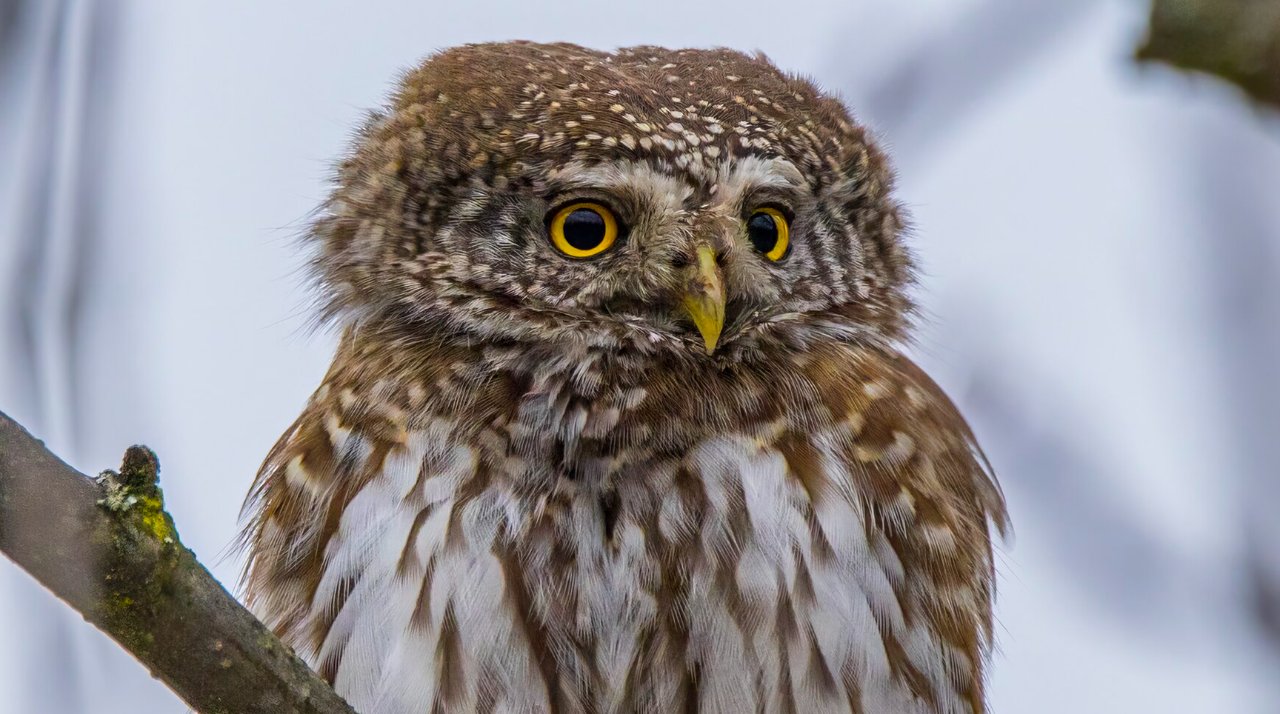
Eurasian Pygmy Owl
Glaucidium passerinum
Identify the Eurasian Pygmy Owl by sound or photo and log your sightings with Birdpass.


The Eurasian Pygmy Owl is Europe's smallest owl, a compact, sparrow-sized hunter of coniferous and mixed forests from northern and central Europe across Siberia. It is active at dawn, dusk and even in daylight, and often nests in old woodpecker holes. Most adults are resident, and it is known for storing surplus prey for the winter.
Did you know?
- It has “false eyes” – dark spots on the back of the head that may deter attackers.
- In autumn it may store dozens of small mammals and birds in a single larder for the winter.
Voice
About the species
Identification
Europe's smallest owl: very small and short-tailed. Brown above with white spots and paler below with brown streaks; the bill is yellow and the head fairly small. The nape shows two dark “false eyes”. Its territorial call, a clear, monotonous piping whistle, is easy to tell from other owls. Told from Tengmalm's Owl by its much smaller size and lack of a strong facial disc.
Family
Strigidae
Size
Medium (thrush)
Colours
brown, white, grey, yellow
About the habitat
Mature boreal and mountain forest, especially spruce and pine with clearings and edges, and mixed conifer-birch stands; it needs holes for nesting and a varied forest structure with hunting perches.
Diet
Mainly small mammals such as voles and mice, and small birds such as tits, finches and thrushes, which it can snatch in flight; also large insects and lizards. It caches surplus prey in tree holes and nest boxes.
Behaviour
Perches quietly on exposed branches, often flicking its tail, then makes short, rapid sallies to seize prey. Adults hold territories year-round, while young birds disperse in autumn; in some years there are larger movements. It nests in deep tree holes, often old Great Spotted Woodpecker holes, and readily uses nest boxes. The male advertises with a clear, repeated whistle, especially at dawn and dusk in spring and autumn.
Sources
Photo: Charles J. Sharp, CC BY-SA 4.0 https://commons.wikimedia.org/wiki/File:Eurasian pygmy owl (Glaucidium passerinum) Białowieza.jpg
Sound: Robert Petersen, XC986020, CC BY-SA 4.0 https://xeno-canto.org/986020
Text: Wikipedia (English) + FinBIF species descriptions, CC BY-SA 4.0; FinBIF: CC BY 4.0 https://en.wikipedia.org/wiki/Eurasian_pygmy_owl
 Białowieza.jpg)