
 Suomi
 Svenska
 Polski
 Čeština
 Slovenčina
 Norsk
 Dansk
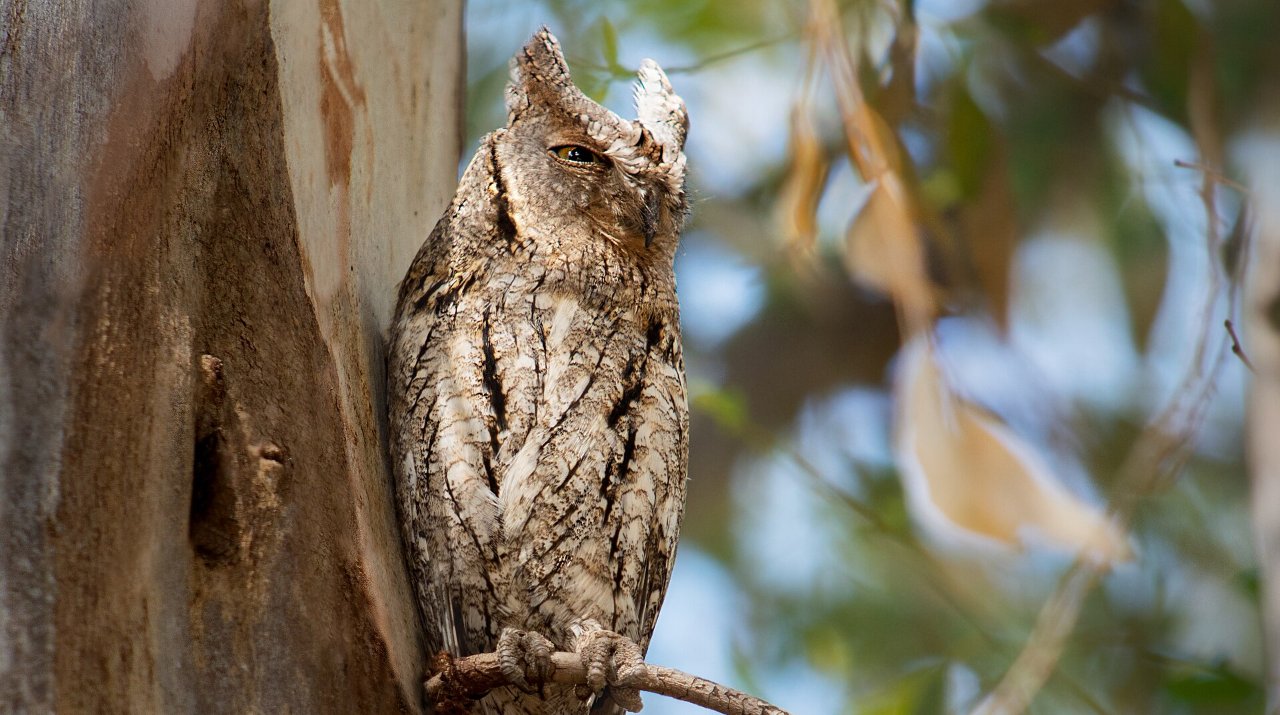
Eurasian Scops Owl
Otus scops
Identify the Eurasian Scops Owl by sound or photo and log your sightings with Birdpass.


The Eurasian Scops Owl is a small, ear-tufted owl with grey-brown, bark-like camouflage and long, narrow wings. It breeds from southern Europe across western and central Asia and winters mainly in Africa south of the Sahara, though some birds stay year-round around the Mediterranean. Active after dark, it is usually detected by its mellow, monotonous whistled call.
Did you know?
- Its whistle closely resembles the call of midwife toads, causing night-time mix-ups.
- Both Otus and scops refer to “eared owls”.
Voice
About the species
Identification
A small owl with short ear tufts, grey-brown mottled plumage and a face paler than the body. The wings are fairly long; length about 19–21 cm, wingspan 47–54 cm. It looks slim and well adapted to migration. Its call, a single short whistle repeated steadily, is the best clue.
Family
Strigidae
Size
Medium (thrush)
Colours
grey, brown, white, black, yellow
About the habitat
Open woodland, olive groves, orchards, parks, gardens and villages with old trees or walls offering nest holes; winters in African savanna.
Diet
Mainly large insects such as grasshoppers, crickets, moths and beetles, as well as other invertebrates, occasionally small birds, rodents and lizards, taken mostly at night.
Behaviour
Largely nocturnal; the male repeats a single deep, whistled “tyoo” every few seconds for hours, and pairs often duet. By day it roosts pressed against a tree trunk, relying on camouflage. It nests in holes in trees or walls or in nest boxes; the female incubates while both parents feed the young.
Sources
Photo: Frank Vassen from Brussels, Belgium, CC BY 2.0 https://commons.wikimedia.org/wiki/File:Scops Owl (Otus scops), Kalloni, Lesvos, Greece, 19.04.2015 (16773748434).jpg
Sound: Carlo Fracasso, XC787411, CC0 1.0 https://xeno-canto.org/787411
Text: Wikipedia (English), CC BY-SA 4.0 https://en.wikipedia.org/wiki/Eurasian_scops_owl
, Kalloni, Lesvos, Greece, 19.04.2015 (16773748434).jpg)