
 Suomi
 Svenska
 Polski
 Čeština
 Slovenčina
 Norsk
 Dansk
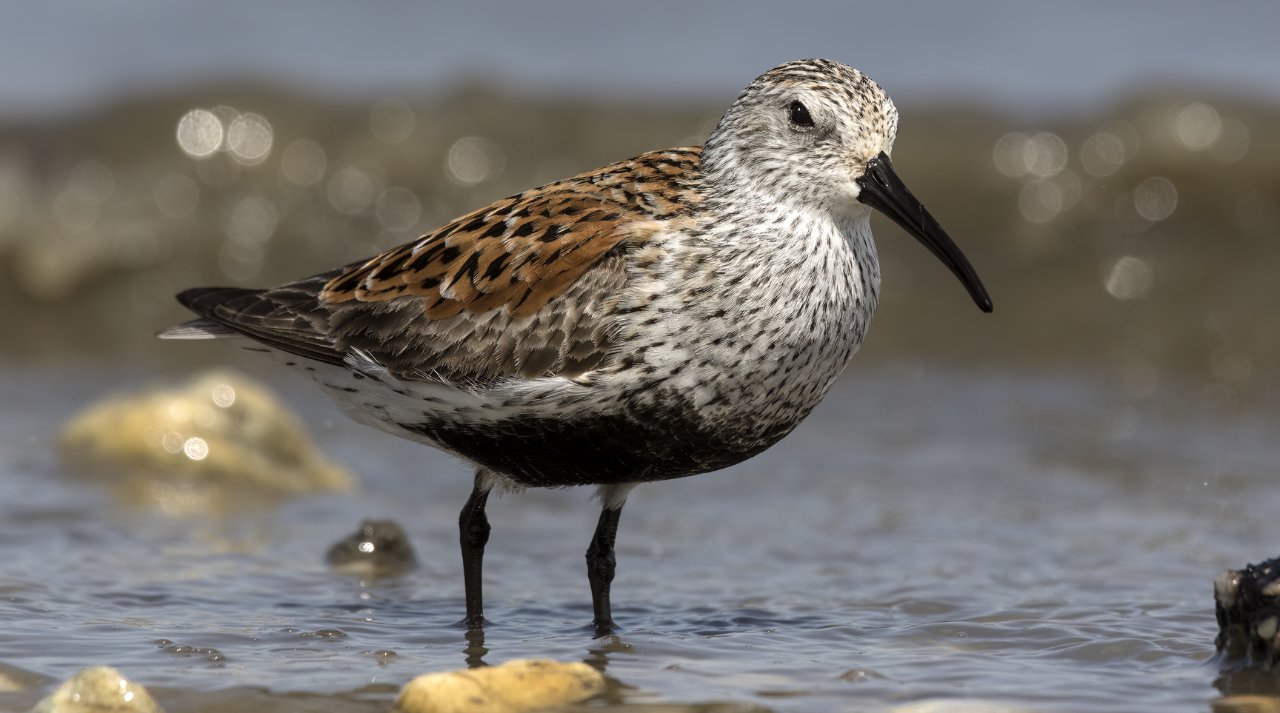
Dunlin
Calidris alpina
Identify the Dunlin by sound or photo and log your sightings with Birdpass.


The Dunlin is a small, slightly droop-billed sandpiper that breeds across the Arctic and subarctic and winters on coasts around the Northern Hemisphere. In breeding plumage it shows a black belly patch and rufous back; in winter it is grey-brown above and white below. Populations migrate varying distances, from short coastal moves to journeys to Africa and Asia. Several subspecies occur, including the southern schinzii of coastal meadows. Overall numbers are declining.
Did you know?
- The tip of a Dunlin's bill is soft and packed with nerve endings, forming a sensitive probe for prey hidden in mud.
- Its black belly patch in breeding plumage is unique among waders of its size.
Voice
About the species
Identification
In breeding plumage recognised by its black belly, rufous-brown back and dark, slightly downcurved bill. The southern subspecies schinzii has a mottled black-and-white belly patch. Juveniles and winter birds are greyish or brownish, and in flight a narrow white wingbar shows. It is larger than the stints, with a longer, drooping bill, and lacks the white rump of Curlew Sandpiper.
Family
Scolopacidae
Size
Medium (thrush)
Colours
brown, white, black
About the habitat
Breeds on wet tundra, fell and blanket bogs and, in the south, on low, grazed coastal meadows. Outside the breeding season tidal mudflats, estuaries, beaches and lake shores.
Diet
On the breeding grounds mainly insects such as crane flies, midges and beetles; on coasts worms, small molluscs and crustaceans, probed from mud with its sensitive bill.
Behaviour
Feeds with a rapid, “sewing-machine” probing action, often in active flocks. In winter it gathers in huge flocks that twist and wheel in synchronised flight over mudflats. Many birds return to their natal areas to breed. The nest is a shallow scrape with usually four eggs; both adults incubate, and the male often finishes caring for the chicks. Calls include a buzzy “treep” and a soft, trilling song.
Sources
Photo: Charles Homler d/b/a FocusOnWildlife, CC BY-SA 4.0 https://commons.wikimedia.org/wiki/File:Dunlin (Calidris alpina) in the Delaware Bay at Heislerville Wildlife Management Area, New Jersey, USA.png
Sound: Luis Alvarez Menendez, CC BY-SA 4.0 https://commons.wikimedia.org/wiki/File:Calidris_alpina_-_Dunlin_XC545082.mp3
Text: Wikipedia (English) + FinBIF species descriptions + Wikipedia (Finnish), CC BY-SA 4.0; FinBIF: CC BY 4.0; Wikipedia: CC BY-SA 4.0 https://en.wikipedia.org/wiki/Dunlin
 in the Delaware Bay at Heislerville Wildlife Management Area, New Jersey, USA.png)