
 Suomi
 Svenska
 Polski
 Čeština
 Slovenčina
 Norsk
 Dansk
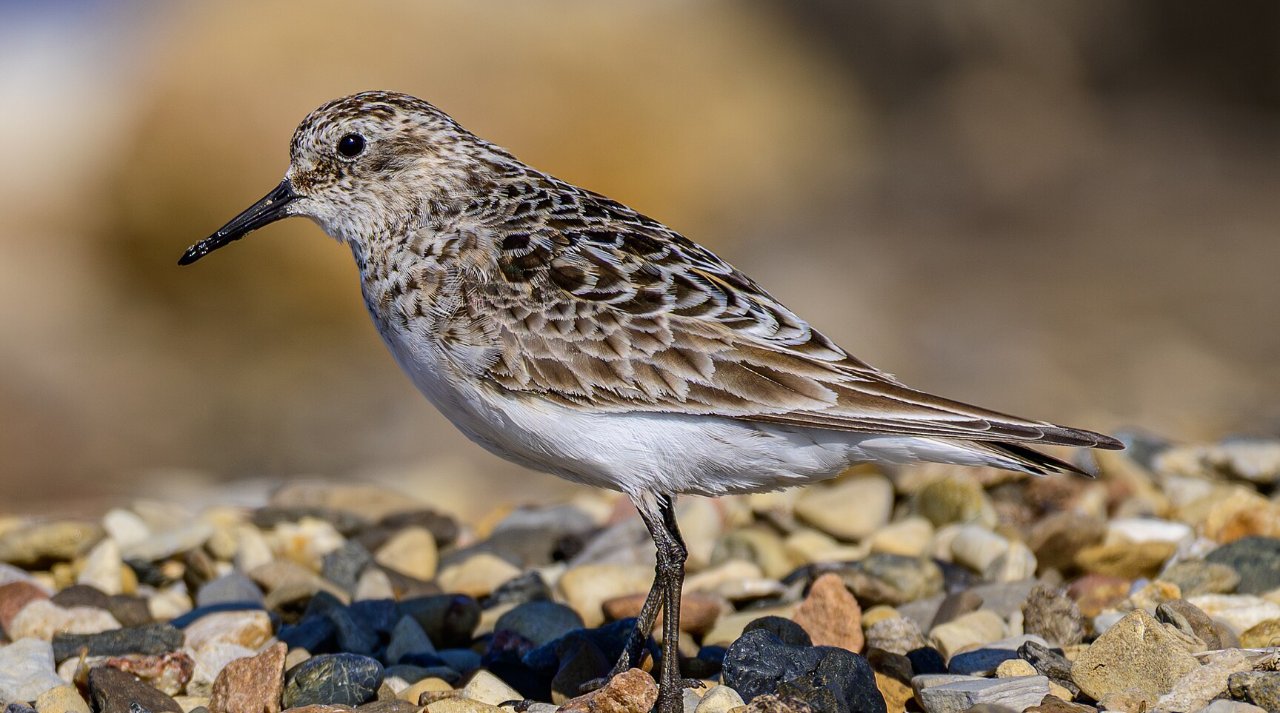
Baird's Sandpiper
Calidris bairdii
Identify the Baird's Sandpiper by sound or photo and log your sightings with Birdpass.


Baird's Sandpiper is a small Arctic-breeding sandpiper best recognised by its long wings that project well beyond the tail, giving it a slender, attenuated look. It nests on dry tundra from north-eastern Siberia across Arctic North America to north-western Greenland and migrates to western and southern South America. It is an occasional vagrant to Europe.
Did you know?
- On the ground its long wings extend beyond the tail – a feature shared mainly with White-rumped Sandpiper.
- In winter it frequents high Andean lake shores at up to 4,700 m.
Voice
About the species
Identification
A small sandpiper (14–19 cm) with long wings that clearly extend beyond the tail when standing, giving an elongated look. It is buffy with a scaly-looking back, a buff breast band and a dark rump. Told from Dunlin by its shorter, finer straight bill; identification often requires good views, and it lacks the white rump of White-rumped Sandpiper.
Family
Scolopacidae
Size
Small (sparrow)
Colours
brown, white, grey, black
About the habitat
Breeds on barren, dry Arctic coasts and hills with low vegetation; on migration lake shores, grassland and mudflats, and in winter even high Andean lakes up to 4,700 m.
Diet
Mainly insects and some small crustaceans, picked by sight on mudflats, shores and dry ground.
Behaviour
A long-distance migrant that forages by walking and picking food by sight, often on drier ground than other small sandpipers. It nests on the ground on dry tundra.
Sources
Photo: Stephan Sprinz, CC BY 4.0 https://commons.wikimedia.org/wiki/File:Baird's sandpiper (Calidris bairdii) 01.jpg
Sound: Doug Hynes, XC613406, CC BY-SA 4.0 https://xeno-canto.org/613406
Text: Wikipedia (English), CC BY-SA 4.0 https://en.wikipedia.org/wiki/Baird%27s_sandpiper
 01.jpg)