
 Suomi
 Svenska
 Polski
 Čeština
 Slovenčina
 Norsk
 Dansk
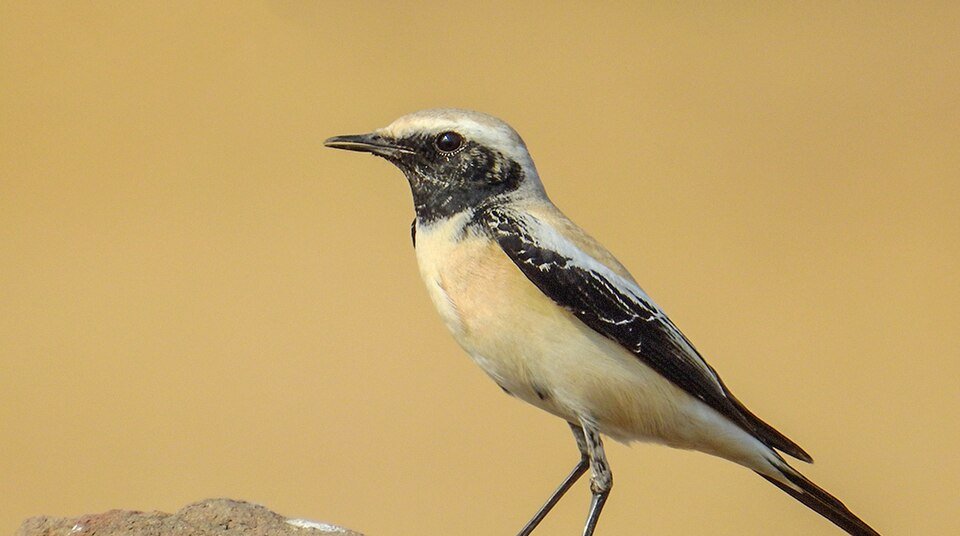
Desert Wheatear
Oenanthe deserti
Identify the Desert Wheatear by sound or photo and log your sightings with Birdpass.


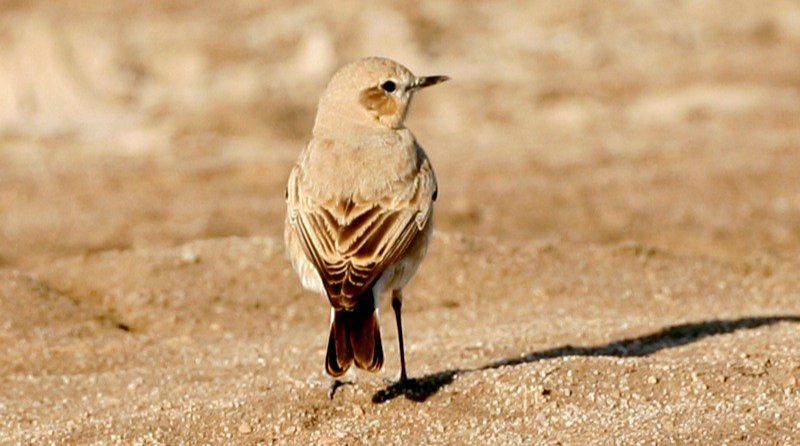
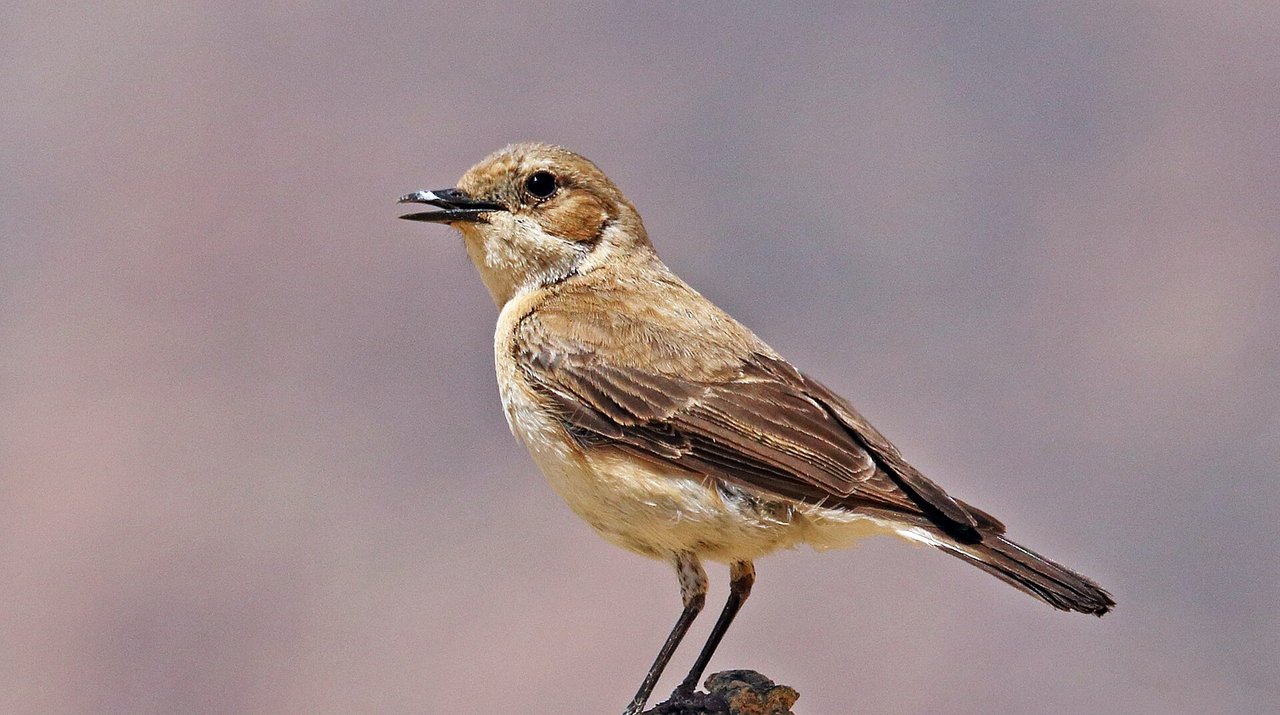
The Desert Wheatear is a small, sandy wheatear of deserts and semi-deserts across North Africa, the Middle East and Central Asia. Males have a black face and throat, and both sexes have an almost entirely black tail with a white rump; females are plainer and greyer. Western birds breed in the Sahara and Arabia, eastern birds in Central Asia, wintering in north-east Africa and Pakistan. It is a regular late-autumn vagrant to northern Europe.
Did you know?
- “Wheatear” has nothing to do with wheat – it comes from “white-arse”, after the white rump.
- Its all-black tail is a key mark in all plumages.
Voice
About the species
Identification
A pale, sandy wheatear the size of a Northern Wheatear, whose decisive mark is an almost entirely black tail with a white rump – it lacks the Northern Wheatear's black “T” on a white tail. The breeding male has a black face and throat joined to the black wings. It has an upright posture, and the wings and tail look dark against the pale body.
Family
Turdidae
Size
Small (sparrow)
Colours
brown, white, black, orange
About the habitat
Open, barren country – deserts, semi-arid plains, steppe, salt flats, dry riverbeds and stony or sandy wasteland; in winter also fields with bare ground.
Diet
Mainly insects taken on the ground – ants, beetles, caterpillars, flies and antlion larvae – and sometimes caught in flight; occasionally seeds.
Behaviour
Perches on low bushes, rocks or tussocks and drops to the ground to seize prey, sometimes hovering briefly. It builds a neat cup nest in a crevice, under a rock or bush, usually laying about four pale blue eggs; the female incubates, and both parents feed the young.
Sources
Photo: Shantanu Kuveskar, CC BY-SA 4.0 https://commons.wikimedia.org/wiki/File:Desert Wheatear (Oenanthe deserti) Photograph by Shantanu Kuveskar.jpg
Sound: ALESSANDRO MOTTA, CC BY-SA 4.0 https://commons.wikimedia.org/wiki/File:Oenanthe_deserti_-_Desert_Wheatear_XC615083.mp3
Text: Wikipedia (English), CC BY-SA 4.0 https://en.wikipedia.org/wiki/Desert_wheatear
 Photograph by Shantanu Kuveskar.jpg)