
 Suomi
 Svenska
 Polski
 Čeština
 Slovenčina
 Norsk
 Dansk
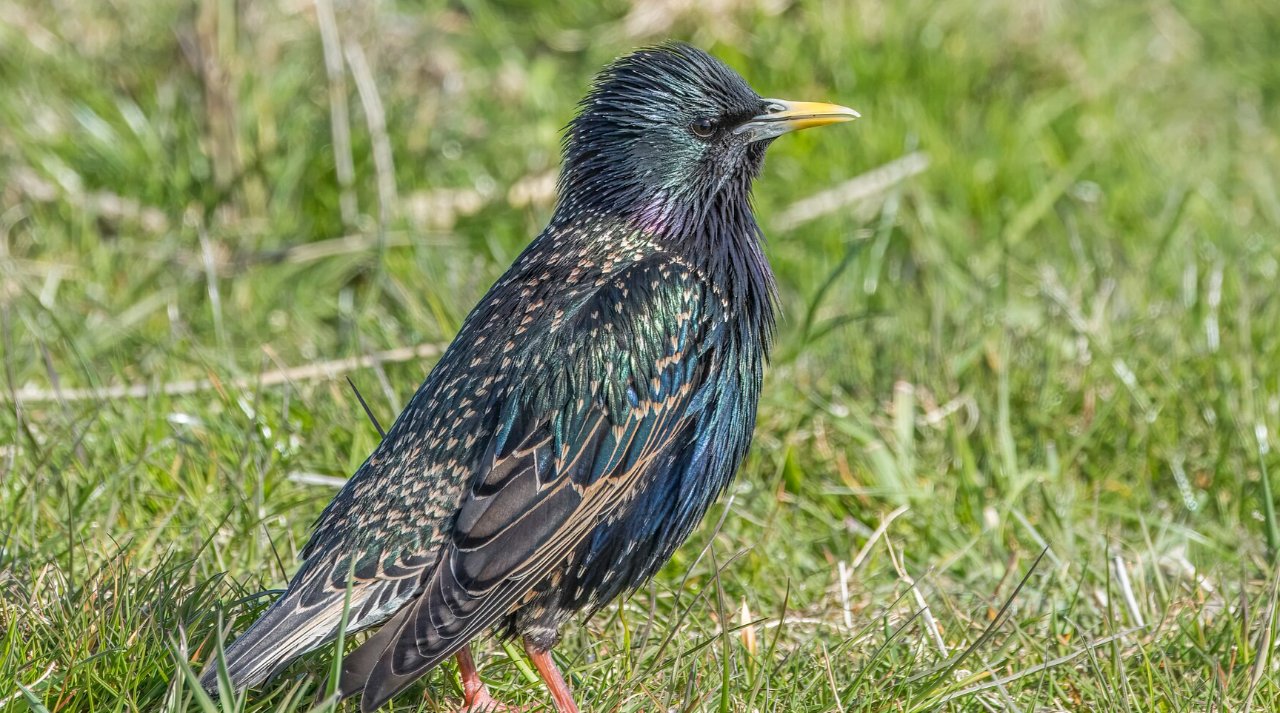
Common Starling
Sturnus vulgaris
Identify the Common Starling by sound or photo and log your sightings with Birdpass.


The Common Starling is a familiar, noisy songbird with glossy black plumage shining purple and green, speckled with white in winter. Native to Europe and western Asia, it has been introduced to North America, Australia and elsewhere. It lives in open country and towns, nests in cavities and after breeding gathers in huge flocks whose evening displays, called murmurations, are spectacular. It has declined in parts of northern and western Europe.
Did you know?
- Its mimicry has been celebrated since antiquity, by writers from Pliny to Shakespeare.
- Each bird in a murmuration coordinates with its nearest neighbours, creating fluid shapes.
Voice
About the species
Identification
A medium-sized, glossy black bird whose plumage shines green and purple and is pale-spotted in winter; the bill is yellow in spring and otherwise dark. Young birds are grey-brown until their moult. It walks on the ground and flies straight on triangular, pointed wings. Its song is loud and varied, often with mimicry. It differs from Blackbird in its shorter tail, pointed wings and gloss.
Family
Sturnidae
Size
Medium (thrush)
Colours
black, green, white, yellow, brown
About the habitat
Open habitats with short vegetation and nearby cavities – farmland, pastures, meadows, parks, gardens and towns.
Diet
Omnivorous: mainly insects and other invertebrates such as leatherjackets, beetles, caterpillars and earthworms, probed from short grass; also fruit, berries, seeds and scraps.
Behaviour
Highly social and vocal, it walks rather than hops, probing lawns and pastures, often following livestock. It sings a chattering mix of whistles, clicks and rattles with much mimicry, even of phones and machinery. It nests in holes in trees and buildings or nest boxes, laying four to six pale blue eggs; the young fledge in about three weeks. North-eastern birds migrate south-west in winter.
Sources
Photo: Charles J. Sharp, CC BY-SA 4.0 https://commons.wikimedia.org/wiki/File:Common starling (Sturnus vulgaris) breeding male Marken.jpg
Sound: Marie-Lan Taÿ Pamart, XC474427, CC BY-SA 4.0 https://xeno-canto.org/474427
Sound: Sonothèque ADVL, XC934628, CC0 1.0 https://xeno-canto.org/934628
Text: Wikipedia (English) + FinBIF species descriptions + GBIF regional observations + Wikipedia (Swedish), CC BY-SA 4.0; FinBIF: CC BY 4.0; GBIF occurrence data; Wikipedia: CC BY-SA 4.0 https://en.wikipedia.org/wiki/Common_starling
 breeding male Marken.jpg)