Suomi
 Svenska
 Polski
 Čeština
 Slovenčina
 Norsk
 Dansk
Rosy Starling
Pastor roseus
Identify the Rosy Starling by sound or photo and log your sightings with Birdpass.


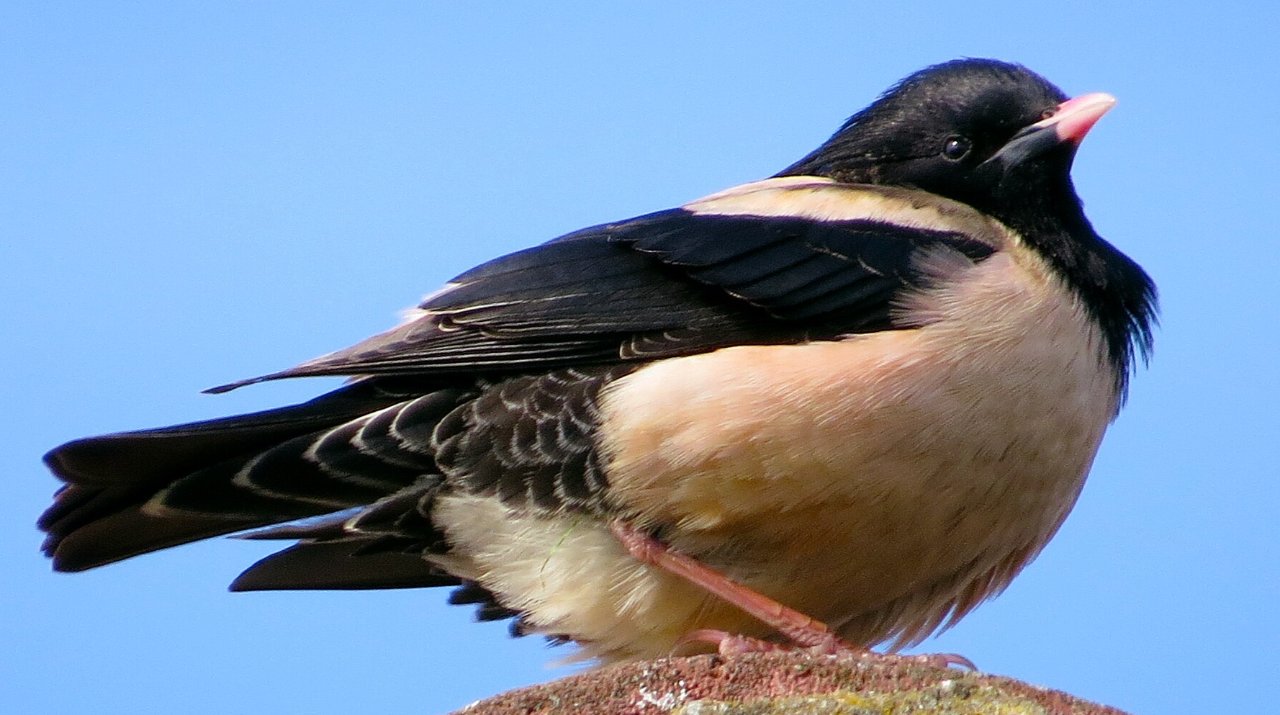
The Rosy Starling is a striking pink-and-black starling of the Eurasian steppes; males have a silky crest in the breeding season. It breeds in dense colonies across steppe, semi-desert and open farmland from south-eastern Europe through Central Asia and winters mainly in India. Highly social, it times its short breeding season to grasshopper booms and in good years irrupts far to the west.
Did you know?
- In China farmers attract Rosy Starlings with artificial nest sites to control locusts.
- In years with insect booms it can irrupt far beyond its usual range.
About the species
Identification
Shaped like a Common Starling. Adults are recognised by their pink body and black head, wings, tail and vent; males have a crest on the head. Young birds are pale sandy-brown throughout, with a yellowish bill and pale lores; they can resemble young Common Starlings but look paler overall, with contrasting darker wings.
Family
Sturnidae
Size
Medium (thrush)
Colours
black, red
About the habitat
Open steppe, semi-desert and farmland, near rocky crevices or buildings for colonial nesting; outside the breeding season also orchards, grassland and towns.
Diet
In summer mainly insects, especially locusts and grasshoppers, as well as beetles and caterpillars; in winter fruit and berries, flower nectar and cereal grains.
Behaviour
Highly gregarious and mobile, it forms large, noisy flocks that forage on the ground and swarm over insect outbreaks. It breeds in tight colonies in rock crevices, walls and buildings, with nesting closely synchronised. Its song is a mix of squeaks and rattles delivered with fluttering wings. It often perches on wires and rooftops.
Sources
Photo: MPF, CC BY-SA 4.0 https://commons.wikimedia.org/wiki/File:2018-05-18 Pastor roseus, Ashington, Northumberland 2.jpg
Text: Wikipedia (English) + FinBIF species descriptions + GBIF regional observations + Wikipedia (English), CC BY-SA 4.0; FinBIF: CC BY 4.0; GBIF occurrence data; Wikipedia: CC BY-SA 4.0 https://en.wikipedia.org/wiki/Rosy_starling