
 Suomi
 Svenska
 Polski
 Čeština
 Slovenčina
 Norsk
 Dansk
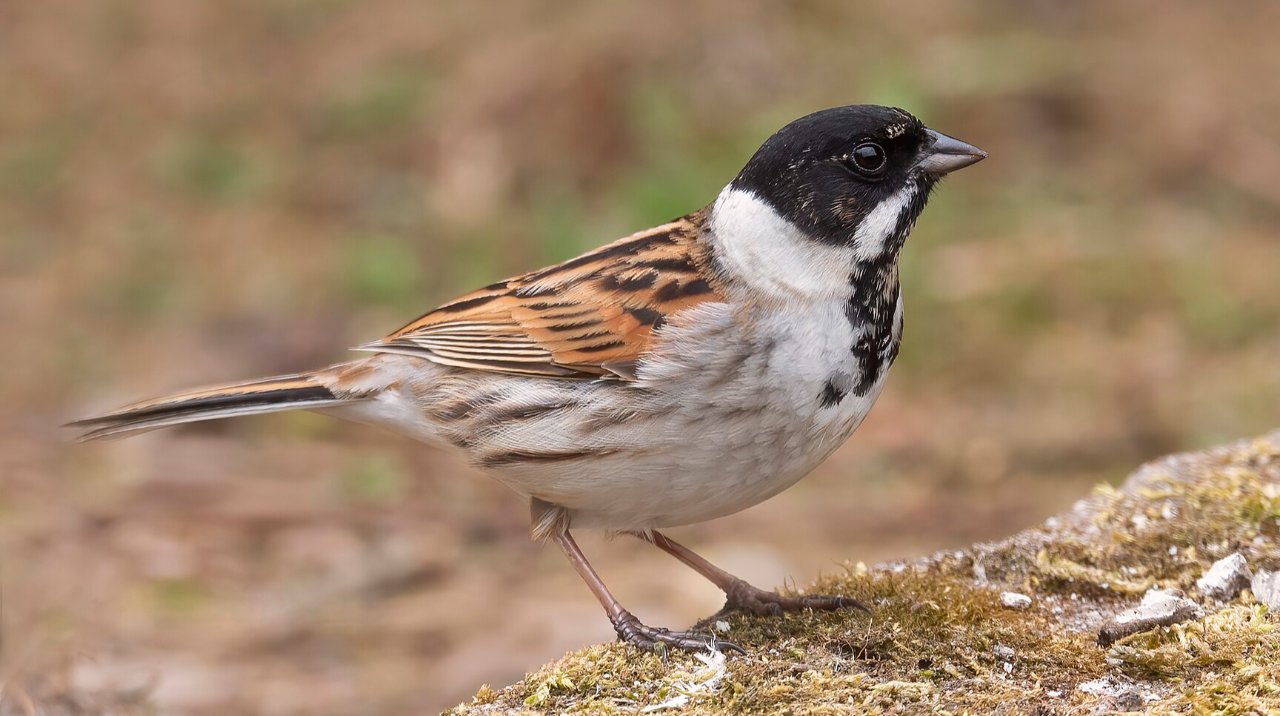
Common Reed Bunting
Emberiza schoeniclus
Identify the Common Reed Bunting by sound or photo and log your sightings with Birdpass.


The Common Reed Bunting is a small bunting of wetlands and open country, breeding across Europe and much of the Palearctic. Breeding males have a black head and throat with a crisp white collar, while females are browner and streaked. Many birds migrate south for the winter, though populations in milder western and southern areas stay year-round. It sings a simple, repeated song from reed tops and bushes.
Did you know?
- Despite its name it also breeds in drier places such as moorland and farmland, not just reedbeds.
- The male's black head is revealed in spring as the brown tips of the head feathers wear away – no moult is needed.
Voice
About the species
Identification
In spring the male has a black head and white collar that set off its brown back and wings; the female lacks the strong black-and-white head pattern and has a pale supercilium and moustachial stripe. The dark tail has white outer feathers, and the bill is small but typical of a seed-eater. It often sings a simple, monotonous song from the top of a reed or bush; the call is a clear “tsiu”. After the moult the male can look female-like until the brown feather tips wear off and the black-and-white pattern reappears.
Family
Emberizidae
Size
Small (sparrow)
Colours
brown, black, white, grey
About the habitat
Reedbeds, marshes, lakeshores, wet meadows and ditch-lined farmland with patches of reeds or tall sedges; also drier open country such as moorland and arable land.
Diet
Mainly seeds for much of the year; insects and other invertebrates especially in the breeding season. It forages on the ground and among reeds and wet vegetation.
Behaviour
Often perches on reed stems to sing; otherwise feeds low and can be skulking. It nests low in dense vegetation, often in reed tussocks or bushes, and both parents feed the young. Outside the breeding season it joins small flocks, flicking its long, white-edged tail.
Sources
Photo: caroline legg, CC BY 2.0 https://commons.wikimedia.org/wiki/File:Reed Bunting - Emberiza schoeniclus (52015951301).jpg
Sound: Pascal Christe, XC731093, CC BY-SA 4.0 https://xeno-canto.org/731093
Sound: Teet Sirotkin, XC1157224, CC BY-SA 4.0 https://xeno-canto.org/1157224
Sound: Sonothèque ADVL, XC707688, CC0 1.0 https://xeno-canto.org/707688
Text: Wikipedia (English) + FinBIF species descriptions, CC BY-SA 4.0; FinBIF: CC BY 4.0 https://en.wikipedia.org/wiki/Common_reed_bunting
.jpg)