Suomi
 Svenska
 Polski
 Čeština
 Slovenčina
 Norsk
 Dansk
Broad-billed Sandpiper
Calidris falcinellus
Identify the Broad-billed Sandpiper by sound or photo and log your sightings with Birdpass.


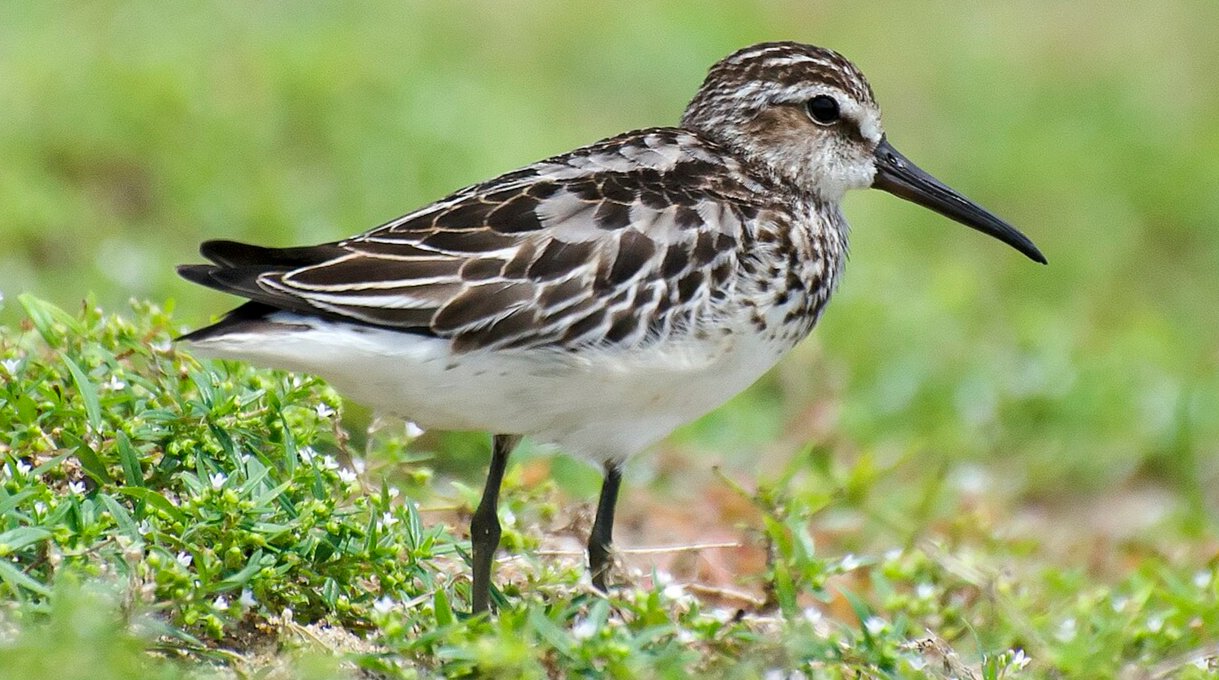
The Broad-billed Sandpiper is a small wader that breeds in wet bogs of northern Fennoscandia and Siberia and migrates south-east to winter from eastern Africa through South and South-East Asia to Australasia. It has a bold, split white eyebrow and a long bill with a slightly drooping tip. Formerly placed in its own genus Limicola, it is now within Calidris. Because of its south-easterly migration it is rarely seen in western Europe.
Did you know?
- Its scientific name falcinellus means “little sickle”.
- Its split white eyebrow gives it a striking “double-eyebrow” look.
Voice
About the species
Identification
A small sandpiper that resembles a young Dunlin but has a strong, snipe-like head pattern with a split white supercilium. The bill tip bends slightly downward, and the bill is rather thick at the base; the back is grey-brown with pale stripes. The sexes are alike.
Family
Scolopacidae
Size
Small (sparrow)
Colours
brown, white, black, grey
About the habitat
Breeds in wet, sedge-dominated fens and bogs with pools and hummocks; on migration coastal mudflats, estuaries, saltmarsh pools and flooded meadows.
Diet
Small invertebrates such as insect larvae, small crustaceans, worms and tiny molluscs, picked and shallowly probed from wet mud and shallow water.
Behaviour
Forages by rapid picking and shallow probing, often with Dunlins and stints. Rather secretive on the breeding grounds; males display with fluttering song flights and trills. It nests in a scrape on a hummock and usually lays four eggs. Its calls are dry, buzzing trills.
Sources
Photo: Sreedev Puthur, CC BY-SA 4.0 https://commons.wikimedia.org/wiki/File:Broad billed sandpiper by Sreedev Puthur.jpg
Sound: Alfonso Maffezzoli, XC671794, CC0 1.0 https://xeno-canto.org/671794
Text: Wikipedia (English) + FinBIF species descriptions, CC BY-SA 4.0; FinBIF: CC BY 4.0 https://en.wikipedia.org/wiki/Broad-billed_sandpiper