
 Suomi
 Svenska
 Polski
 Čeština
 Slovenčina
 Norsk
 Dansk
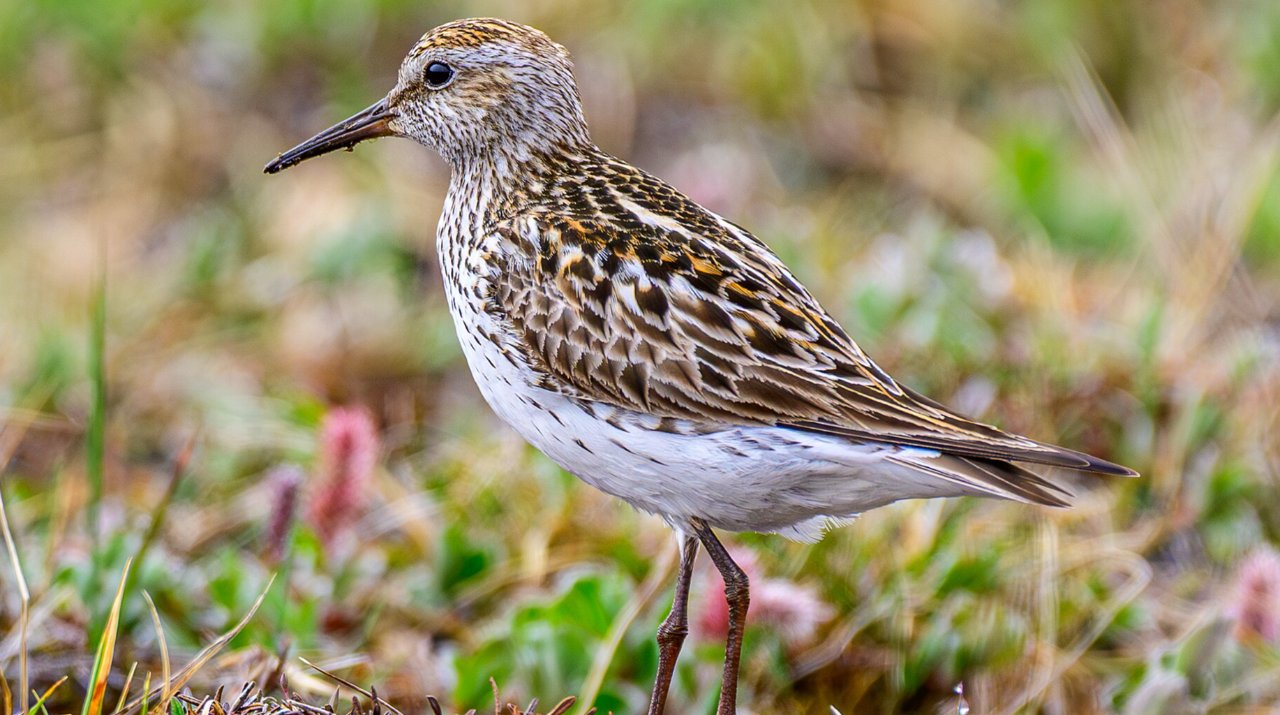
White-rumped Sandpiper
Calidris fuscicollis
Identify the White-rumped Sandpiper by sound or photo and log your sightings with Birdpass.


The White-rumped Sandpiper is a small sandpiper that breeds on the vegetated tundra of Arctic Alaska and Canada and winters in southern South America. It is hard to pick out among other small sandpipers on the ground but is readily recognised in flight by its white rump and by its long wings, which extend beyond the tail. It is an extreme long-distance migrant and a scarce vagrant to Europe.
Did you know?
- It can make a single nonstop flight of about 4,200 km.
- Its sharp, metallic call has been likened to two pebbles scraping together.
About the species
Identification
A smallish sandpiper, dark brown above and white below in summer, pale grey above in winter. Very long wings extend beyond the tail when standing, giving a slim look. In flight the white rump stands out, which together with its proportions separates it from other small sandpipers; Baird's Sandpiper has a dark rump.
Family
Scolopacidae
Size
Small (sparrow)
Colours
brown, white, grey
About the habitat
Breeds on marshy, hummocky tundra; on migration and in winter lagoons, estuaries, marshes and mudflats, generally avoiding sandy beaches.
Diet
Small aquatic invertebrates such as molluscs, crustaceans, worms and insects and their larvae; also some seeds and moss.
Behaviour
Probes in shallow water and soft mud and picks prey from the surface, often moving quickly and mixing with other small sandpipers. Its call is a thin, metallic “tzeep”. Courtship includes aerial displays with hovering. Migration is swift, with nonstop flights of up to about 4,200 km.
Sources
Photo: Stephan Sprinz, CC BY 4.0 https://commons.wikimedia.org/wiki/File:White-rumped sandpiper (Calidris fuscicollis) in breeding plumage 01.jpg
Text: Wikipedia (English) + GBIF regional observations + Wikipedia (Finnish) + GBIF regional observations + Wikipedia (English), CC BY-SA 4.0; GBIF occurrence data; Wikipedia: CC BY-SA 4.0 https://en.wikipedia.org/wiki/White-rumped_sandpiper
 in breeding plumage 01.jpg)