Suomi
 Svenska
 Polski
 Čeština
 Slovenčina
 Norsk
 Dansk
Black-necked Grebe
Podiceps nigricollis
Identify the Black-necked Grebe by sound or photo and log your sightings with Birdpass.


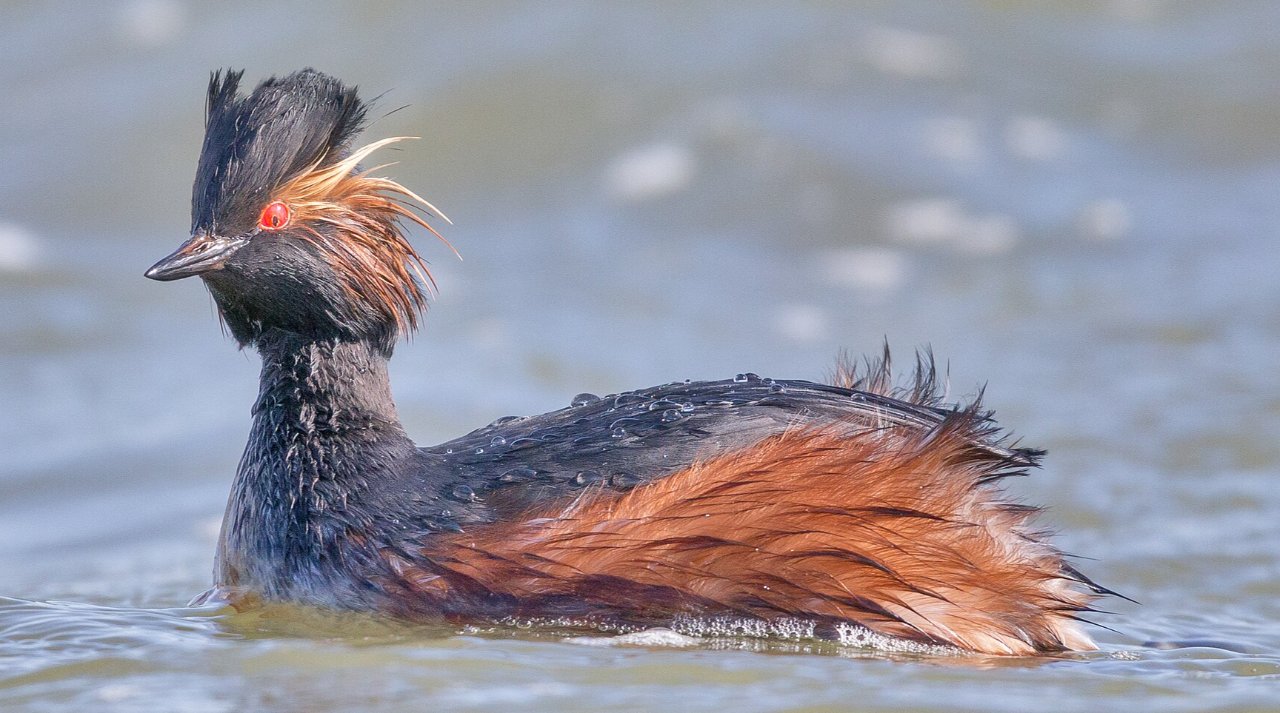
The Black-necked Grebe is a small grebe with a black head and neck in the breeding season, set off by fan-shaped golden plumes behind bright red eyes; in winter it is grey and white. It occurs in Europe, Asia, Africa and the Americas and is probably the most numerous grebe in the world. It breeds in colonies on shallow, vegetated lakes, often among Black-headed Gulls.
Did you know?
- Although it seldom flies, it can migrate up to 6,000 km.
- On moulting lakes it becomes flightless and can double its weight.
About the species
Identification
A small grebe with a steep forehead and a thin, slightly upturned bill. In breeding plumage the head, neck and back are black, the flanks rufous, and fan-shaped golden plumes spread behind the red eye. In winter it is dark grey and white with a dusky neck, and the black cap extends below the eye, making the face darker than a Horned Grebe's.
Family
Podicipedidae
Size
Large (crow)
Colours
black, brown, yellow, red, white
About the habitat
Breeds on shallow, nutrient-rich lakes and ponds with emergent vegetation; moults and winters on saline lakes, coastal lagoons and sheltered coasts.
Diet
Mainly insects and their larvae taken from the surface or in flight, as well as crustaceans, molluscs, tadpoles and small fish; at salt lakes where it moults it feeds largely on brine shrimps.
Behaviour
It builds a floating nest on open water, often in colonies, laying three to four eggs; incubation lasts about three weeks, and the parents later split the brood. Although it rarely flies, it can migrate up to 6,000 km at night, and on moulting lakes it becomes flightless for at least a month, doubling its weight.
Sources
Photo: Andreas Trepte, CC BY-SA 2.5 https://commons.wikimedia.org/wiki/File:Black-necked Grebe Schwarzhalstaucher.jpg
Text: Wikipedia (English), CC BY-SA 4.0 https://en.wikipedia.org/wiki/Black-necked_grebe