
 Suomi
 Svenska
 Polski
 Čeština
 Slovenčina
 Norsk
 Dansk
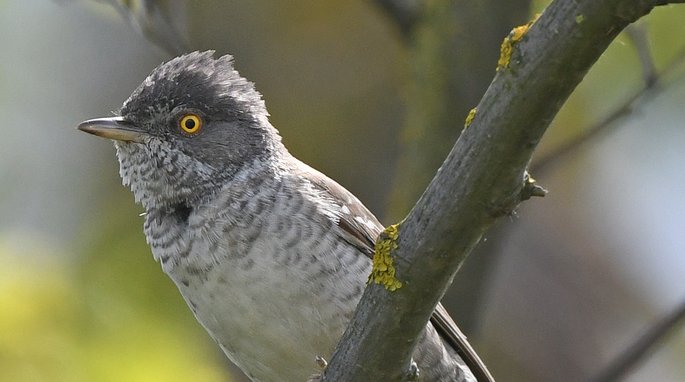
Barred Warbler
Curruca nisoria
Identify the Barred Warbler by sound or photo and log your sightings with Birdpass.


The Barred Warbler is the largest Curruca warbler, a robust, grey-and-white bird of thickets and hedgerows that breeds from central and eastern Europe into western and Central Asia and winters in eastern Africa. Adult males show bold dark barring below and a staring yellow eye; females are paler with finer barring, and juveniles are buffy and faintly barred, recalling a Garden Warbler.
Did you know?
- Its scientific name, nisoria, comes from medieval Latin for the Sparrowhawk, after its barred underparts.
- It is the largest warbler in the genus Curruca.
Voice
About the species
Identification
A large warbler; adults are dark grey above and pale below with dense dark bars, a yellow eye and white tips to the tail feathers. Young birds resemble a Garden Warbler but are larger, with pale bars on the wings and dark barring on the undertail coverts.
Family
Sylviidae
Size
Small (sparrow)
Colours
grey, white, brown, black, yellow
About the habitat
Dense thorny scrub, hedgerows, juniper and woodland edges, especially with blackthorn or hawthorn.
Diet
Mainly insects and other invertebrates such as beetles, caterpillars and spiders; berries and other soft fruit in late summer and autumn.
Behaviour
Usually skulks in dense shrubs but may forage openly in berry-laden bushes; often flicks its long tail. Its song is a chattering warble, harsher than a Garden Warbler's, often delivered in a short song flight, and it gives rattling alarm calls. It nests low in thorny scrub, often near Red-backed Shrikes.
Sources
Photo: Christoph Moning, CC BY 4.0 https://commons.wikimedia.org/wiki/File:Curruca nisoria 378155893 (cropped).jpg
Sound: Jochem Verweij, XC910640, CC BY-SA 4.0 https://xeno-canto.org/910640
Sound: Jochem Verweij, XC903882, CC BY-SA 4.0 https://xeno-canto.org/903882
Text: Wikipedia (English) + FinBIF species descriptions, CC BY-SA 4.0; FinBIF: CC BY 4.0 https://en.wikipedia.org/wiki/Barred_warbler
.jpg)