
 Suomi
 Svenska
 Polski
 Čeština
 Slovenčina
 Norsk
 Dansk
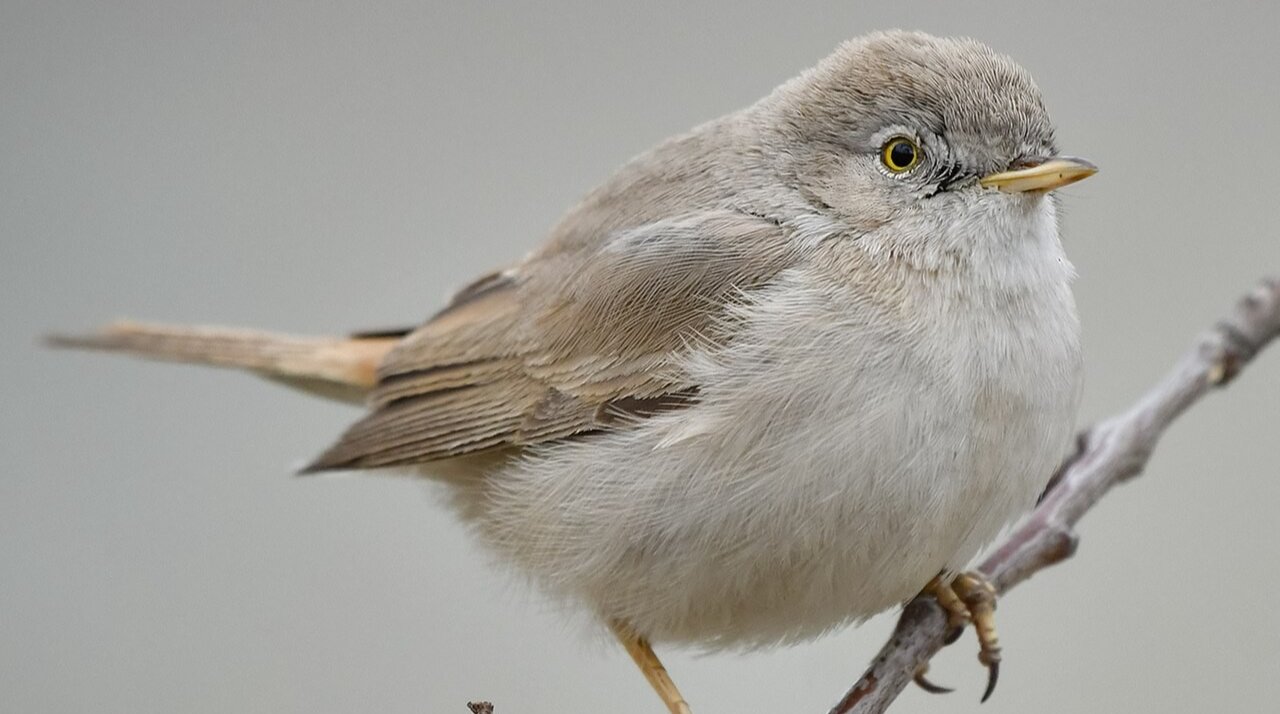
Asian Desert Warbler
Curruca nana
Identify the Asian Desert Warbler by sound or photo and log your sightings with Birdpass.


The Asian Desert Warbler is a tiny, sandy-toned warbler of semi-desert and dry steppe, breeding from the Volga delta across Central Asia to western Mongolia and wintering from Arabia to north-western India. It is pale grey-brown above and whitish below, with a rufous tail, yellowish bill and legs and a pale yellow eye. Once lumped with the African Desert Warbler, it is now treated as a separate species. It is a rare vagrant to Europe, mostly in late autumn.
Did you know?
- Its species name, nana, means “dwarf”.
- Its pale yellow iris gives it a distinctive staring look.
About the species
Identification
A small warbler, brown above and pale below. The upper tail is clearly rusty and the eye yellow; these features separate it from similar warblers. It looks compact and short-winged, with pale legs and a fine bill.
Family
Sylviidae
Size
Tiny (goldcrest)
Colours
grey, brown, white, orange
About the habitat
Arid and semi-arid landscapes with scattered low shrubs such as saxaul and tamarisk; in winter similar open, sparsely vegetated country.
Diet
Mainly small insects and spiders, often picked from the ground; also small berries and seeds, especially outside the breeding season.
Behaviour
Forages close to the ground in sparse shrubs, gleaning and making short dashes, and often flicks and fans its tail; it sometimes follows desert wheatears. Its song is a jingling phrase often delivered in a short display flight. It nests low in a bush, laying 4–6 eggs.
Sources
Photo: Birds of Gilgit-Baltistan from Aliabad, Hunza, Pakistan, CC BY-SA 2.0 https://commons.wikimedia.org/wiki/File:Asian Desert Warbler (Sylvia nana) (53678154976) (cropped).jpg
Text: Wikipedia (English) + FinBIF species descriptions, CC BY-SA 4.0; FinBIF: CC BY 4.0 https://en.wikipedia.org/wiki/Asian_desert_warbler
 (53678154976) (cropped).jpg)