Suomi
 Svenska
 Polski
 Čeština
 Slovenčina
 Norsk
 Dansk
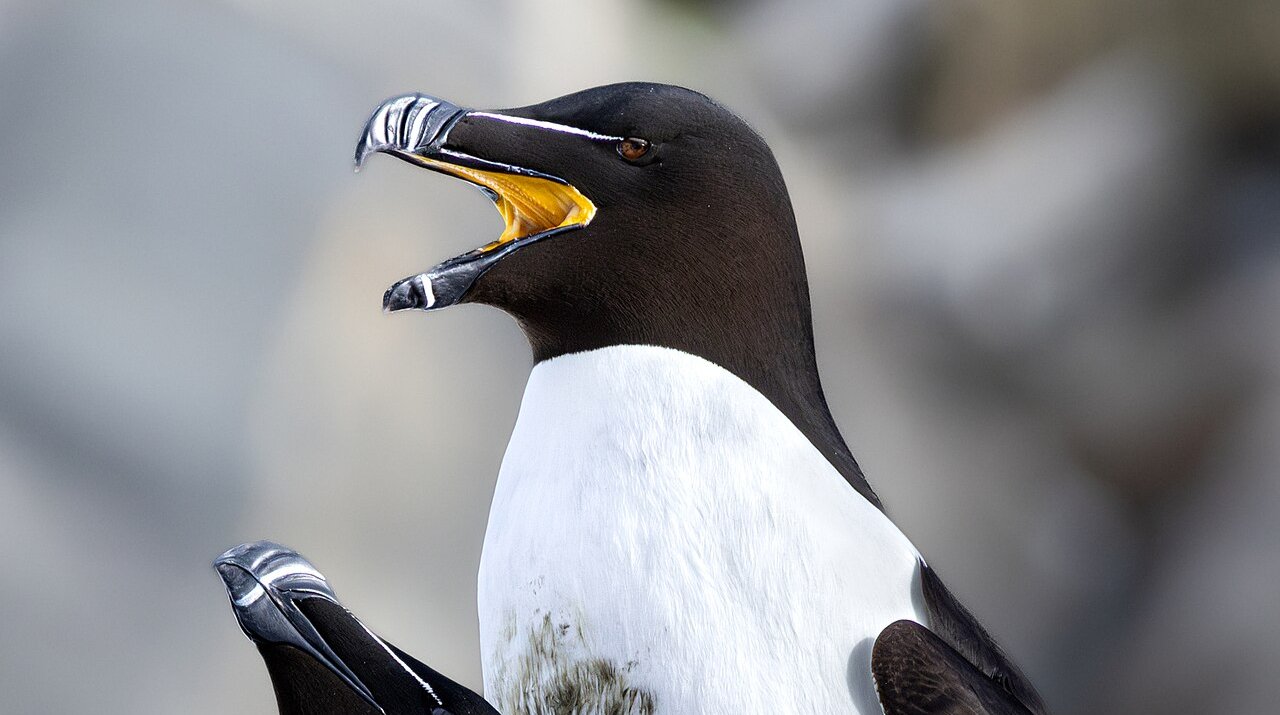
Razorbill
Alca torda
Identify the Razorbill by sound or photo and log your sightings with Birdpass.


The Razorbill is a striking black-and-white auk of the North Atlantic and the only living member of its genus. Closely related to the extinct Great Auk, it spends most of its life at sea and comes ashore only to breed on rocky coasts and islands. Monogamous pairs lay a single egg and share incubation and chick-rearing. Threats include oil spills, bycatch and changes in the quality of its fish prey.
Did you know?
- The Razorbill is the closest living relative of the extinct Great Auk.
- Pairs are monogamous and often stay together for life.
About the species
Identification
White belly and breast, black back and head. The tall, black bill with white lines and the upright stance on land stand out among seabirds; in breeding plumage a thin white line runs from bill to eye. Told from guillemots by the much deeper, blunt-tipped bill and slightly longer, pointed tail.
Family
Alcidae
Size
Large (crow)
Colours
black, white, yellow
About the habitat
Cool coastal and offshore waters of the North Atlantic; breeds on islands, rocky shores, sea cliffs and boulder skerries, and disperses offshore outside the breeding season.
Diet
Mainly small schooling fish such as sandeels, sprats and herring, also capelin and occasionally small crustaceans, caught in wing-propelled pursuit dives.
Behaviour
A powerful diver that uses rapid wingbeats underwater and often feeds in small parties or mixed auk flocks. Breeds colonially in crevices, on ledges and among boulders; both adults rear the chick, which leaps to the sea at night before it can fly and is then cared for by the male at sea. Sits low on the water and flies low with fast, direct wingbeats.
Sources
Photo: (c) Diego González Dopico, some rights reserved (CC BY), CC BY 4.0 https://commons.wikimedia.org/wiki/File:Razorbill, Hornøya, Vardø, Norway 528771693.jpg
Text: Wikipedia (English) + FinBIF species descriptions, CC BY-SA 4.0; FinBIF: CC BY 4.0 https://en.wikipedia.org/wiki/Razorbill