Suomi
 Svenska
 Polski
 Čeština
 Slovenčina
 Norsk
 Dansk
Yellowhammer
Emberiza citrinella
Identify the Yellowhammer by sound or photo and log your sightings with Birdpass.


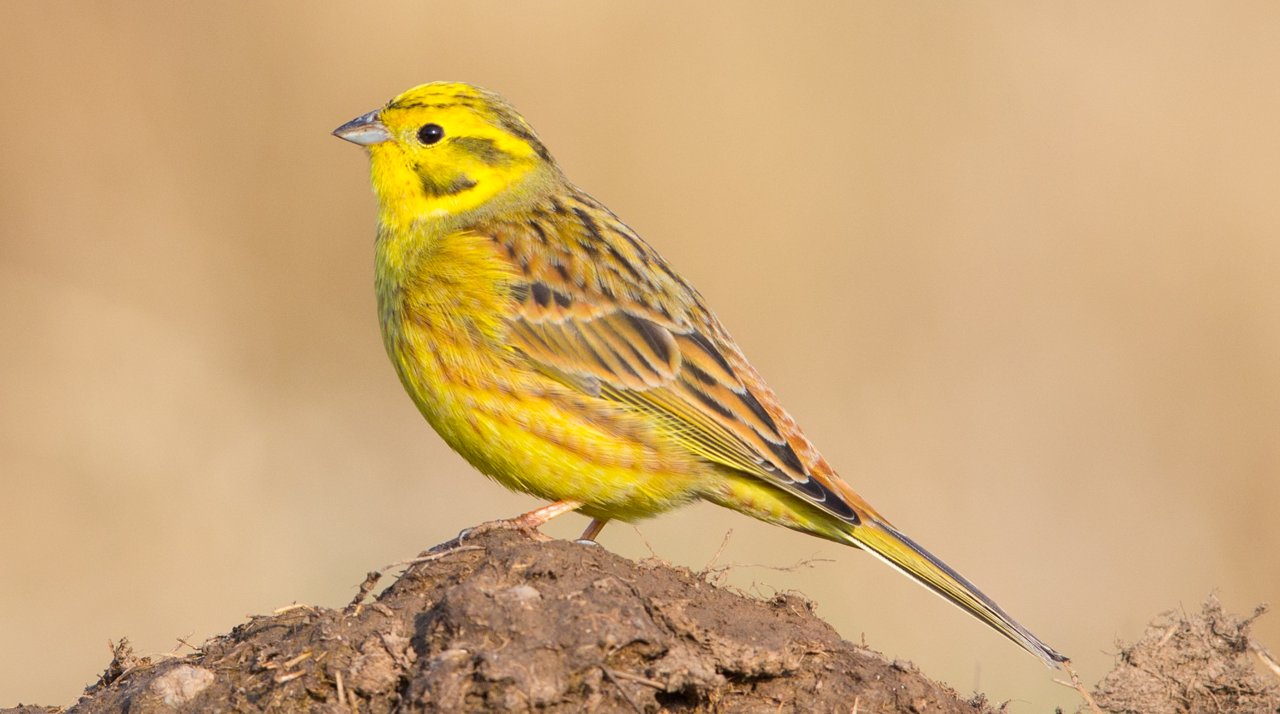
The Yellowhammer is a bright, yellow-headed bunting of open country across much of Eurasia, with introduced populations in New Zealand and Australia. Males are conspicuously yellow with a chestnut rump, while females and juveniles are duller and more streaked. Most birds in western and central Europe are resident, but northern and eastern populations move south for the winter. It has declined in many regions because of changes in agriculture.
Did you know?
- Its ringing song is commonly rendered as “a little bit of bread and no cheese”.
- Its eggs are scribbled with fine dark lines, inspiring old names like “scribble lark” and “writing lark”.
Voice
About the species
Identification
The male has a bright yellow crown and underparts and a brown, dark-streaked back; the rump is rufous and the dark tail shows white outer feathers. The bill is a stout seed-eater's bill. The female is browner and plainer with more streaked underparts; young birds resemble the female. The yellow head, rufous rump and white tail edges separate it from other buntings.
Family
Emberizidae
Size
Small (sparrow)
Colours
yellow, brown, orange
About the habitat
Open countryside with hedges, scattered bushes and trees – farmland, field margins, roadsides, clearings and young forest edges.
Diet
Mainly seeds and grain taken on the ground; in spring and summer also insects and other invertebrates, and chicks are fed largely on soft-bodied insects.
Behaviour
Feeds on the ground or flies low between hedges and field edges, showing white outer tail feathers. Males sing from prominent perches; they learn their songs, so regional dialects arise. The female hides a cup nest on or near the ground, and both parents feed the chicks, often raising several broods. Outside the breeding season it forms flocks, often around farms and stubble fields.
Sources
Photo: UNKNOWN - verify before publishing
Sound: Benoît Van Hecke, XC531170, CC BY-SA 4.0 https://xeno-canto.org/531170
Sound: Jochem verweij, XC902153, CC BY-SA 4.0 https://xeno-canto.org/902153
Sound: Sonothèque ADVL, XC707693, CC0 1.0 https://xeno-canto.org/707693
Text: Wikipedia (English) + FinBIF species descriptions, CC BY-SA 4.0; FinBIF: CC BY 4.0 https://en.wikipedia.org/wiki/Yellowhammer