
 Suomi
 Svenska
 Polski
 Čeština
 Slovenčina
 Norsk
 Dansk
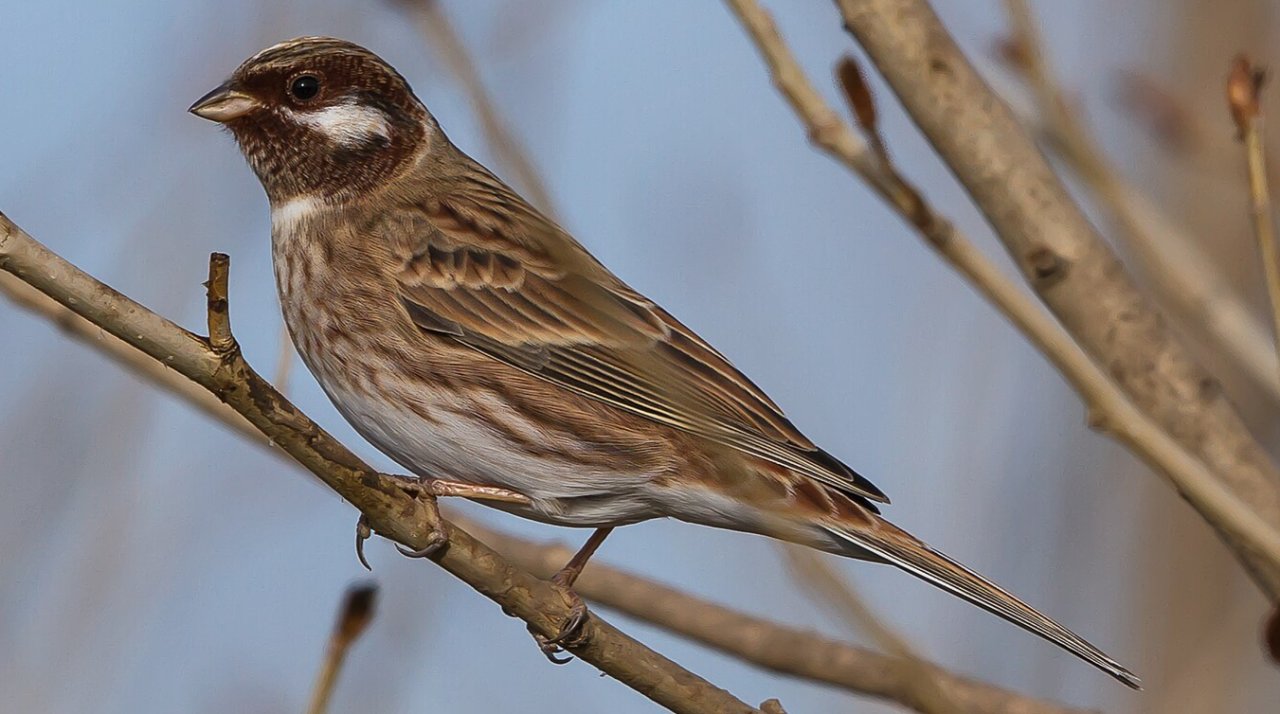
Pine Bunting
Emberiza leucocephalos
Identify the Pine Bunting by sound or photo and log your sightings with Birdpass.


The Pine Bunting is a robust bunting of Siberia and temperate Asia east of the Urals, the white counterpart of the Yellowhammer. Males show a white crown and cheeks with chestnut on the forehead and throat, while females are duller and heavily streaked. It winters in Central Asia, northern India and southern China, and a few birds reach Europe each year. Where its range meets the Yellowhammer's in western Siberia, the two hybridise.
Did you know?
- In non-breeding plumage it looks much like a Yellowhammer, with white replacing the yellow.
- It hybridises with the Yellowhammer where their ranges meet in western Siberia.
About the species
Identification
Yellowhammer-like. The breeding male has a chestnut head and throat, a white crown stripe bordered with black and a clear white cheek patch; the back is brown with black streaks, the rump rufous and the underparts white with sparse dark streaks; the bill is stout and grey. Females and young are streaked all over and lack yellow tones, which helps separate them from female Yellowhammer, although field identification is often difficult.
Family
Emberizidae
Size
Small (sparrow)
Colours
brown, white, orange, grey
About the habitat
Open, sparse forest – especially pine woods – forest edges and open country with scattered trees and scrub, including farmland.
Diet
Mainly seeds; nestlings are fed insects and other small invertebrates.
Behaviour
A migratory bunting that forages on the ground at woodland edges and in semi-open country. It nests on the ground and lays 4–6 eggs marked with the fine, hair-like lines typical of buntings. Its song and calls are very like the Yellowhammer's.
Sources
Photo: Jargal Lamjav from Ulaanbaatar, Mongolia, CC BY 2.0 https://commons.wikimedia.org/wiki/File:Pine Bunting (Emberiza leucocephalos) - Цагааншанаат хөмрөг (15617685422).jpg
Text: Wikipedia (English) + GBIF regional observations + Wikipedia (Finnish), CC BY-SA 4.0; GBIF occurrence data; Wikipedia: CC BY-SA 4.0 https://en.wikipedia.org/wiki/Pine_bunting
 - Цагааншанаат хөмрөг (15617685422).jpg)