Suomi
 Svenska
 Polski
 Čeština
 Slovenčina
 Norsk
 Dansk
Stilt Sandpiper
Calidris himantopus
Identify the Stilt Sandpiper by sound or photo and log your sightings with Birdpass.


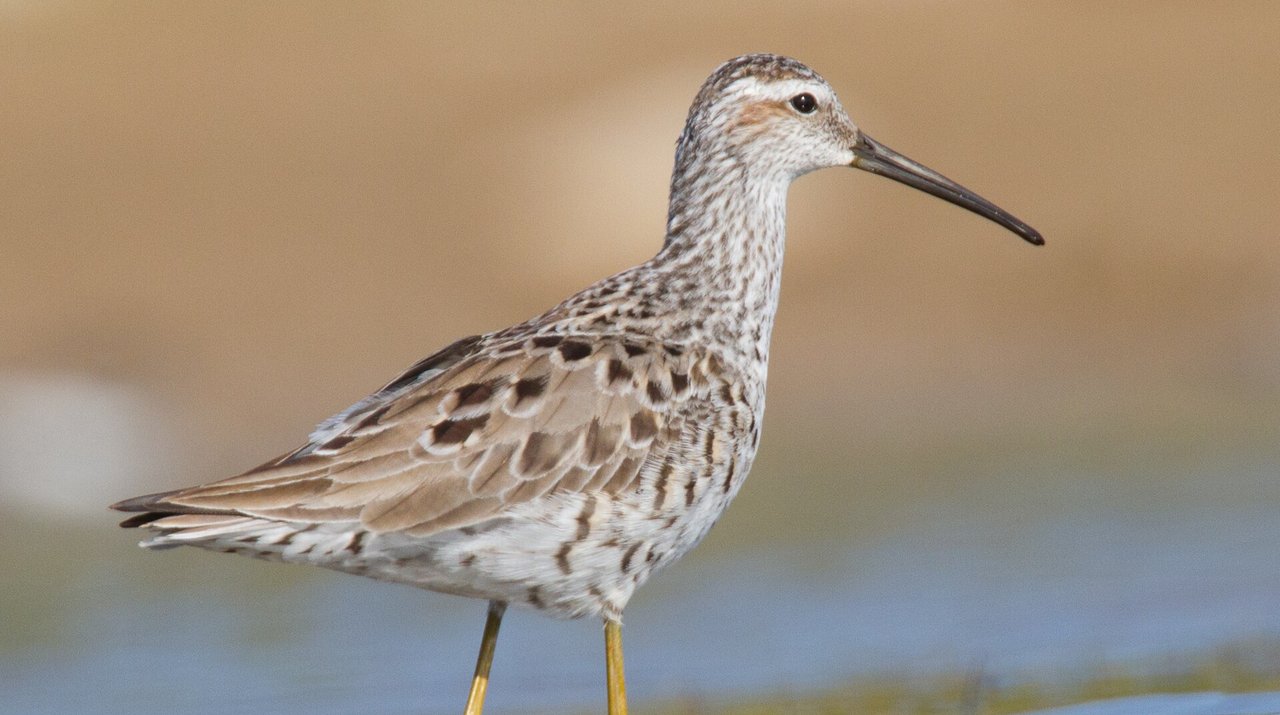
The Stilt Sandpiper is a slender sandpiper named for its long, stilt-like greenish-yellow legs; it has a long neck and a slightly drooping bill. It breeds on the tundra of northern Alaska and Canada and winters mainly in central South America, pausing at muddy freshwater pools on the way. Breeding adults are boldly barred below with rufous on the head, while non-breeding birds are plain grey with a white eyebrow. It is a very rare vagrant to Europe.
Did you know?
- Genetic studies moved it from its own genus, Micropalama, into Calidris, where its closest relative is the Curlew Sandpiper.
- In flight it shows a white rump but no obvious wing bar.
About the species
Identification
A sandpiper of 18–23 cm with a slim build, long neck, slightly curved bill, pale overall tone and long yellow-green legs. Told from Curlew Sandpiper by its clearly longer, paler legs; in flight it shows a white rump but no clear wing bar. The sexes are alike.
Family
Scolopacidae
Size
Medium (thrush)
Colours
grey, white, brown
About the habitat
Breeds on open Arctic tundra; on migration and in winter muddy margins of freshwater pools, marshes and flooded fields rather than open coasts.
Diet
Mainly insects and their larvae and other invertebrates such as molluscs, as well as seeds and parts of aquatic plants.
Behaviour
Often feeds in belly-deep water with rapid, sewing-machine-like jabbing, frequently alongside dowitchers. Nests on the ground on the tundra, and males perform display flights. Outside the breeding season it gathers in flocks at inland freshwater sites.
Sources
Photo: Dan Pancamo, CC BY-SA 2.0 https://commons.wikimedia.org/wiki/File:Stilt Sandpiper by Dan Pancamo.jpg
Text: Wikipedia (English), CC BY-SA 4.0 https://en.wikipedia.org/wiki/Stilt_sandpiper