Suomi
 Svenska
 Polski
 Čeština
 Slovenčina
 Norsk
 Dansk
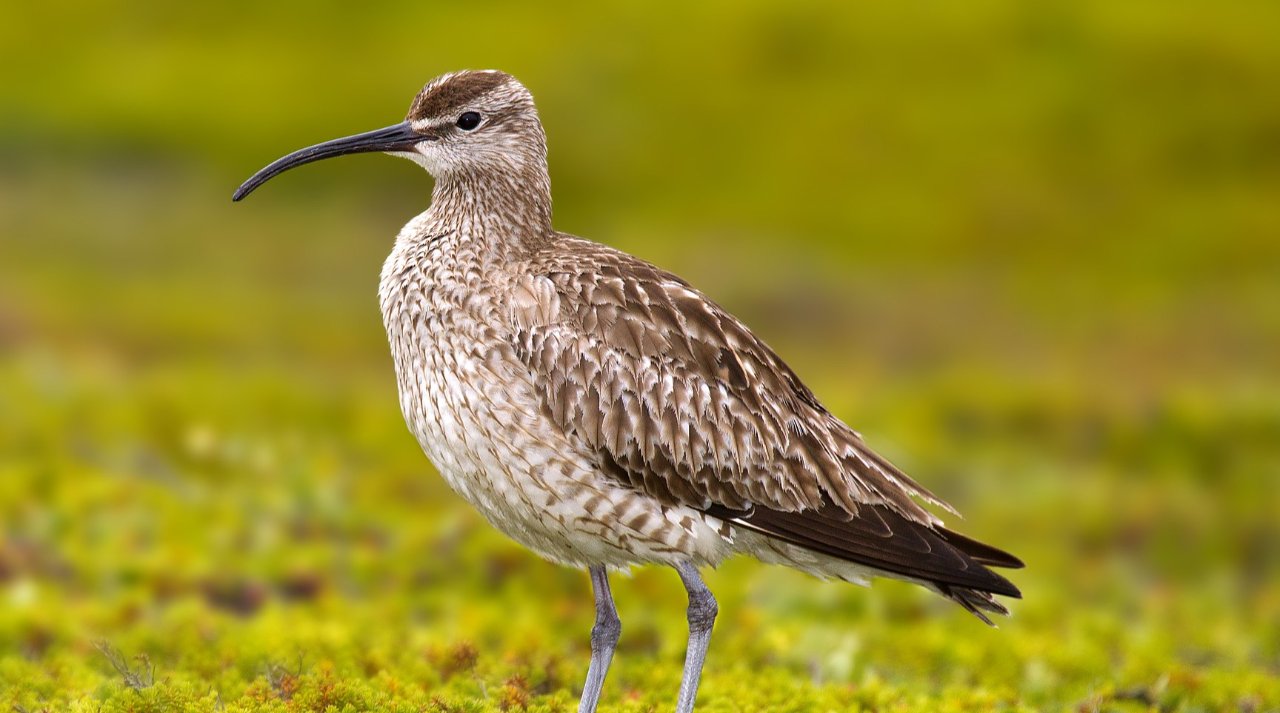
Whimbrel
Numenius phaeopus
Identify the Whimbrel by sound or photo and log your sightings with Birdpass.


The Whimbrel is a medium-sized curlew of the subarctic Palearctic with a boldly striped crown and a downcurved bill. It breeds on tundra, bogs and moorland from Iceland across northern Eurasia and winters on coasts in Africa, South Asia and Australasia. The very similar Hudsonian Whimbrel of the Americas is now treated as a separate species.
Did you know?
- Its name imitates its rippling call.
- Before migrating it often fuels up on berries.
Voice
About the species
Identification
A curlew smaller than Eurasian Curlew, with clear pale stripes on the head (including a pale supercilium and a pale central crown stripe) and a relatively shorter, downcurved bill. In flight it shows a white wedge up the back. Its call is a rippling, far-carrying whinny of seven notes, distinct from the Curlew's song.
Family
Scolopacidae
Size
Large (crow)
Colours
brown, white, grey, black
About the habitat
Breeds on open subarctic tundra, heaths, bogs and moorland; outside the breeding season shores, tidal flats, sandy beaches, estuaries and salt marshes.
Diet
Mainly small invertebrates – crabs, marine worms and molluscs – probed or picked from mud and sand; also insects, and in the north berries such as crowberry and bilberry, especially before migration.
Behaviour
A long-distance migrant, some making non-stop flights over the ocean. It forages by steady walking and probing and is often seen singly or in loose flocks on coasts outside the breeding season. It nests in a simple ground scrape and performs distraction displays to lure predators from its chicks. Its rippling whistle can build into a trilling song.
Sources
Photo: Andreas Trepte, CC BY-SA 2.5 https://commons.wikimedia.org/wiki/File:Whimbrel Numenius phaeopus.jpg
Sound: Sonothèque ADVL, XC931810, CC0 1.0 https://xeno-canto.org/931810
Text: Wikipedia (English) + FinBIF species descriptions, CC BY-SA 4.0; FinBIF: CC BY 4.0 https://en.wikipedia.org/wiki/Eurasian_whimbrel