Suomi
 Svenska
 Polski
 Čeština
 Slovenčina
 Norsk
 Dansk
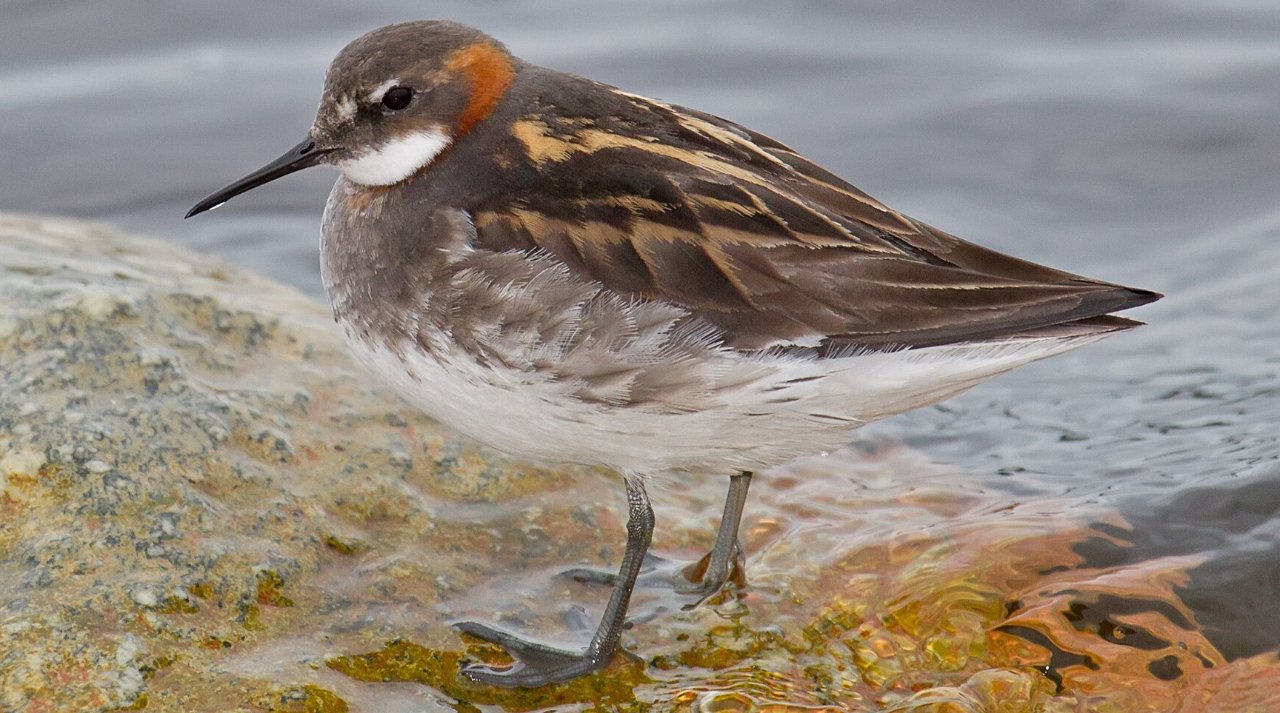
Red-necked Phalarope
Phalaropus lobatus
Identify the Red-necked Phalarope by sound or photo and log your sightings with Birdpass.


The Red-necked Phalarope is a tiny Arctic-breeding wader that spends most of the year far out at sea – an unusual lifestyle for a wader. Females are brighter and slightly larger and compete for mates, while males incubate the eggs and raise the chicks. Famous for spinning on the water to feed, it makes long ocean migrations to winter in tropical seas.
Did you know?
- A tagged bird from the North Atlantic made a 25,000 km round trip to winter in the tropical Pacific.
- Its spinning creates a tiny whirlpool that lifts prey to the surface.
Voice
About the species
Identification
A small wader; in breeding plumage it has a rufous neck, dark grey head and white throat, a mottled back with buff stripes and a very thin, needle-like bill. The female is larger and more colourful than the male. In winter it is grey above and white below with a dark eye patch. Its unusual feeding style – swimming and spinning in small circles while picking prey from the surface – also identifies it. Told from Red Phalarope by its much thinner bill.
Family
Scolopacidae
Size
Small (sparrow)
Colours
grey, white, orange, brown
About the habitat
Breeds on shallow freshwater wetlands in the Arctic and subarctic – tundra pools, bogs and marshy lake edges; on migration coastal lagoons and lakes, and in winter the open ocean over upwellings.
Diet
Small aquatic invertebrates – insects and their larvae, zooplankton and tiny crustaceans – picked from the water surface or from the whirlpool it creates; at sea it feeds where currents and upwellings concentrate plankton.
Behaviour
A buoyant swimmer that spins in tight circles while picking prey from the surface. Sex roles are reversed: females court and defend mates, and males incubate the eggs in a simple, grass-lined scrape and tend the precocial chicks. Outside the breeding season it is highly pelagic and, because it seldom meets people, remarkably tame.
Sources
Photo: Andreas Trepte, CC BY-SA 2.5 https://commons.wikimedia.org/wiki/File:Red-necked Phalarope.jpg
Sound: Teet Sirotkin, XC1157235, CC BY-SA 4.0 https://xeno-canto.org/1157235
Text: Wikipedia (English) + FinBIF species descriptions, CC BY-SA 4.0; FinBIF: CC BY 4.0 https://en.wikipedia.org/wiki/Red-necked_phalarope