Suomi
 Svenska
 Polski
 Čeština
 Slovenčina
 Norsk
 Dansk
Steller's Eider
Polysticta stelleri
Identify the Steller's Eider by sound or photo and log your sightings with Birdpass.


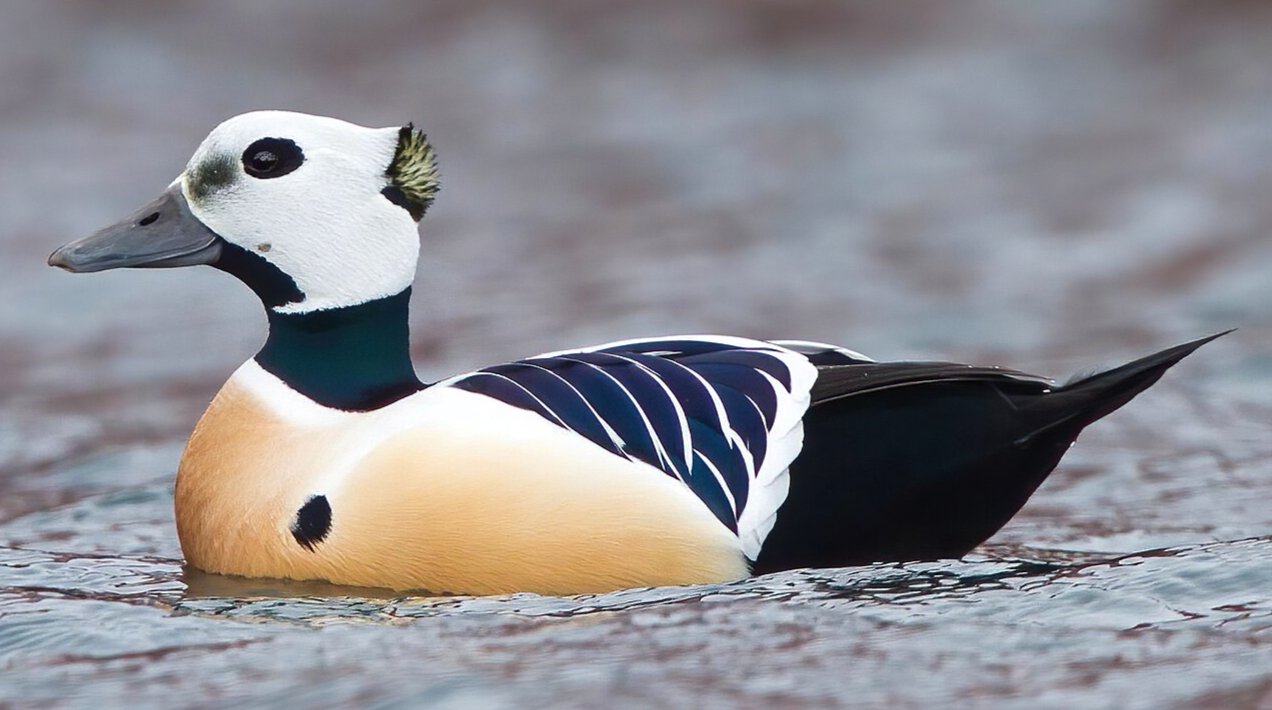
Steller's Eider is the smallest and fastest-flying eider, a compact Arctic sea duck and the only member of its genus. It breeds on coastal tundra in northern Siberia and Alaska and winters in sheltered seas, mostly in the Bering Sea, with smaller numbers in northern Europe. Breeding males have a white head with a black eye patch and greenish nape, a buff breast and black back. It has declined and is listed as Vulnerable.
Did you know?
- It is the smallest and fastest-flying of all eiders.
- It is named after the naturalist Georg Wilhelm Steller.
About the species
Identification
The male has sharply defined colour areas: a white head with a greenish nape tuft and a black eye patch, an ochre breast and belly, white shoulders, and a black throat, collar, tail and wing edges; a single black spot shows on the side of the breast. The female is dark brown and mottled, more dabbling-duck-like in shape than a female Common Eider, with a white-bordered purple speculum. It is clearly smaller than other eiders, with a short bill and steep forehead.
Family
Anatidae
Size
Large (crow)
Colours
white, black, orange, blue, green
About the habitat
Breeds on coastal marshy tundra near ponds; winters in shallow, sheltered coastal waters – bays, lagoons and fjords – and moults in shallow lagoons.
Diet
Mainly small marine invertebrates taken by dabbling, up-ending and shallow dives near shore – crustaceans, molluscs, mussels, worms and echinoderms; on the tundra aquatic insects and some plant material.
Behaviour
Strongly migratory and gregarious, it forms tight flocks near coasts that dive and surface in unison. Males display in groups with synchronised head movements; pairs form in late winter. The female nests on a raised, mossy hummock and incubates alone, and broods sometimes merge. In flight its wings make a whistling sound.
Sources
Photo: Ron Knight from Seaford, East Sussex, United Kingdom, CC BY 2.0 https://commons.wikimedia.org/wiki/File:Polysticta stelleri.jpg
Text: Wikipedia (English) + GBIF regional observations + Wikipedia (Danish) + FinBIF species descriptions, CC BY-SA 4.0; GBIF occurrence data; Wikipedia: CC BY-SA 4.0; FinBIF: CC BY 4.0 https://en.wikipedia.org/wiki/Steller%27s_eider