Suomi
 Svenska
 Polski
 Čeština
 Slovenčina
 Norsk
 Dansk
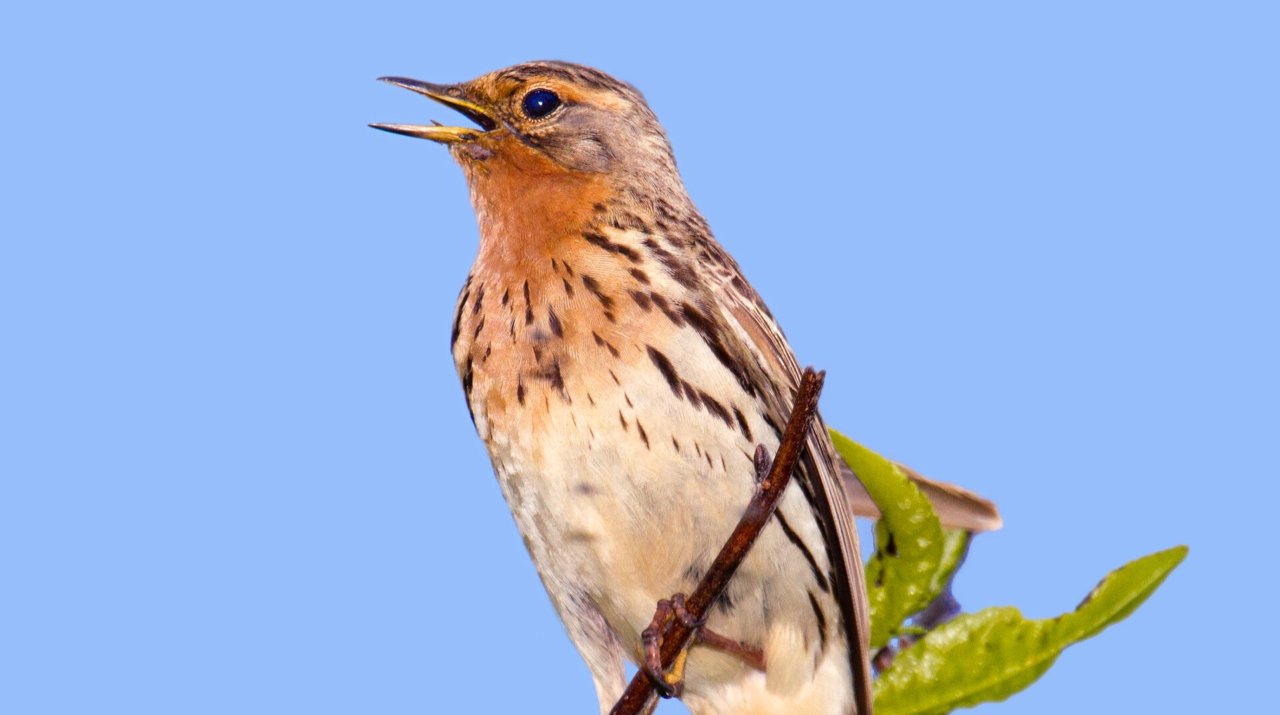
Red-throated Pipit
Anthus cervinus
Identify the Red-throated Pipit by sound or photo and log your sightings with Birdpass.


The Red-throated Pipit is a small pipit of the far north, breeding on Arctic and sub-Arctic wetlands across Europe and Asia and in western Alaska. Breeding adults have a brick-red face and throat; at other times it is a heavily streaked, rather cryptic bird. A long-distance migrant, it winters mainly in Africa and South-East Asia. Its large global population is assessed as Least Concern.
Did you know?
- It often lines its ground nest with reindeer hair.
- Its scientific name means “stag-coloured”, referring to the reddish tones of its breeding plumage.
Voice
About the species
Identification
In summer plumage the rusty-red throat (and on males also the face) separates it from Meadow Pipit; the back has bold black spots. In autumn it is best told from Meadow Pipit by the heavy black streaking on the back, pale stripes on the mantle and the stronger face pattern; the bill is thin and the legs pinkish.
Family
Motacillidae
Size
Small (sparrow)
Colours
brown, red, white, black
About the habitat
Breeds on wet tundra, sedge bogs, willow scrub and marshy meadows. On migration and in winter it uses open grassy fields, coastal meadows, marsh edges and stubble.
Diet
Mainly small invertebrates such as flies, beetles, caterpillars and spiders; also seeds, especially in autumn and winter.
Behaviour
Forages on the ground, walking rather than hopping, picking prey from short vegetation and damp ground. Flies strongly and gives a thin, drawn-out “psiih” call. Nests on the ground beside tussocks; the female incubates 4–6 eggs for nearly two weeks, and the young fledge at about 12 days. Males display with fluttering song flights over the tundra.
Sources
Photo: Andreas Trepte, CC BY-SA 2.5 https://commons.wikimedia.org/wiki/File:Red-throated Pipit.jpg
Sound: Sonothèque ADVL, XC1048900, CC0 1.0 https://xeno-canto.org/1048900
Text: Wikipedia (English) + FinBIF species descriptions, CC BY-SA 4.0; FinBIF: CC BY 4.0 https://en.wikipedia.org/wiki/Red-throated_pipit