
 Suomi
 Svenska
 Polski
 Čeština
 Slovenčina
 Norsk
 Dansk
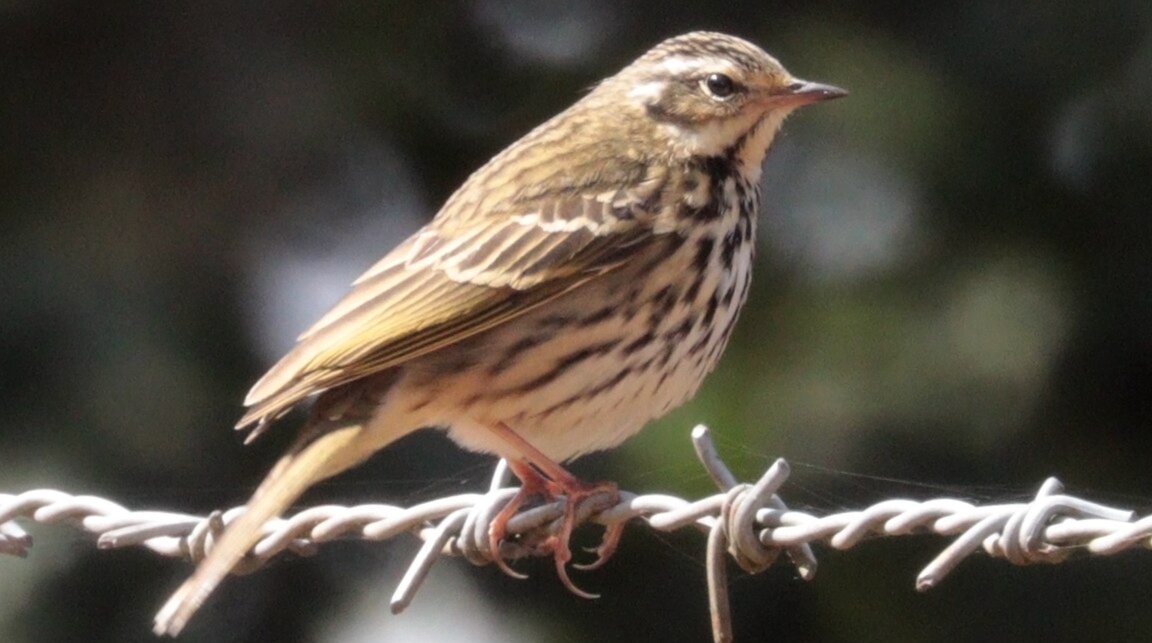
Olive-backed Pipit
Anthus hodgsoni
Identify the Olive-backed Pipit by sound or photo and log your sightings with Birdpass.


The Olive-backed Pipit is a small pipit that breeds in the taiga from north-eastern European Russia across Siberia to Japan and in the Himalayas, and winters in southern Asia. It closely resembles the Tree Pipit in looks and voice, but shows a more olive, less streaked back and a crisper face pattern. It is a rare vagrant to western and northern Europe, mostly in autumn.
Did you know?
- Its song is lark-like and often delivered in flight.
- The species name hodgsoni honours the English naturalist Brian Houghton Hodgson.
Voice
About the species
Identification
A pipit of 14–15.5 cm, very like a Tree Pipit in shape and voice. It is more olive above with faint streaking, and has a bold face pattern: a long pale supercilium, buff in front of the eye and white behind it, a dark border above it and a pale spot with a dark spot on the rear cheek. Like Tree Pipit, it has a short, curved hind claw.
Family
Motacillidae
Size
Small (sparrow)
Colours
brown, white, black, green
About the habitat
Open, lightly wooded taiga, especially coniferous forest, but also birch, alder and larch stands; on migration forest edges and clearings, and in winter evergreen woodland.
Diet
In summer mostly insects and other small invertebrates; in winter also grass and weed seeds. It forages mainly on the ground.
Behaviour
Walks and pauses on the forest floor as it feeds, flies up into trees when disturbed and often pumps its tail. The flight is undulating, and the call a thin “tseep”. It sings a brisk, lark-like song, often in song flight. Nests on the ground concealed by vegetation.
Sources
Photo: Charles J. Sharp, CC BY-SA 4.0 https://commons.wikimedia.org/wiki/File:Olive-backed pipit (Anthus hodgsoni hodgsoni) Phulchowki.jpg
Sound: Teet Sirotkin, XC1178530, CC BY-SA 4.0 https://xeno-canto.org/1178530
Text: Wikipedia (English) + FinBIF species descriptions + Wikipedia (Finnish), CC BY-SA 4.0; FinBIF: CC BY 4.0; Wikipedia: CC BY-SA 4.0 https://en.wikipedia.org/wiki/Olive-backed_pipit
 Phulchowki.jpg)