
 Suomi
 Svenska
 Polski
 Čeština
 Slovenčina
 Norsk
 Dansk
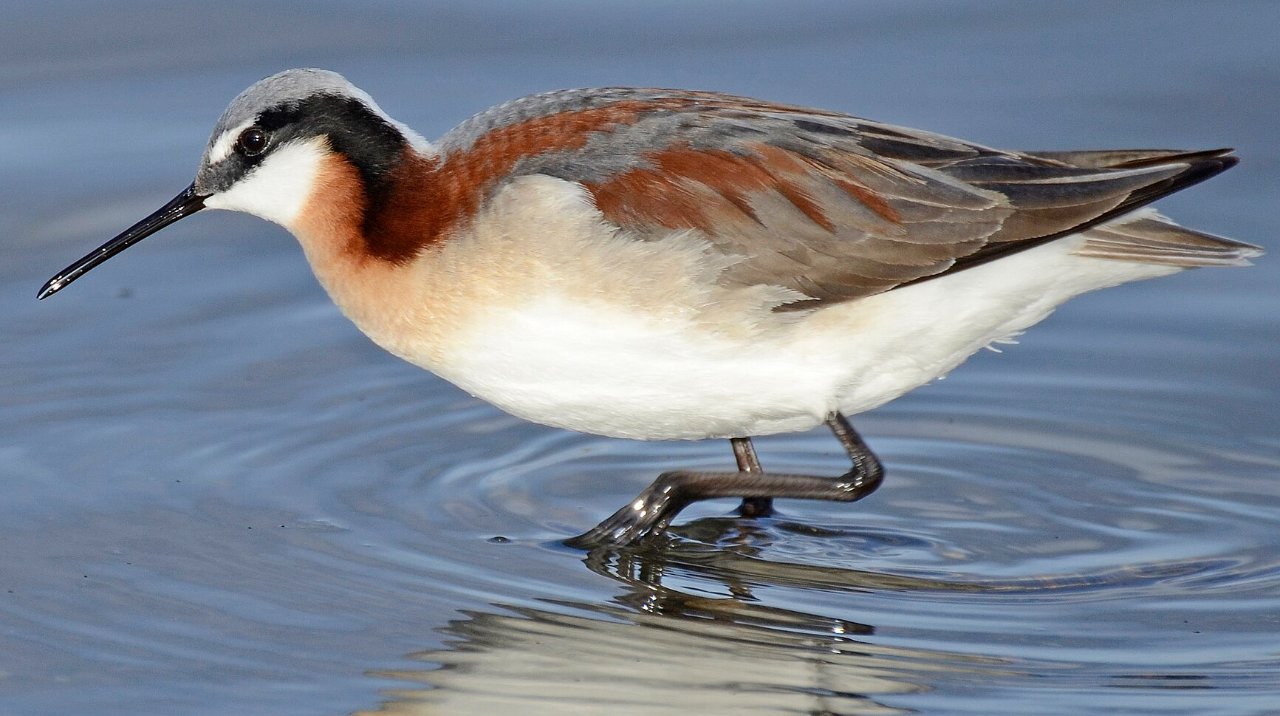
Wilson's Phalarope
Phalaropus tricolor
Identify the Wilson's Phalarope by sound or photo and log your sightings with Birdpass.


Wilson's Phalarope is the largest phalarope, a slim wader with lobed toes and a fine, needle-like black bill. It breeds on prairie wetlands of western Canada and the western United States and winters on salt lakes in the Andes of South America. Unusually tame, it has reversed sex roles, with larger, brighter females courting the males. It is a rare vagrant to Europe.
Did you know?
- Females leave on migration soon after laying, leaving males to incubate.
- It feeds walking on mud more than other phalaropes.
About the species
Identification
The largest phalarope (about 23 cm), clearly larger and longer-billed than Red-necked Phalarope. In summer the sexes differ: the female is larger and more striking, with a black stripe through the eye and down the neck and a chestnut wash; winter plumage is plain grey above and white below, without a dark eye patch. In flight it shows a white rump and no wing bar. It also feeds by spinning in small circles.
Family
Scolopacidae
Size
Medium (thrush)
Colours
grey, white, orange, black
About the habitat
Breeds on shallow prairie marshes and lakes; on migration and in winter saline lakes, including high Andean salt lakes.
Diet
Mainly small aquatic insects and crustaceans, such as brine shrimps, picked from the surface or from the whirlpools it creates while spinning in shallow, salty water.
Behaviour
Highly migratory, gathering in huge numbers on salt lakes on passage. It often spins in circles to concentrate prey but also feeds walking on mud. Females court and defend mates and leave soon after laying; males incubate the eggs in a ground nest near water, and the young feed themselves.
Sources
Photo: VJAnderson, CC BY-SA 4.0 https://commons.wikimedia.org/wiki/File:Wilson's Phalarope, Oregon 03 (cropped).jpg
Text: Wikipedia (English), CC BY-SA 4.0 https://en.wikipedia.org/wiki/Wilson%27s_phalarope
.jpg)