
 Suomi
 Svenska
 Polski
 Čeština
 Slovenčina
 Norsk
 Dansk
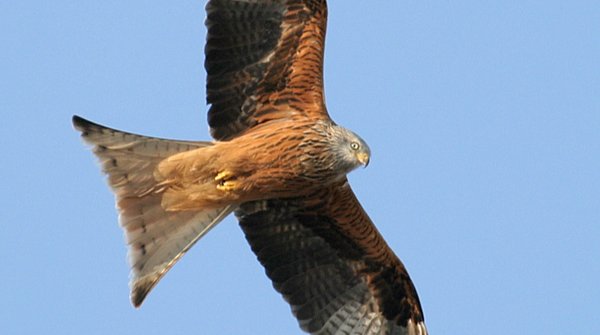
Red Kite
Milvus milvus
Identify the Red Kite by sound or photo and log your sightings with Birdpass.


The Red Kite is a graceful, long-winged raptor instantly recognised by its rufous body, pale wing panels with black tips and long, deeply forked tail, which it twists like a rudder. It breeds almost only in Europe, and after historic declines, reintroductions and protection have made it a well-known conservation success. Northern birds once mostly migrated south-west, but increasing numbers now stay year-round.
Did you know?
- A rare white leucistic form occurs in about 1% of chicks in some populations.
- Red and Black Kites have been known to pair and raise hybrid young.
Voice
About the species
Identification
A large, long-winged raptor with a long, clearly forked tail. The overall colour is rusty brown, with a pale, streaked head; the wings show pale bases to the primaries and dark tips, and it often flies with wings in a shallow V. It is separated from Black Kite by its much more deeply forked tail and warmer, redder tone; young birds are paler and less deeply forked.
Family
Accipitridae
Size
Large (crow)
Colours
orange, grey, brown, white, black
About the habitat
Open countryside with a mix of farmland, meadows and scattered woods, often in valleys; it nests in tall trees at woodland edges and forages over open ground.
Diet
Mainly carrion and roadkill, small mammals such as voles, earthworms, insects and occasionally small birds or fish; it also scavenges human scraps.
Behaviour
Soars and glides for long periods with wings held in a shallow V, using its forked tail to steer with subtle, acrobatic turns. It often scavenges along roads and fields. Outside the breeding season it gathers at communal roosts. Its call is a thin, piping whistle.
Sources
Photo: Thomas Kraft (ThKraft), CC BY-SA 2.5 https://commons.wikimedia.org/wiki/File:Milvus milvus R(ThKraft).jpg
Sound: Pascal Christe, XC576967, CC BY-SA 4.0 https://xeno-canto.org/576967
Text: Wikipedia (English) + FinBIF species descriptions, CC BY-SA 4.0; FinBIF: CC BY 4.0 https://en.wikipedia.org/wiki/Red_kite
.jpg)