Suomi
 Svenska
 Polski
 Čeština
 Slovenčina
 Norsk
 Dansk
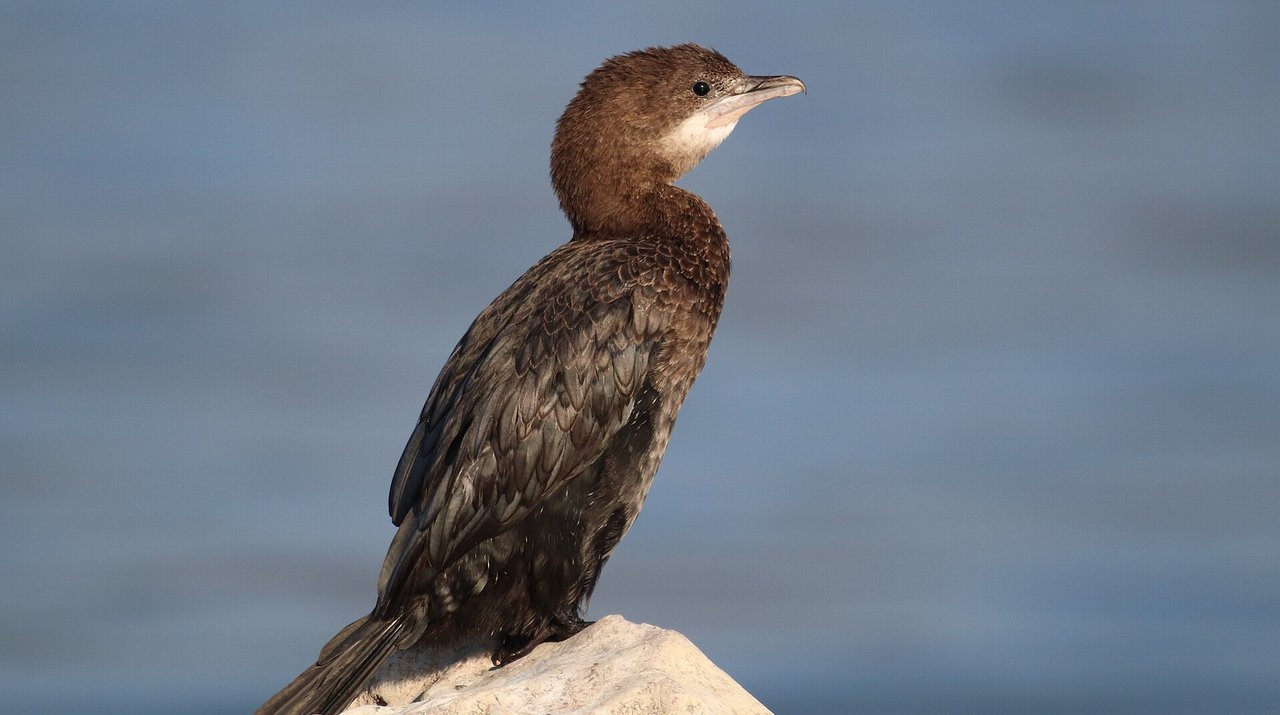
Pygmy Cormorant
Microcarbo pygmaeus
Identify the Pygmy Cormorant by sound or photo and log your sightings with Birdpass.


The Pygmy Cormorant is a small, long-tailed cormorant of lowland wetlands in south-eastern Europe and south-western Asia. It breeds in colonies around reed-fringed lakes, river deltas and flooded forests, and many birds move south in winter to ice-free waters. Unlike larger cormorants, it often perches in waterside trees and bushes between fishing bouts. It is a rare vagrant further north and west.
Did you know?
- It is much smaller than the Great Cormorant, with a noticeably longer tail.
- It often roosts in trees in large communal roosts.
About the species
Identification
A small cormorant (length 45–55 cm, wingspan 80–90 cm) with a long tail, a short, thick bill and a fairly short neck. The overall colour is blackish with a dark green and brown gloss. Breeding adults have white flecks on the head, neck and underparts and a dark brown head; non-breeding adults are browner with a paler throat and breast and no white flecks. Young birds are duller and faintly streaked.
Family
Phalacrocoracidae
Size
Large (crow)
Colours
black, brown
About the habitat
Lowland freshwater wetlands rich in fish and cover – river deltas, reedy lakes, flooded meadows, fishponds and rice fields; in winter also brackish lagoons and estuaries.
Diet
Mainly small fish caught underwater, sometimes by groups hunting together; occasionally other small aquatic animals.
Behaviour
Dives repeatedly, surfacing to swallow prey and often spreading its wings to dry afterwards. It is partially migratory. It nests in colonies, often with herons, building nests of sticks and reeds in willows, bushes or reedbeds; both parents tend the eggs and young.
Sources
Photo: Warrieboy, CC BY-SA 4.0 https://commons.wikimedia.org/wiki/File:Microcarbo pygmaeus - Pygmy cormorant.jpg
Text: Wikipedia (English) + GBIF regional observations + Wikipedia (Finnish), CC BY-SA 4.0; GBIF occurrence data; Wikipedia: CC BY-SA 4.0 https://en.wikipedia.org/wiki/Pygmy_cormorant