
 Suomi
 Svenska
 Polski
 Čeština
 Slovenčina
 Norsk
 Dansk
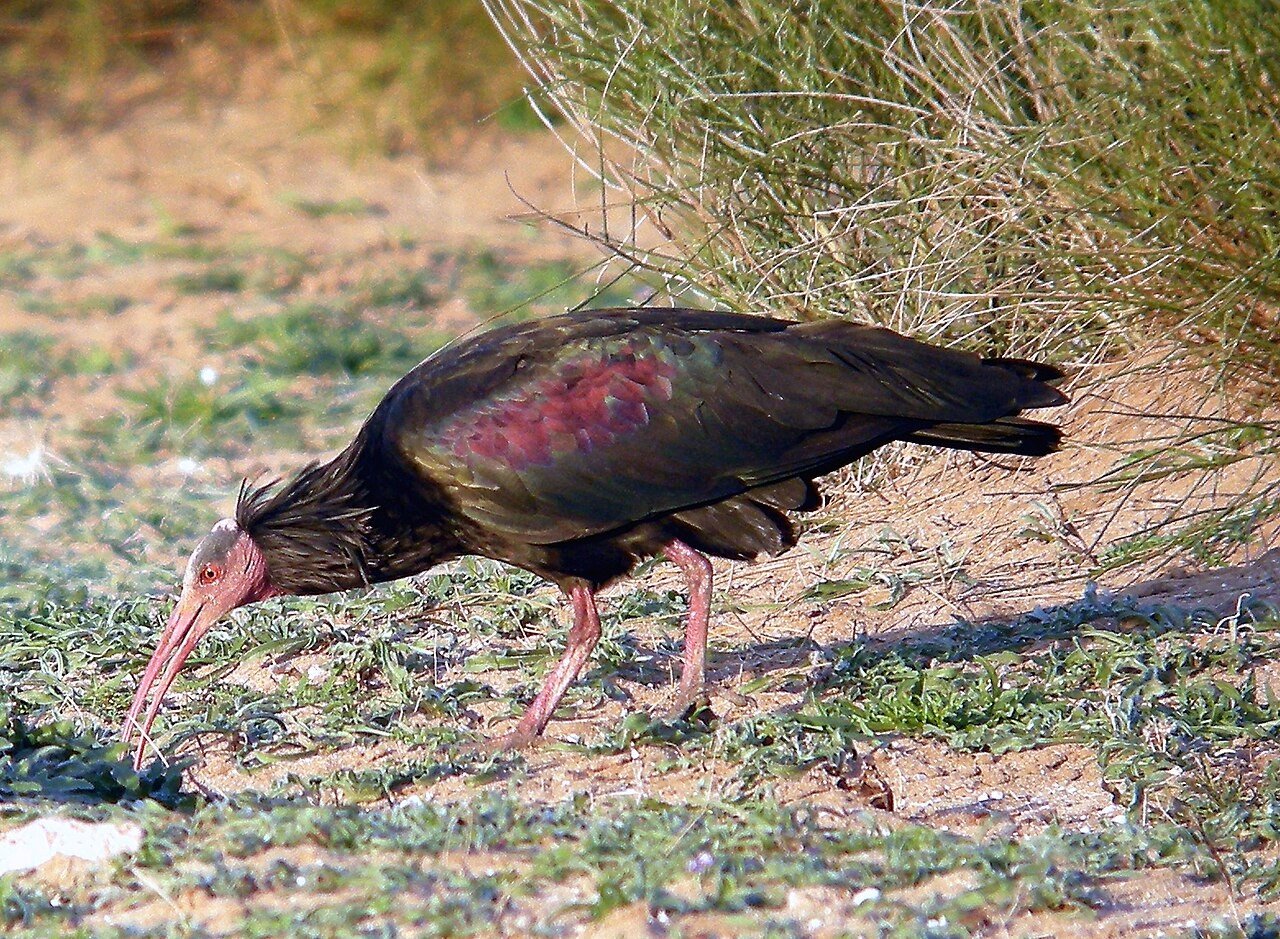
Northern Bald Ibis
Geronticus eremita
Identify the Northern Bald Ibis by sound or photo and log your sightings with Birdpass.


The Northern Bald Ibis is a striking, glossy black ibis with a bare red face and head, a shaggy crest of feathers on the nape and a long, curved red bill. Unlike most ibises it does not wade but forages in dry, open country, and it nests in colonies on cliff ledges. Once widespread across Europe, North Africa and the Middle East, it now survives in the wild mainly in southern Morocco, with reintroduced and semi-wild colonies in parts of Europe and Turkey.
Did you know?
- Its fossil record stretches back at least 1.8 million years.
- Its genus name, Geronticus, means “old man”, a reference to its bald head.
About the species
Identification
A large, all-dark ibis with a metallic green and purple gloss. The head is bare and red with a long, down-curved red bill, and a ruff of long feathers hangs from the nape. Young birds have a feathered, greyish head. In flight it looks dark with broad wings and short legs that barely project beyond the tail.
Family
Threskiornithidae
Size
Very large (swan)
Colours
black, red, green
About the habitat
Open grassland, rocky mountains, semi-desert and farmland, often near running water; breeds on sea or mountain cliffs.
Diet
Lizards, insects and their larvae, scorpions and other small animals picked or probed from the ground.
Behaviour
A colonial breeder that builds stick nests on cliff ledges and usually lays two or three eggs. Northern populations are migratory. It is mostly silent away from colonies, where it gives guttural, hoarse calls and greets its mate with bowing displays.
Sources
Photo: Len Worthington, CC BY-SA 2.0 https://commons.wikimedia.org/wiki/File:Northern Bald Ibis Geronticus eremita (8470600428).jpg
Text: Wikipedia (English), CC BY-SA 4.0 https://en.wikipedia.org/wiki/Northern_bald_ibis
.jpg)