Suomi
 Svenska
 Polski
 Čeština
 Slovenčina
 Norsk
 Dansk
European Shag
Gulosus aristotelis
Identify the European Shag by sound or photo and log your sightings with Birdpass.


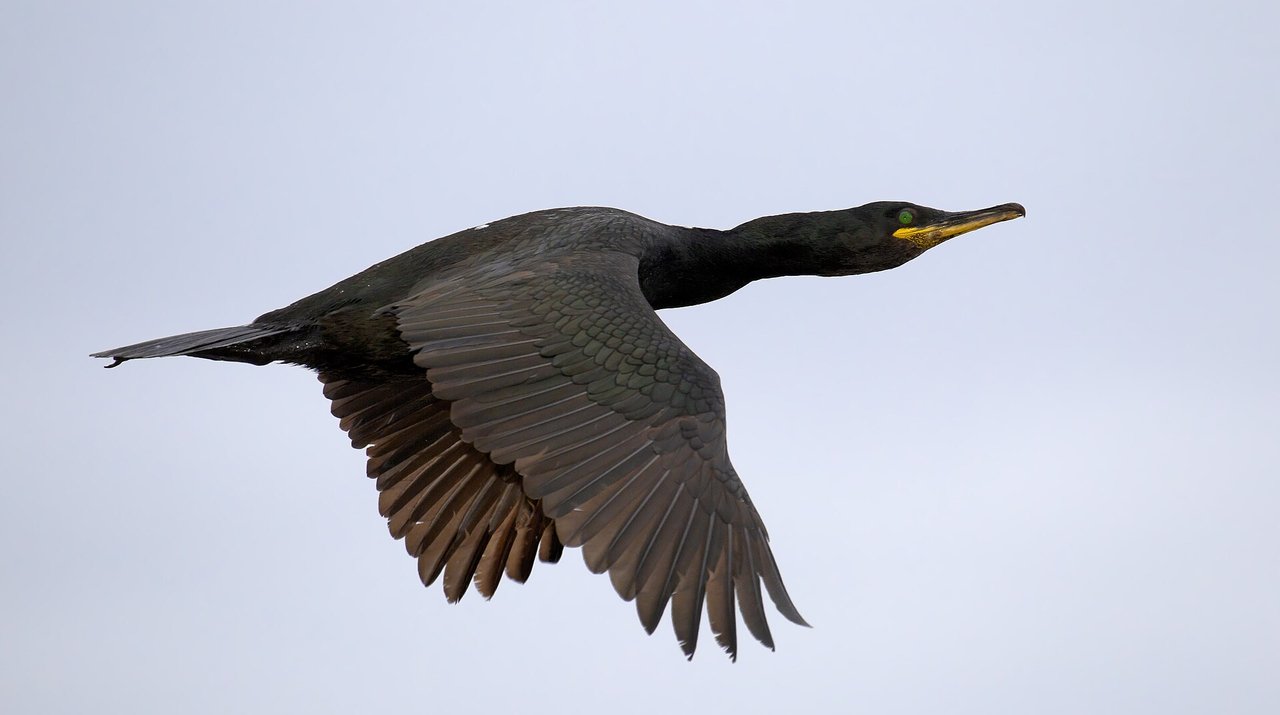
The European Shag is a sleek, black coastal cormorant with a metallic green sheen and a small forward-curling crest in the breeding season. The only member of its genus, it breeds on rocky shores of western and southern Europe, south-western Asia and North Africa and usually stays near those coasts year-round. Smaller and slimmer than the Great Cormorant, it is an agile underwater hunter that often forages near the sea floor.
Did you know?
- It is among the deepest-diving cormorants, recorded at about 61 m.
- Gulosus is Latin for “glutton”, and aristotelis honours Aristotle.
Voice
About the species
Identification
Smaller and slimmer than Great Cormorant, with a thinner bill and steeper forehead; adults are all black, young birds brownish with a pale throat. In breeding plumage the feathers have a greenish gloss and a small forward-curling crest sits on the forehead. The base of the bill shows yellow skin. In flight it has fast, deep wingbeats and usually flies low over the sea.
Family
Phalacrocoracidae
Size
Very large (swan)
Colours
black, green, yellow
About the habitat
Rugged rocky coasts, cliffs and offshore islands along the Atlantic, Mediterranean and Black Sea; rarely seen inland.
Diet
Mainly small fish caught near the seabed, often sand eels, as well as other fish depending on local conditions.
Behaviour
Dives repeatedly with short pauses at the surface, often leaping forward to start a dive, and may travel several kilometres from roosts to feed. It nests in colonies on rocky ledges, crevices and small caves, building untidy piles of seaweed and twigs cemented with droppings; the chicks hatch naked and depend on their parents for warmth.
Sources
Photo: Andreas Trepte, CC BY-SA 2.5 https://commons.wikimedia.org/wiki/File:European Shag.jpg
Sound: Sternanita3, CC BY-SA 4.0 https://commons.wikimedia.org/wiki/File:Cormoran_moñudo.ogg
Text: Wikipedia (English), CC BY-SA 4.0 https://en.wikipedia.org/wiki/European_shag