
 Suomi
 Svenska
 Polski
 Čeština
 Slovenčina
 Norsk
 Dansk
Parrot Crossbill
Loxia pytyopsittacus
Identify the Parrot Crossbill by sound or photo and log your sightings with Birdpass.


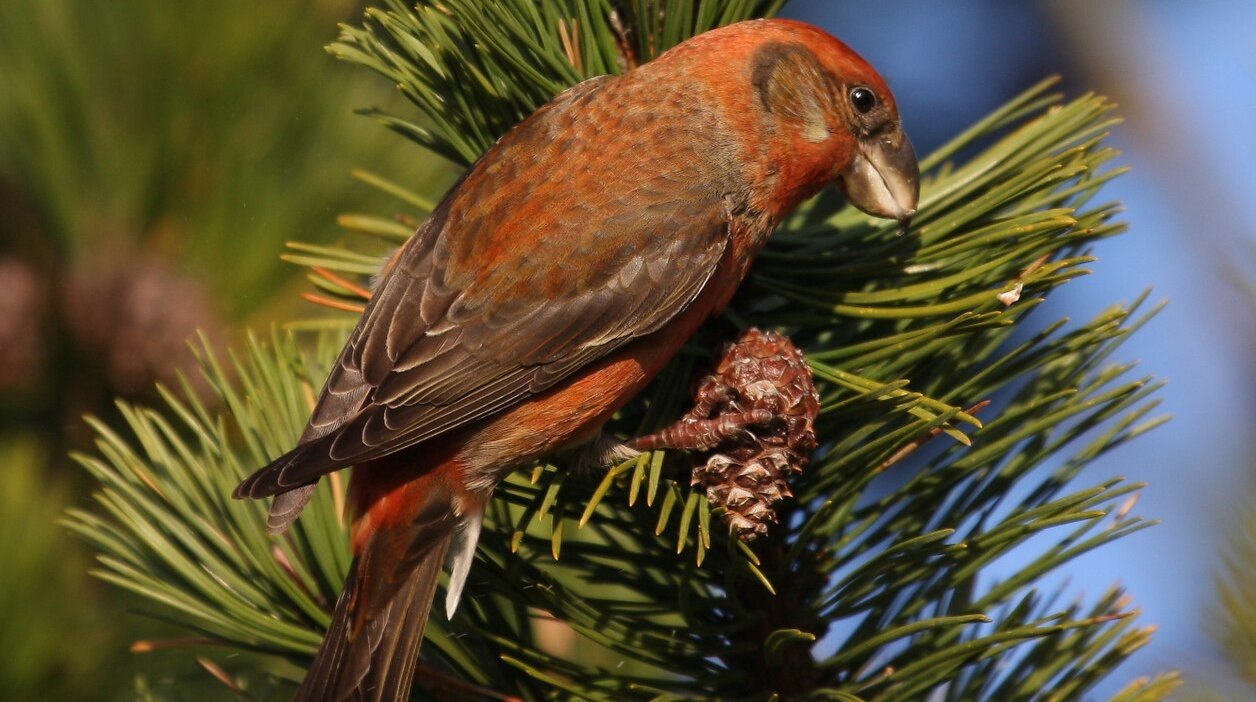
The Parrot Crossbill is a chunky, bull-necked finch of the pine forests of northern Europe and western Russia. It is notoriously hard to separate from the Red Crossbill but has a heavier head and a deeper, more parrot-like bill, and a deeper call. It specialises in extracting seeds from pine cones and is mostly resident, wandering only when cone crops fail.
Did you know?
- Its species name combines Greek words for “pine” and “parrot”.
- Its deeper “choop” call is often the most reliable clue to its identity.
Voice
About the species
Identification
The Parrot Crossbill has the largest bill of the crossbills, clearly deeper and more powerful than the Red Crossbill's, with crossed tips. Males are brick- or orange-red, females grey- or yellow-green; both have dark wings and tail without white wing bars. It is bulkier and more bull-necked than Red Crossbill, and its calls are lower.
Family
Fringillidae
Size
Medium (thrush)
Colours
red, brown, orange, grey
About the habitat
Pine-dominated forest, such as rocky pine ridges and open pine heaths; it generally avoids pure spruce stands.
Diet
Mainly pine seeds, also spruce seeds; some insects in the breeding season, and other seeds and rowan berries in poor cone years.
Behaviour
Often in small flocks or family groups that follow good cone crops, sometimes with other crossbills. Pairs are monogamous and nest high in pines; the male feeds the incubating female, and both parents feed the young a “porridge” of regurgitated seeds. It moves less widely than the Red Crossbill but can irrupt when cones are scarce.
Sources
Photo: Marton Berntsen, CC BY-SA 3.0 https://commons.wikimedia.org/wiki/File:Furukorsnebb..(Loxia pytyopsittacus) (cropped).jpg
Sound: Teet Sirotkin, XC1157227, CC BY-SA 4.0 https://xeno-canto.org/1157227
Text: Wikipedia (English) + FinBIF species descriptions + Wikipedia (Finnish), CC BY-SA 4.0; FinBIF: CC BY 4.0; Wikipedia: CC BY-SA 4.0 https://en.wikipedia.org/wiki/Parrot_crossbill
 (cropped).jpg)