Suomi
 Svenska
 Polski
 Čeština
 Slovenčina
 Norsk
 Dansk
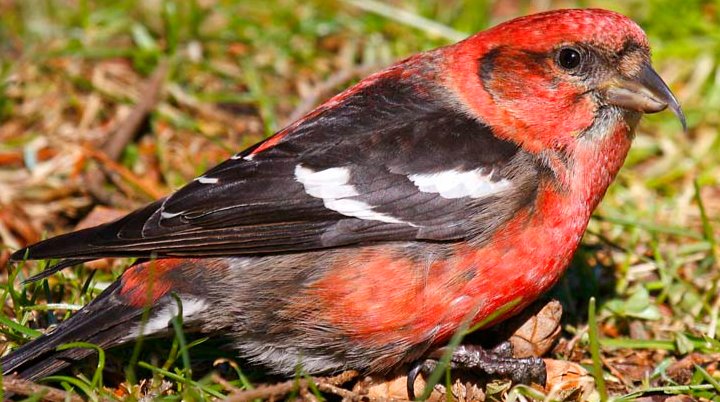
Two-barred Crossbill
Loxia leucoptera
Identify the Two-barred Crossbill by sound or photo and log your sightings with Birdpass.


The Two-barred Crossbill is a nomadic finch of the boreal conifer forests of North America and the Palearctic, easily recognised by its bold white wing bars and crossed bill. It specialises in larch seeds and wanders widely as it tracks shifting cone crops, sometimes irrupting far to the south and west. It may breed whenever food is abundant.
Did you know?
- It prefers larch cones – tamarack in North America and Siberian larch in Eurasia.
- Crossbills can breed even in midwinter if the cone crop is heavy.
Voice
About the species
Identification
A stocky, thick-billed crossbill with dark wings and tail and clear white wing bars, which separate it from other crossbills; the tertials have white tips. The male is pink-red, females and young greenish-yellow. Red Crossbills can show wing bars, but they are much narrower. Calls include a higher, weaker “kheep, kheep” than Red Crossbill's and a toy-trumpet-like note; the song is faster than other crossbills'.
Family
Fringillidae
Size
Small (sparrow)
Colours
red, black, white
About the habitat
Boreal coniferous forest, especially larch and spruce taiga and boggy spruce woods; during irruptions also plantations and parks.
Diet
Mainly seeds of larch, spruce and other conifers; also rowan berries, buds and occasionally insects.
Behaviour
Nomadic and often irruptive, moving widely with cone abundance. It forages acrobatically in the canopy, clambering and hanging while prying open cones, usually in small to large flocks, often mixed with Red Crossbills. It nests in conifers; the female builds the nest and incubates, and both parents feed the young. Breeding is opportunistic and tied to good cone years.
Sources
Photo: John Harrison at https://www.flickr.com/photos/15512543@N04/, CC BY-SA 3.0 https://commons.wikimedia.org/wiki/File:Whitewingedcrossbillmale09.jpg
Sound: Doug Hynes, XC613110, CC BY-SA 4.0 https://xeno-canto.org/613110
Sound: Max Karlsson, XC667826, CC BY-SA 4.0 https://xeno-canto.org/667826
Sound: Max Karlsson, XC978670, CC BY-SA 4.0 https://xeno-canto.org/978670
Text: Wikipedia (English) + GBIF regional observations + Wikipedia (Danish) + FinBIF species descriptions, CC BY-SA 4.0; GBIF occurrence data; Wikipedia: CC BY-SA 4.0; FinBIF: CC BY 4.0 https://en.wikipedia.org/wiki/Two-barred_crossbill