Suomi
 Svenska
 Polski
 Čeština
 Slovenčina
 Norsk
 Dansk
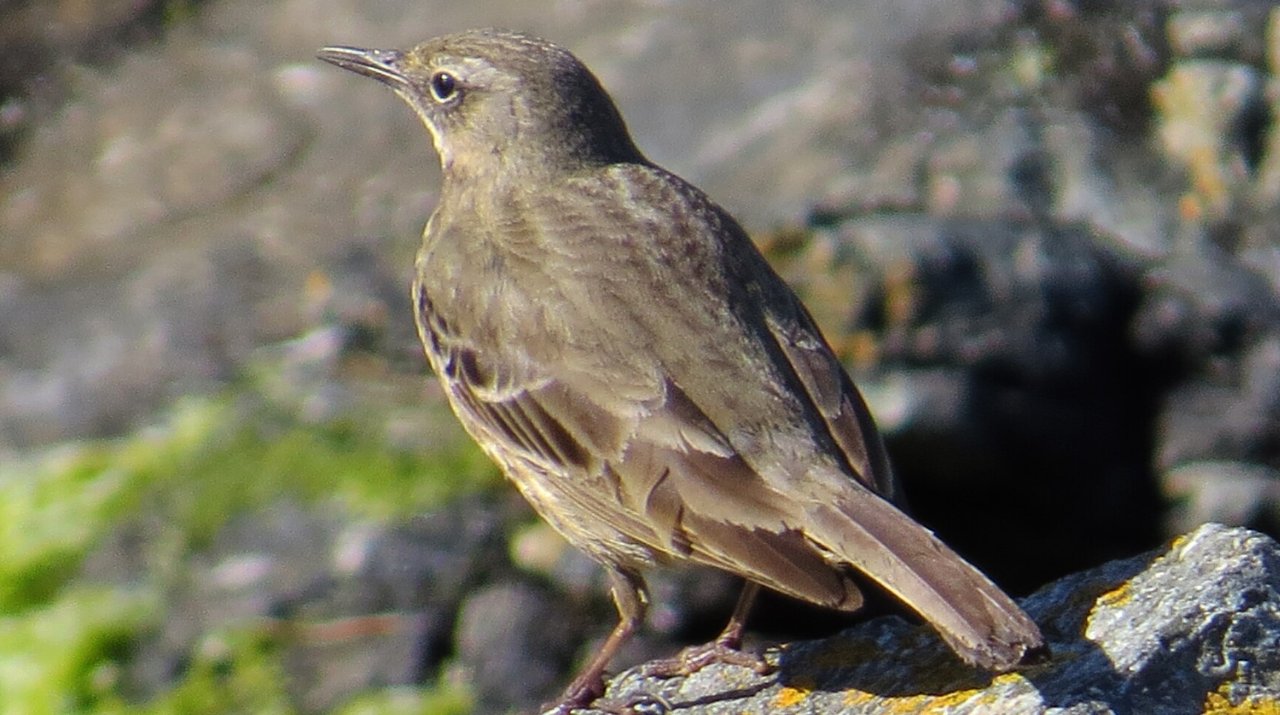
Eurasian Rock Pipit
Anthus petrosus
Identify the Eurasian Rock Pipit by sound or photo and log your sightings with Birdpass.


The Eurasian Rock Pipit is a sturdy, dark, streaky pipit of rocky sea coasts in western and northern Europe. Birds on Atlantic shores are mostly resident, while the northern subspecies breeding around the Baltic and in northern Europe migrates west and south to winter on milder coasts. It is a strictly coastal breeder, and its large, stable population is of Least Concern.
Did you know?
- Males sometimes help a neighbour chase an intruder out of its territory.
- Its scientific name, petrosus, is Latin for “rocky”.
Voice
About the species
Identification
A dusky, olive-brown to grey pipit, darker above and heavily streaked below, with a fairly long dark bill. The outer tail feathers are pale grey, not bright white as on Meadow Pipit. The call is a sharp “psriit”, and the male's song, often in song flight, is coarser than Meadow Pipit's.
Family
Motacillidae
Size
Small (sparrow)
Colours
brown, grey, white
About the habitat
Rocky shores, skerries and islets of the outer archipelago, boulder beaches and cliff bases; on migration and in winter also wrack-strewn beaches and sometimes a little inland.
Diet
Mainly insects, small crustaceans, worms and molluscs picked from wet rocks, seaweed and shallow water; in winter often small snails; also some seeds.
Behaviour
Forages by walking and probing among seaweed and rock crevices along the shore, often perching on boulders between bouts of feeding. Usually seen singly or in pairs and strongly territorial. The male delivers a Meadow Pipit-like song in display flight. The nest is tucked into a rock crevice or under coastal vegetation; 4–6 eggs hatch in about two weeks.
Sources
Photo: MPF, CC BY-SA 3.0 https://commons.wikimedia.org/wiki/File:2015-04-22 Anthus petrosus, Portsoy.jpg
Sound: Sonothèque ADVL, XC707268, CC0 1.0 https://xeno-canto.org/707268
Text: Wikipedia (English) + FinBIF species descriptions + Wikipedia (Finnish), CC BY-SA 4.0; FinBIF: CC BY 4.0; Wikipedia: CC BY-SA 4.0 https://en.wikipedia.org/wiki/European_rock_pipit