Suomi
 Svenska
 Polski
 Čeština
 Slovenčina
 Norsk
 Dansk
Marsh Warbler
Acrocephalus palustris
Identify the Marsh Warbler by sound or photo and log your sightings with Birdpass.


The Marsh Warbler is a slim Old World warbler of tall, damp vegetation that breeds across temperate Europe and western Asia and winters mainly in south-eastern Africa. It is famous for its rich, fast song packed with imitations of other birds. Though easily confused with the Reed Warbler, its mimicry and preference for rank herbage rather than pure reedbeds help tell it apart. The species is generally common and has spread northward in parts of its range.
Did you know?
- A male Marsh Warbler typically imitates around 75 other bird species, often including more African than European voices.
- It learns its whole repertoire in its first summer and first winter; sounds heard in later years are not added.
Voice
About the species
Identification
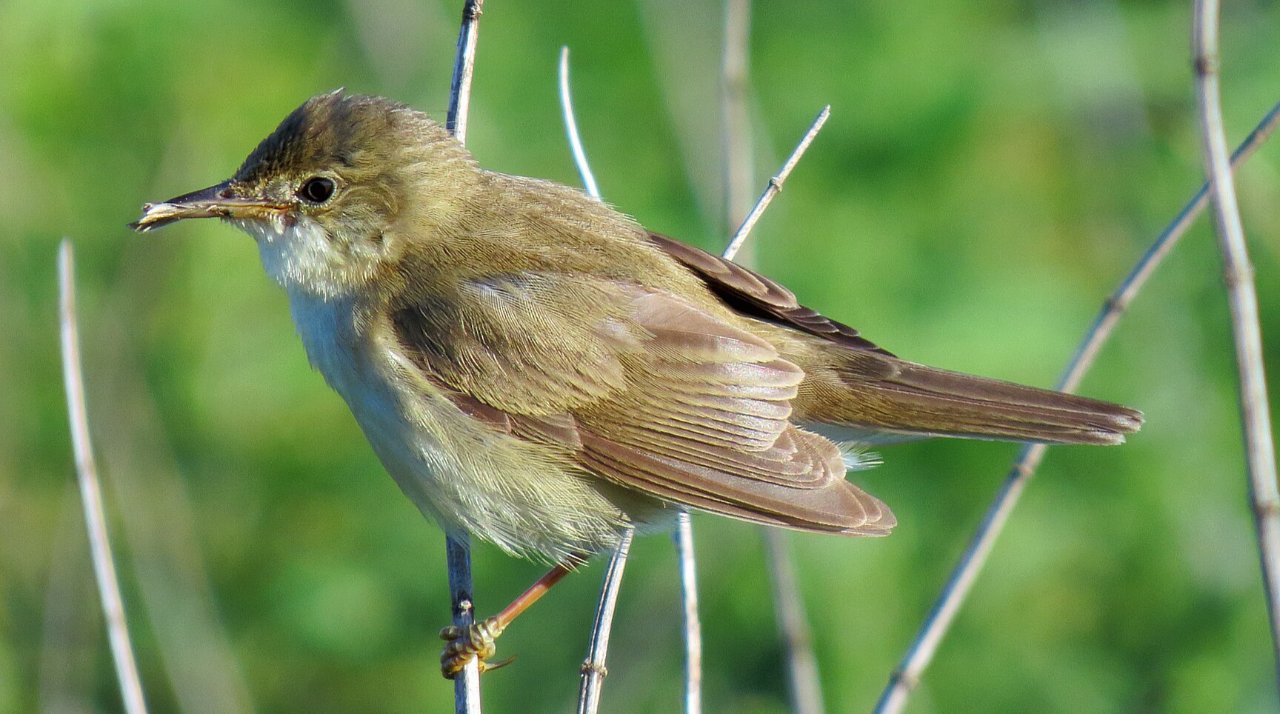
A medium-sized warbler, brown above (slightly greenish-olive in spring) and yellowish-white below, with a long, pointed bill slightly shorter than Reed Warbler's and pale legs. Very similar to Reed Warbler; young birds are hard to tell apart in the field. The song is fast and bubbling, full of mimicry, and the call is a sharp “tchek”, unlike Reed Warbler's.
Family
Acrocephalidae
Size
Tiny (goldcrest)
Colours
brown, yellow, white, green
About the habitat
Tall, rank vegetation on damp ground – nettle beds, meadowsweet, willowherb, overgrown ditches, riverbanks, young willows and field edges; it is not tied to open water and avoids pure reed stands. In Africa it winters in moist scrub, thickets and woodland edges.
Diet
Mainly insects and other small invertebrates such as flies, beetles, caterpillars and spiders, gleaned from vegetation; in late summer and autumn also some berries.
Behaviour
Skulks in dense herbage but sings energetically from exposed stems, often at night. Territorial on the breeding grounds, sometimes in loose clusters, and usually monogamous for a season. The nest is a deep, neatly woven cup slung between sturdy stems low in rank vegetation; both parents feed the young. A long-distance migrant, largely solitary in Africa.
Sources
Photo: Аимаина хикари, CC0 https://commons.wikimedia.org/wiki/File:Acrocephalus palustris Irpin6.JPG
Sound: Robert Petersen, XC1083487, CC BY-SA 4.0 https://xeno-canto.org/1083487
Text: Wikipedia (English) + FinBIF species descriptions, CC BY-SA 4.0; FinBIF: CC BY 4.0 https://en.wikipedia.org/wiki/Marsh_warbler