Suomi
 Svenska
 Polski
 Čeština
 Slovenčina
 Norsk
 Dansk
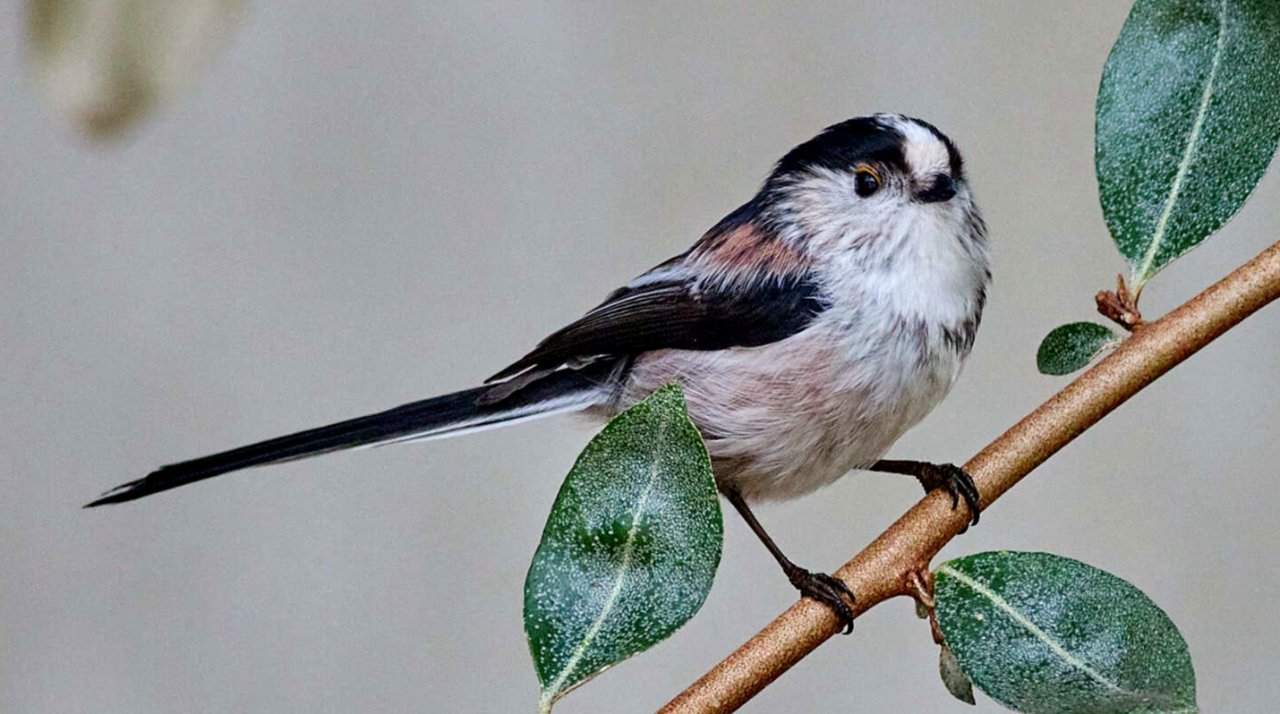
Long-tailed Tit
Aegithalos caudatus
Identify the Long-tailed Tit by sound or photo and log your sightings with Birdpass.


The Long-tailed Tit is a tiny, round-bodied songbird of Europe and Asia, instantly recognised by its extremely long tail. Northern birds are strikingly white-headed, while southern populations show dark stripes on the head. Outside the breeding season it roams in tight, chattering family flocks through woodland edges and hedges. It is mostly resident, although northern birds make irregular movements and irruptions in some years.
Did you know?
- It stitches its sac-like nest together with spider silk and tiny moss “hooks”, a natural Velcro, and lines it with over a thousand feathers.
- Despite its name, it is not a true tit but belongs to its own family, Aegithalidae.
Voice
About the species
Identification
Its extremely long tail relative to the tiny body is the clearest feature and separates it from all true tits. The northern subspecies is white-headed, with a back patterned in black and brownish-pink and pale underparts. It moves restlessly and hangs nimbly from twigs. Age and sex cannot be told from plumage in autumn, as both young and adults have completed a full moult.
Family
Aegithalidae
Size
Tiny (goldcrest)
Colours
white, black, brown, grey
About the habitat
Deciduous and mixed woodland with a well-developed shrub layer, especially young broadleaved stands along water, as well as scrub, hedgerows, riverine thickets, parks and gardens.
Diet
Mainly small insects, spiders and other arthropods and their eggs and larvae, especially moth caterpillars; a little seed in autumn and winter, and it readily visits feeders for fat.
Behaviour
Highly social and vocal; family flocks forage acrobatically through trees and shrubs, often hanging upside down, and keep contact with thin, high calls and rattles. The flocks break up for breeding. An expert nest-builder, it weaves a flexible, domed nest of moss and lichen bound with spider silk and lined with feathers.
Sources
Photo: nathanmes, CC BY 4.0 https://commons.wikimedia.org/wiki/File:Aegithalos caudatus aremoricus, La Guérinière, France 1.jpg
Sound: Sonothèque ADVL, XC707392, CC0 1.0 https://xeno-canto.org/707392
Text: Wikipedia (English) + FinBIF species descriptions + Wikipedia (Finnish), CC BY-SA 4.0; FinBIF: CC BY 4.0; Wikipedia: CC BY-SA 4.0 https://en.wikipedia.org/wiki/Long-tailed_tit