Suomi
 Svenska
 Polski
 Čeština
 Slovenčina
 Norsk
 Dansk
Gull-billed Tern
Gelochelidon nilotica
Identify the Gull-billed Tern by sound or photo and log your sightings with Birdpass.


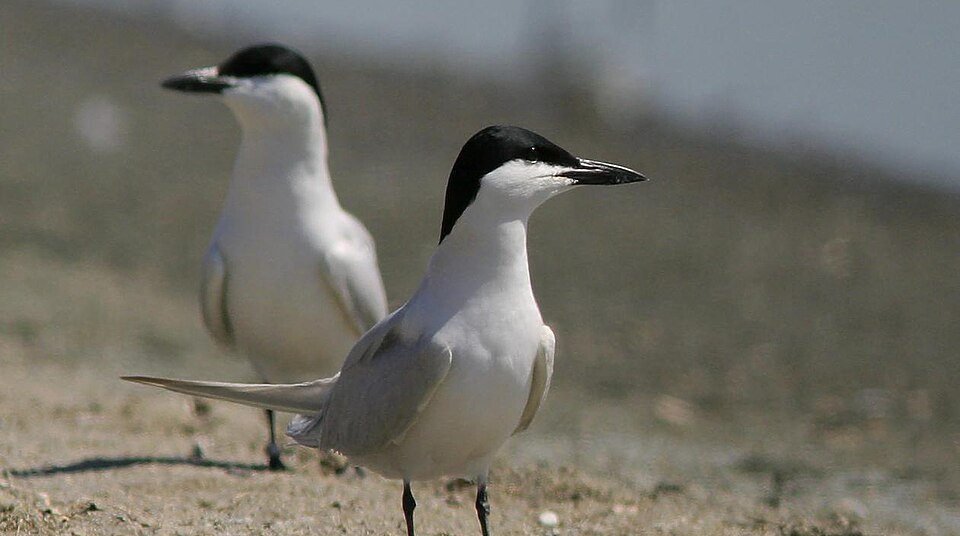
The Gull-billed Tern is a widespread tern that breeds in scattered colonies across southern Europe, much of Asia, north-west Africa and the Americas. It is larger and more robust than many terns, with a thick, gull-like black bill, a black cap in summer and a dark mask behind the eye in winter. Unlike most terns, it rarely plunge-dives and has a very varied diet.
Did you know?
- Its genus name, Gelochelidon, combines Greek words meaning “laughing swallow”.
- It has been seen picking up dead dragonflies from roads.
Voice
About the species
Identification
A medium-sized tern with a black cap in summer, white head and neck and pale grey back. Its strong, thick black bill is a good field mark separating it from most other terns. In winter it lacks the black cap and has a dark spot behind the eye. The sexes look alike.
Family
Sternidae
Size
Medium (thrush)
Colours
white, grey, black
About the habitat
Open wetlands and coasts – lakes, marshes, lagoons, tidal flats and saltpans – as well as nearby fields; nests on low, sparsely vegetated ground near shallow water.
Diet
Opportunistic: mainly flying insects caught on the wing, but also amphibians, lizards, small mammals and crabs taken over wet fields, marshes and shores; fish only rarely.
Behaviour
Hunts mostly by hawking over wetlands, shores and fields, often giving a sharp “ker-wik” call; it seldom plunge-dives. It breeds in colonies on open ground, laying two to five eggs in a simple scrape. After breeding it disperses widely, and northern populations are strongly migratory.
Sources
Photo: Eric Kershner/USFWS, CC BY 2.0 https://commons.wikimedia.org/wiki/File:Gelochelidon nilotica vanrossemi.jpg
Sound: Joost van Bruggen, CC BY-SA 4.0 https://commons.wikimedia.org/wiki/File:Gelochelidon_nilotica_-_Gull-billed_Tern_XC431990.mp3
Text: Wikipedia (English), CC BY-SA 4.0 https://en.wikipedia.org/wiki/Gull-billed_tern