Suomi
 Svenska
 Polski
 Čeština
 Slovenčina
 Norsk
 Dansk
Greylag Goose
Anser anser
Identify the Greylag Goose by sound or photo and log your sightings with Birdpass.


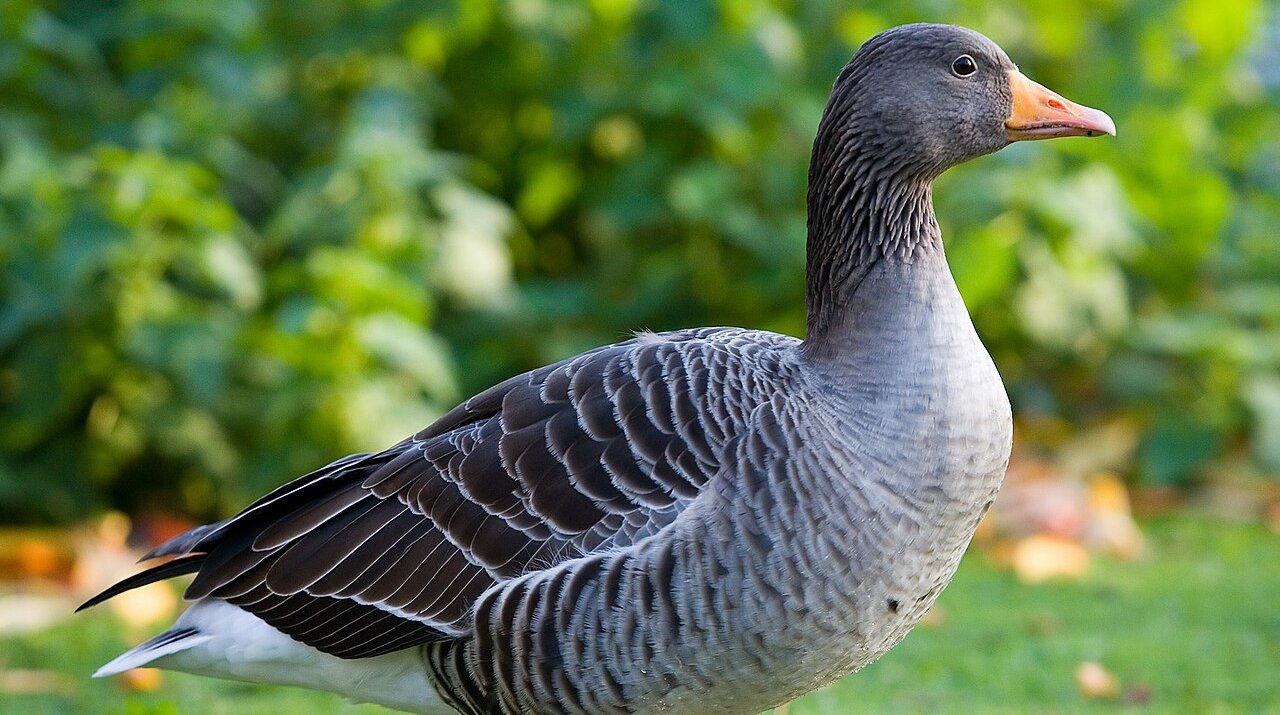
The Greylag Goose is a large, bulky, pale grey goose with an orange bill and pink legs, widespread across Europe and Asia. Northern birds migrate south for the winter, while many other populations are resident, even in towns. It is the wild ancestor of most domestic geese and has been associated with people for thousands of years.
Did you know?
- It is the wild ancestor of most domestic geese, domesticated at least 3,000 years ago.
- Greylags sometimes hybridise with other waterfowl, including Barnacle and Canada Geese and even Mute Swans.
Voice
About the species
Identification
A large, greyish goose with a big head, heavy triangular apricot-orange bill and pink legs. In flight the pale grey forewing is conspicuous. The call is a loud, slightly hoarse cackle. Separated from other grey geese by its size, pale tone and the combination of pale bill and pink legs.
Family
Anatidae
Size
Very large (swan)
Colours
grey, brown, orange, white
About the habitat
Lakes, marshes, river floodplains, coastal islands, lagoons and estuaries, with nearby meadows or fields for grazing and open water for roosting.
Diet
Mainly a grazer on grasses, sedges and herbs; it also eats roots, tubers and aquatic plants, and readily feeds on growing or spilled cereals on farmland.
Behaviour
Pairs usually mate for life and nest on the ground among vegetation near water, lining the nest with down. The female incubates while both parents fiercely defend the young; families migrate together in autumn. Outside the breeding season it forms large flocks that graze on fields by day and roost on open water, flying in V-formations with loud, cackling honks. Adults hiss when threatened.
Sources
Photo: Diliff, CC BY-SA 3.0 https://commons.wikimedia.org/wiki/File:Greylag Goose - St James's Park, London - Nov 2006.jpg
Sound: Joost van Bruggen, XC436358, CC BY-SA 4.0 https://xeno-canto.org/436358
Text: Wikipedia (English) + FinBIF species descriptions, CC BY-SA 4.0; FinBIF: CC BY 4.0 https://en.wikipedia.org/wiki/Greylag_goose