
 Suomi
 Svenska
 Polski
 Čeština
 Slovenčina
 Norsk
 Dansk
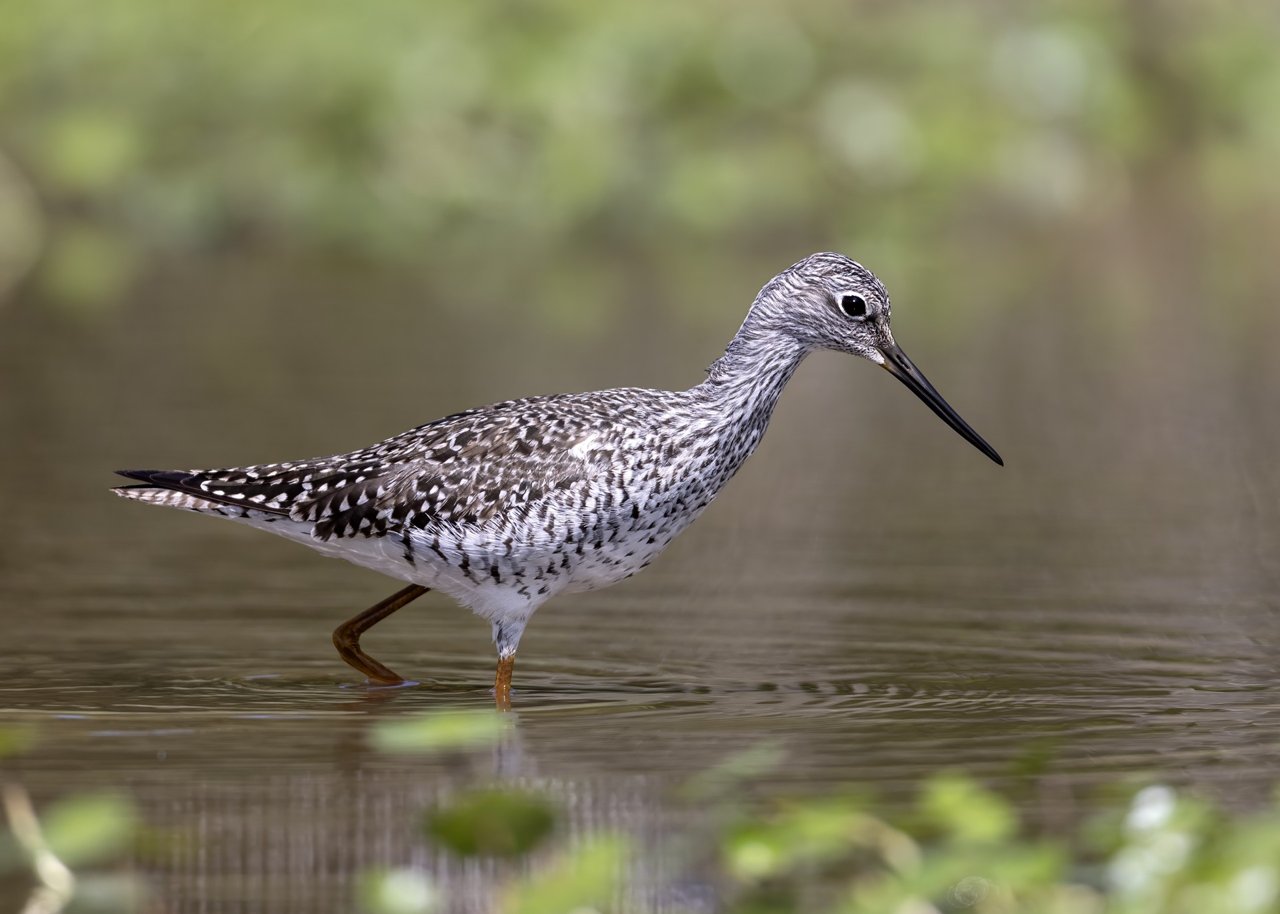
Greater Yellowlegs
Tringa melanoleuca
Identify the Greater Yellowlegs by sound or photo and log your sightings with Birdpass.


The Greater Yellowlegs is a tall, long-billed American wader with bright yellow legs and a crisply streaked neck and breast. It breeds in bogs and marshes of the boreal forest in Canada and Alaska and winters from the southern United States to South America. It is larger than the similar Lesser Yellowlegs, with a slightly upturned bill and a loud, ringing three-note call. Its closest relative is the Common Greenshank. It is a very rare vagrant to Europe.
Did you know?
- Its closest relative is the Common Greenshank, not the Lesser Yellowlegs.
- Its chicks leave the nest area within two days of hatching.
Voice
About the species
Identification
A tall wader with long, bright yellow legs and a long, slightly upturned bill, pale at the base. It is grey-brown above with white spots and heavily streaked on the neck and breast, with a white rump in flight. It is larger than Lesser Yellowlegs, with a bill clearly longer than the head, and has yellow rather than greenish legs compared with Greenshank.
Family
Scolopacidae
Size
Medium (thrush)
Colours
grey, white, brown, yellow, black
About the habitat
Breeds in muskeg bogs and marshes in the boreal forest; on migration and in winter coastal and inland marshes, mudflats and flooded fields.
Diet
Mainly aquatic insects and small fish, as well as crustaceans, worms, frogs and occasionally seeds and berries, picked or probed in shallow water.
Behaviour
An active, restless wader that strides through shallows, sometimes running after fish and stirring the water with its bill. It nests on the ground in well-hidden spots near water. It is very vocal, giving loud, three-note “tew-tew-tew” calls. The chicks leave the nest within a day of hatching.
Sources
Photo: Chuck Homler, Focus On Wildlife, CC BY-SA 4.0 https://commons.wikimedia.org/wiki/File:Greater yellowlegs (Tringa melanoleuca) foraging at Huntley Meadows, Alexandria, Virginia, USA.png
Sound: Niels Krabbe, XC251657, CC BY-SA 4.0 https://xeno-canto.org/251657
Text: Wikipedia (English), CC BY-SA 4.0 https://en.wikipedia.org/wiki/Greater_yellowlegs
 foraging at Huntley Meadows, Alexandria, Virginia, USA.png)