
 Suomi
 Svenska
 Polski
 Čeština
 Slovenčina
 Norsk
 Dansk
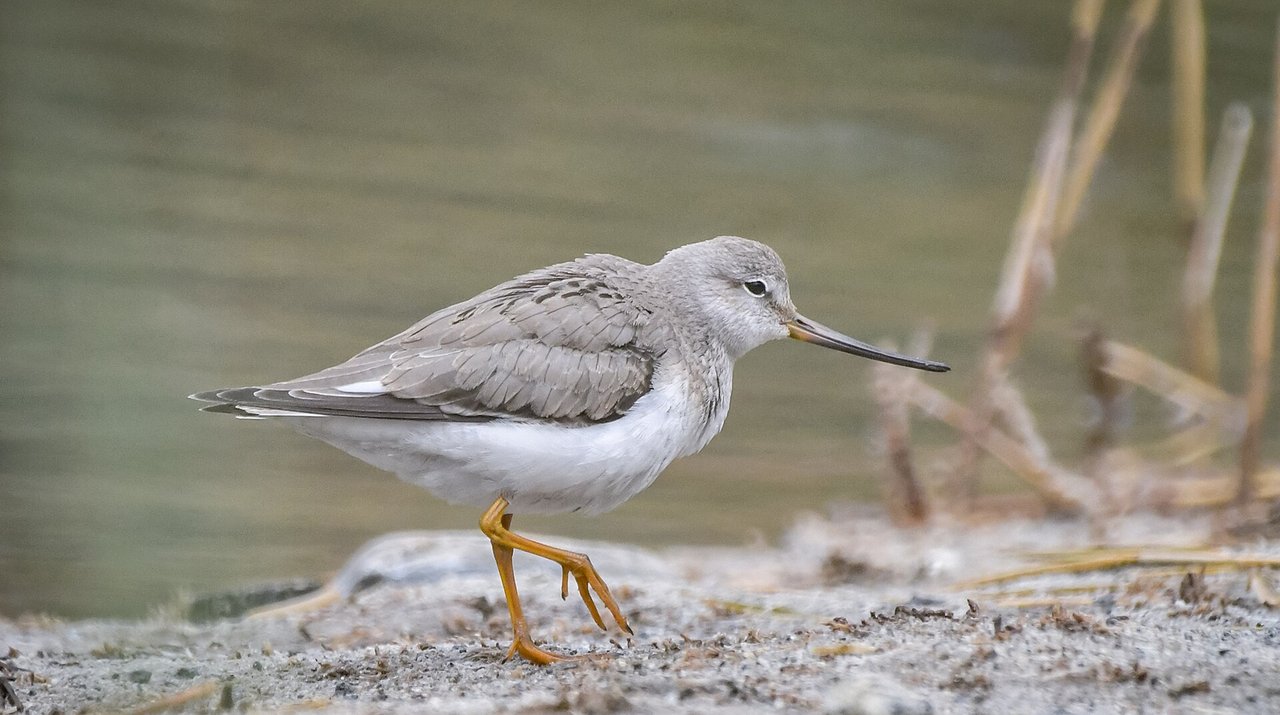
Terek Sandpiper
Xenus cinereus
Identify the Terek Sandpiper by sound or photo and log your sightings with Birdpass.


The Terek Sandpiper is a small, lively wader with a long, upturned bill and short orange-yellow legs, the only member of its genus. It breeds on sandy and shingle banks of rivers and lakes in the northern taiga from north-eastern Europe to Siberia and winters on tropical coasts of Africa, South Asia and Australia, especially on muddy shores and mangroves.
Did you know?
- It is the only species in the genus Xenus.
- It is named after the Terek River by the Caspian Sea.
Voice
About the species
Identification
A small wader, grey above with a black line along the scapulars in breeding plumage and white below. The legs are short and yellow-orange, and the fairly long, dark bill curves clearly upwards. In flight a white trailing edge shows on the wing. It differs from Common Sandpiper in its upturned bill and brighter legs.
Family
Scolopacidae
Size
Medium (thrush)
Colours
grey, white, brown, orange
About the habitat
Breeds on gravelly or sandy bars and banks of broad taiga rivers and lakes, and even log storage areas; outside the breeding season tidal mudflats, estuaries, sandy shores and mangroves.
Diet
Small invertebrates – insects, crustaceans and worms – picked or swept from wet sand and mud; it chases mobile prey and often washes its catch at the water's edge.
Behaviour
An energetic feeder that dashes about after prey and makes quick side-to-side sweeps with its bill, often with Turnstones and small plovers. It readily perches on branches and even wires. Its call is a fluty whistle. It nests in a ground scrape, laying three or four eggs, and migrates long distances.
Sources
Photo: Birds of Gilgit-Baltistan, CC BY-SA 2.0 https://commons.wikimedia.org/wiki/File:Terek Sandpiper (Xenus cinereus) (53969645800).jpg
Sound: Jochem Verweij, XC926291, CC BY-SA 4.0 https://xeno-canto.org/926291
Text: Wikipedia (English) + FinBIF species descriptions, CC BY-SA 4.0; FinBIF: CC BY 4.0 https://en.wikipedia.org/wiki/Terek_sandpiper
 (53969645800).jpg)