Suomi
 Svenska
 Polski
 Čeština
 Slovenčina
 Norsk
 Dansk
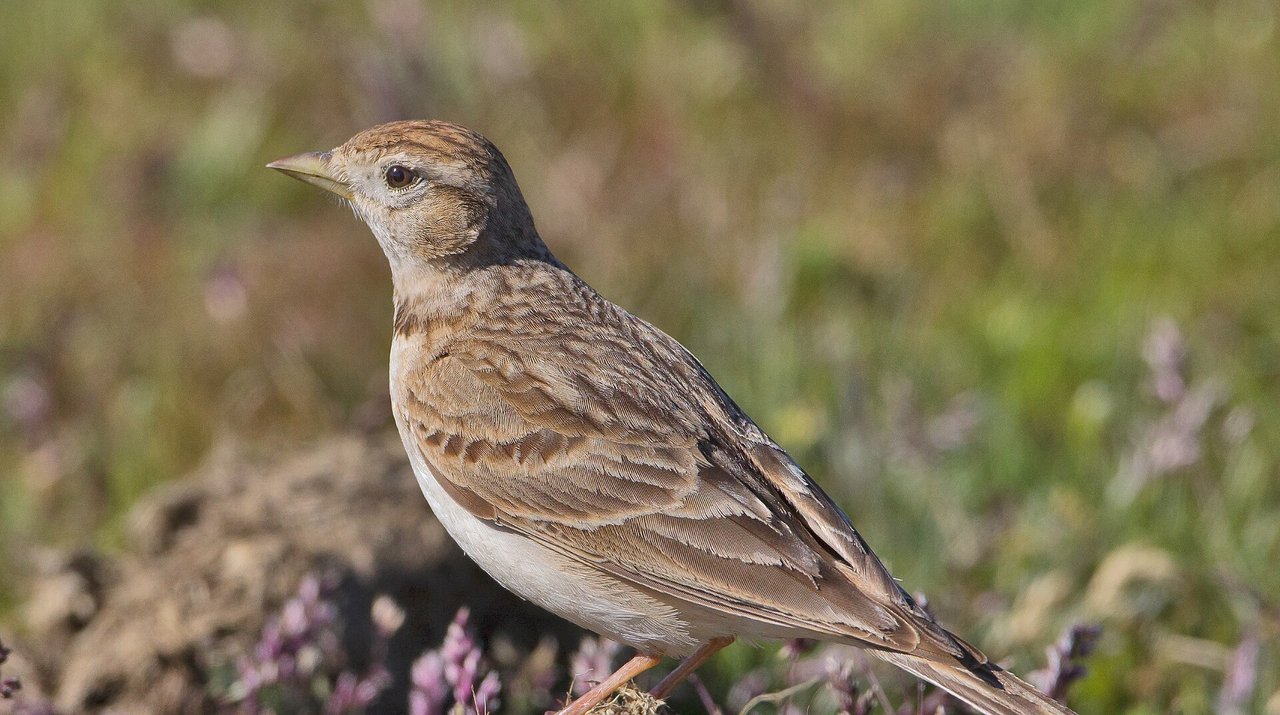
Greater Short-toed Lark
Calandrella brachydactyla
Identify the Greater Short-toed Lark by sound or photo and log your sightings with Birdpass.


The Greater Short-toed Lark is a small, pale, sandy lark of dry open country and farmland, breeding from southern Europe and north-west Africa east across the Palearctic to Mongolia. Most populations migrate, wintering at the southern edge of the Sahara and in India, and it regularly overshoots into northern and western Europe in spring and autumn. Outside the breeding season it gathers in flocks.
Did you know?
- During migration it forms large, tight flocks that move in unison.
- Its name refers to its relatively short hind claw.
Voice
About the species
Identification
A small, lark-like bird with pale underparts and a streaked brown back. There is often a dark patch on the side of the neck, and the median coverts form a dark bar on the wing; the sexes are alike. It is smaller than a Skylark, paler and sandier, with no crest, a plain unstreaked breast and a stout, pointed bill.
Family
Alaudidae
Size
Small (sparrow)
Colours
brown, white, grey, black
About the habitat
Dry, open habitats with sparse vegetation – steppe, sandy or stony ground, fallow and stubble fields and coastal dunes.
Diet
Mainly seeds picked from the ground, supplemented by insects, especially in the breeding season.
Behaviour
Forages by walking or running and pecking at the ground, in loose groups outside the breeding season; migrating flocks fly in tight, synchronised groups. Males sing a fast, dry, twittering song, sometimes with mimicry, from the ground or in an undulating song flight. It nests on the ground and roosts in small depressions.
Sources
Photo: Juan Lacruz, CC BY-SA 3.0 https://commons.wikimedia.org/wiki/File:Alondra.jpg
Sound: Milan Ruzic, XC478478, CC BY-SA 4.0 https://xeno-canto.org/478478
Text: Wikipedia (English) + FinBIF species descriptions, CC BY-SA 4.0; FinBIF: CC BY 4.0 https://en.wikipedia.org/wiki/Greater_short-toed_lark