Suomi
 Svenska
 Polski
 Čeština
 Slovenčina
 Norsk
 Dansk
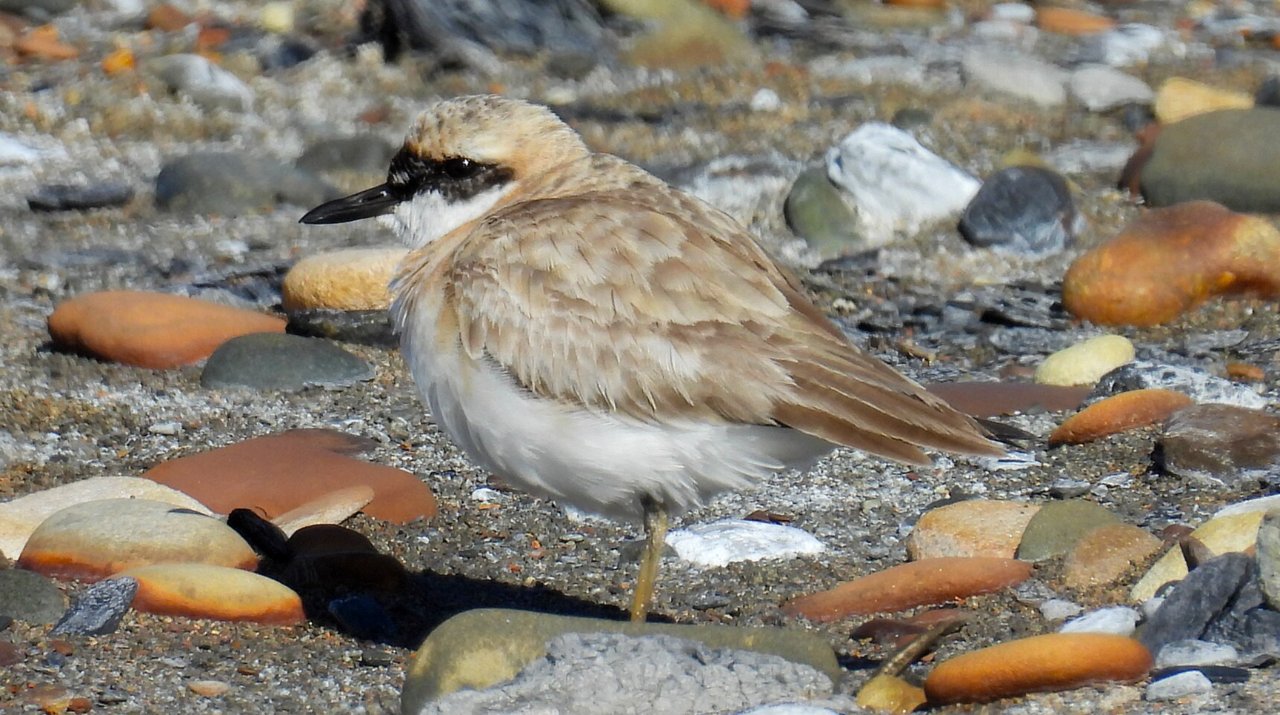
Greater Sand Plover
Anarhynchus leschenaultii
Identify the Greater Sand Plover by sound or photo and log your sightings with Birdpass.


The Greater Sand Plover is a chunky, long-legged plover of about 19–22 cm with a heavy black bill and greenish-yellow legs. It breeds on bare semi-desert from Turkey across Central Asia and winters on sandy coasts in East Africa, South Asia and Australasia. It is a rare vagrant to western and northern Europe, where lone birds can be hard to tell from the similar Siberian and Tibetan Sand Plovers.
Did you know?
- Its scientific name honours the French botanist Jean Baptiste Leschenault de la Tour.
- It feeds with a quick run-and-pause routine rather than steady probing.
About the species
Identification
A medium-sized plover with long greenish-yellow legs and a relatively thick black bill; upperparts sandy and underparts white. Breeding males show orange tones on the forehead, nape and breast band and a dark eye mask; females and non-breeding birds are duller. Compared with Siberian and Tibetan Sand Plovers it tends to look bulkier with longer legs and a heavier bill, but lone vagrants need careful study.
Family
Charadriidae
Size
Medium (thrush)
Colours
brown, white, orange, black
About the habitat
Breeds on open semi-desert and steppe with sparse vegetation; outside the breeding season on sandy beaches, coastal mudflats and lagoons.
Diet
Insects, small crustaceans and worms, taken by sprinting, pausing and picking prey from the surface.
Behaviour
A strongly migratory plover that nests in a shallow scrape on bare ground and forages with a run-and-pause gait rather than steady probing. Its flight call is a soft trill.
Sources
Photo: MPF, CC BY-SA 4.0 https://commons.wikimedia.org/wiki/File:2024-07-26 Anarhynchus leschenaultii leschenaultii, Newbiggin, Northumberland 1.jpg
Text: Wikipedia (English) + GBIF regional observations + Wikipedia (English), CC BY-SA 4.0; GBIF occurrence data; Wikipedia: CC BY-SA 4.0 https://en.wikipedia.org/wiki/Greater_sand_plover