
 Suomi
 Svenska
 Polski
 Čeština
 Slovenčina
 Norsk
 Dansk
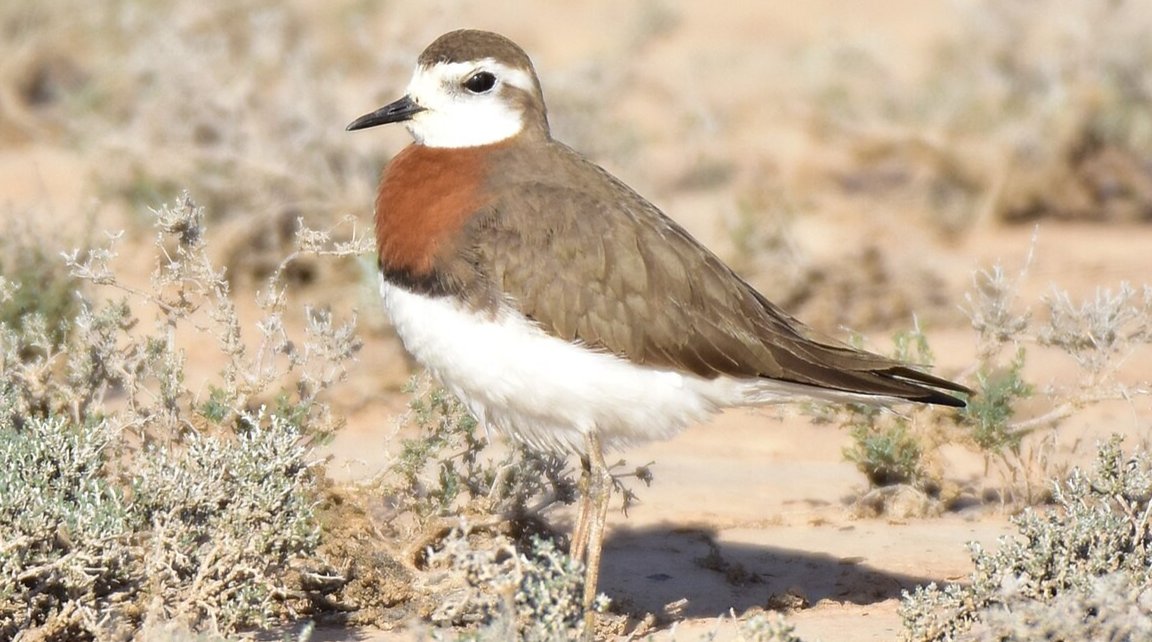
Caspian Plover
Anarhynchus asiaticus
Identify the Caspian Plover by sound or photo and log your sightings with Birdpass.


The Caspian Plover is a slender, long-legged plover that breeds on open steppe and semi-desert around the Caspian Sea and in Central Asia and winters in eastern and southern Africa. Breeding males have a chestnut breast bordered below by black, a white face and belly and a bold white eyebrow. It is a very rare vagrant to western and northern Europe and is globally assessed as Least Concern.
Did you know?
- Its species name, asiaticus, means “Asian”.
- It sometimes turns up far from its range as a rare vagrant in western Europe and even Australia.
About the species
Identification
Slightly larger and slimmer than Common Ringed Plover, with fairly long legs and a fine bill. The breeding male stands out with its broad rusty breast band against a white throat; females and winter birds are plainer. It resembles Greater and Lesser Sand Plovers but looks slimmer and lighter, with a finer bill, longer legs, upright stance and bright white supercilium.
Family
Charadriidae
Size
Medium (thrush)
Colours
brown, white, orange, black
About the habitat
Open, short-grass steppe, desert margins and saline flats with sparse cover when breeding; in winter dry grasslands, floodplains and sometimes cultivated land.
Diet
Mainly ground-dwelling insects such as beetles, termites, ants and grasshoppers, as well as small snails; occasionally grass seeds.
Behaviour
Forages by running and pausing to pick prey from the ground, alone or in small groups. Breeds in loose colonies, laying usually three eggs on bare ground or among short vegetation; both adults incubate. A long-distance migrant with a sharp “chip” call.
Sources
Photo: Kudaibergen Amirekul, CC BY-SA 4.0 https://commons.wikimedia.org/wiki/File:Wermutregenpfeifer (Charadrius asiaticus) 206737679.jpg
Text: Wikipedia (English) + GBIF regional observations + Wikipedia (Finnish), CC BY-SA 4.0; GBIF occurrence data; Wikipedia: CC BY-SA 4.0 https://en.wikipedia.org/wiki/Caspian_plover
 206737679.jpg)