
 Suomi
 Svenska
 Polski
 Čeština
 Slovenčina
 Norsk
 Dansk
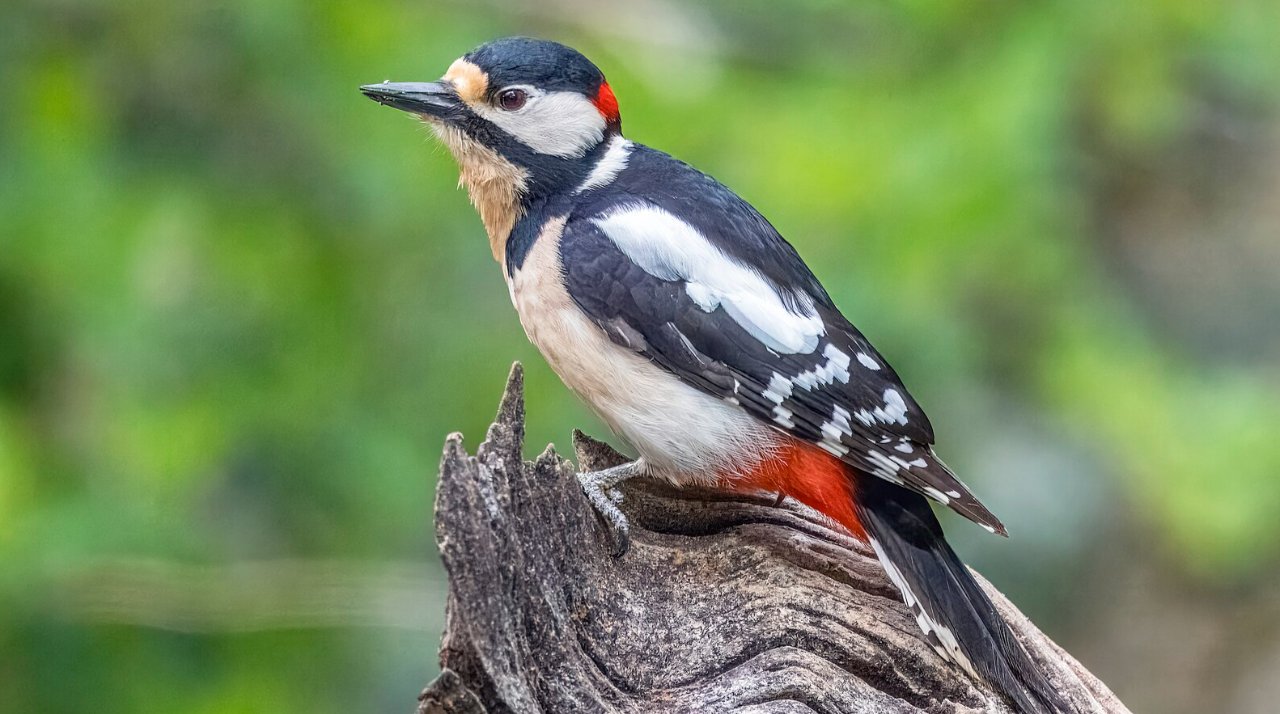
Great Spotted Woodpecker
Dendrocopos major
Identify the Great Spotted Woodpecker by sound or photo and log your sightings with Birdpass.


The Great Spotted Woodpecker is a medium-sized black-and-white woodpecker with a splash of red under the tail. Widespread across the Palearctic and into North Africa, it lives in all kinds of woodland as well as parks and gardens, and readily visits feeders. It announces itself with rapid, far-carrying drumming. Mostly resident, northern birds can irrupt south and west in years when conifer cone crops fail.
Did you know?
- It was long believed that its drumming was a vocal sound; only in 1943 was it proven to be purely mechanical.
- A single “anvil” crevice can be surrounded by hundreds of discarded cones.
Voice
About the species
Identification
A medium-sized woodpecker with a white belly, bright red undertail, black wings barred with white and large white shoulder patches; the flanks are unstreaked. The male has a red nape patch, the female an all-black crown; juveniles have a red crown. Told from Lesser Spotted Woodpecker by its larger size and white shoulder patches, and from White-backed Woodpecker by its black back and unstreaked flanks.
Family
Picidae
Size
Medium (thrush)
Colours
black, white, red
About the habitat
All kinds of woodland from mature coniferous and mixed forest to deciduous woods, as well as parks, gardens and wooded edges.
Diet
Insects and larvae prised from bark and wood, seeds from conifer cones, nuts and berries; sometimes eggs and nestlings of other birds. At feeders it takes fat and peanuts.
Behaviour
Climbs trunks with stiff tail support, hammering to find food and to excavate its unlined nest hole in dead or decaying wood. It wedges cones and nuts into a crevice – an “anvil” – to hammer them open. Both sexes drum to advertise territory, the male more often. Both parents incubate and feed the young; after fledging each parent tends part of the brood. Its flight is strongly undulating.
Sources
Photo: Charles J. Sharp, CC BY-SA 4.0 https://commons.wikimedia.org/wiki/File:Great spotted woodpecker (Dendrocopos major) male Drenthe.jpg
Sound: Sonothèque ADVL, XC707123, CC0 1.0 https://xeno-canto.org/707123
Sound: Sonothèque ADVL, XC707121, CC0 1.0 https://xeno-canto.org/707121
Sound: wilmet sebastien, XC961741, CC0 1.0 https://xeno-canto.org/961741
Sound: Sonothèque ADVL, XC918609, CC0 1.0 https://xeno-canto.org/918609
Text: Wikipedia (English) + FinBIF species descriptions, CC BY-SA 4.0; FinBIF: CC BY 4.0 https://en.wikipedia.org/wiki/Great_spotted_woodpecker
 male Drenthe.jpg)