Suomi
 Svenska
 Polski
 Čeština
 Slovenčina
 Norsk
 Dansk
Northern Fulmar
Fulmarus glacialis
Identify the Northern Fulmar by sound or photo and log your sightings with Birdpass.


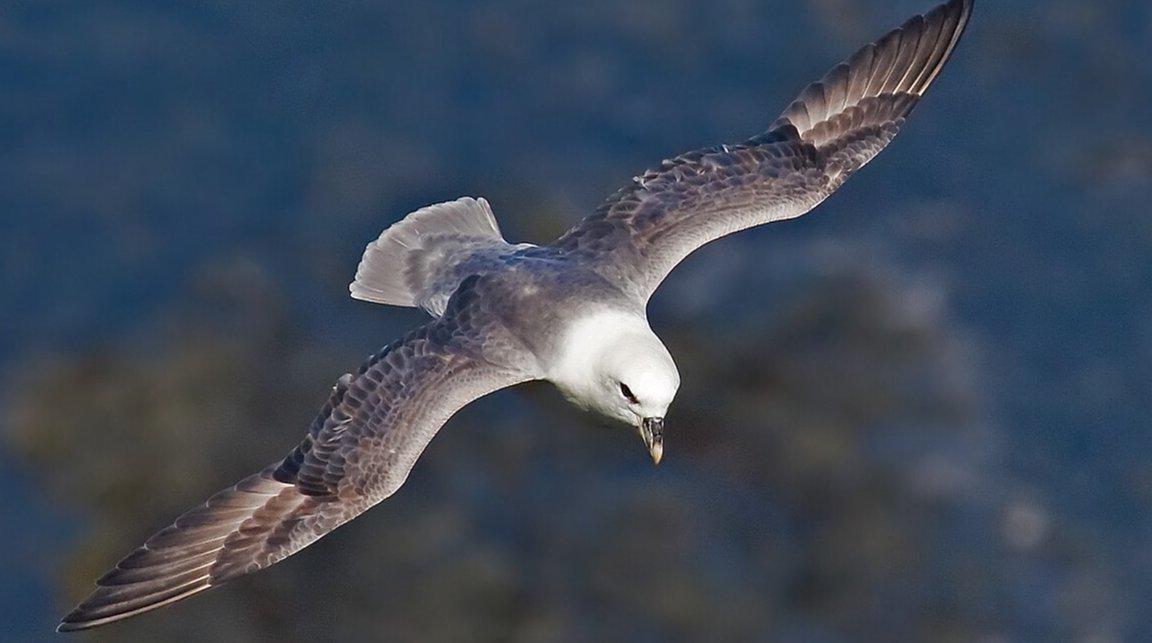
The Northern Fulmar is an abundant seabird of the subarctic North Atlantic and North Pacific, often mistaken for a gull but actually a tube-nosed petrel. It occurs in light and dark morphs, from nearly white with grey wings to uniformly slate-grey, with many intermediates. A powerful, stiff-winged flier and very long-lived, it nests in large colonies on cliff ledges and even on buildings.
Did you know?
- Fulmars spray foul-smelling stomach oil at predators; it can mat the feathers of attacking birds.
- Fulmars can live for over 40 years.
Voice
About the species
Identification
Medium-sized (length 45–50 cm, wingspan 87–112 cm), with a torpedo-shaped body, strong head and thick bill with tubular nostrils. The wings are fairly short and blunt, and it flies with stiff-winged glides. Morphs range from light (off-white below, greyish back, dark around the eye) to dark (lead-grey all over), with intermediates. Told from gulls by its thick tube-nosed bill and stiff, gliding flight.
Family
Procellariidae
Size
Large (crow)
Colours
white, grey
About the habitat
Open subarctic seas of the North Atlantic and North Pacific; breeds in colonies on grassy ledges and slopes of sea cliffs and islands, increasingly also on buildings.
Diet
Omnivorous at sea: shrimps, fish, squid, plankton and jellyfish, as well as carrion and fishing discards; it also makes shallow dives down to about 4 m.
Behaviour
A strong, stiff-winged flier that glides low over the waves and forages widely over cold oceans, often following fishing boats. Fulmars form long-term pairs and return to the same nest site in large colonies; both sexes share the long incubation and chick-rearing. Courtship involves head-waving and cackling calls. Adults and chicks can eject foul-smelling stomach oil in defence.
Sources
Photo: Northern-Fulmar2.jpg: Andreas Trepte, CC BY-SA 2.5 https://commons.wikimedia.org/wiki/File:Northern-Fulmar2 cropped.jpg
Sound: Unknown, CC BY-SA 4.0 https://commons.wikimedia.org/wiki/File:Northern_Fulmar_(Fulmarus_glacialis)_(W1CDR0001409_BD2).ogg
Text: Wikipedia (English), CC BY-SA 4.0 https://en.wikipedia.org/wiki/Northern_fulmar