Suomi
 Svenska
 Polski
 Čeština
 Slovenčina
 Norsk
 Dansk
Ross's Gull
Rhodostethia rosea
Identify the Ross's Gull by sound or photo and log your sightings with Birdpass.


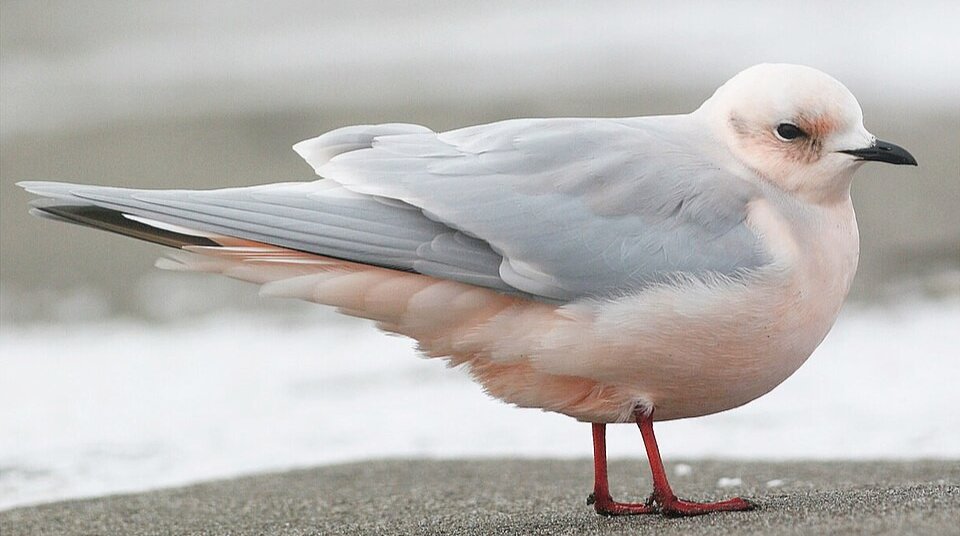
Ross's Gull is a small, elegant Arctic gull and the only member of its genus, named after the explorer James Clark Ross. Summer adults are pale grey above and white below with a delicate pink flush, a neat black neck ring, red legs and a wedge-shaped tail. It breeds in north-eastern Siberia and locally in the North American Arctic and winters at the edge of the pack ice, with rare wanderers reaching temperate coasts.
Did you know?
- Its pink flush comes from its diet and may fade in winter.
- Its breeding grounds were discovered in 1905 by Sergei Buturlin, who was there as a judge.
About the species
Identification
A small, elegant gull (29–31 cm, wingspan 90–100 cm), resembling Little Gull but slightly larger and longer-winged, with a wedge-shaped tail. The back is pale grey and the rest of the plumage nearly white; in summer the body has a pink flush and there is a thin black neck ring, and the legs are red. The underwing is grey. Young birds resemble young Little Gulls, with a dark “W” on the upperwing.
Family
Laridae
Size
Medium (thrush)
Colours
white, grey, black, red
About the habitat
Wet Arctic tundra with sedges, dwarf willows and pools, and swampy river deltas; in winter the edge of the pack ice.
Diet
Insects, especially beetles and flies, on the breeding grounds; at sea small fish, crustaceans and plankton picked from the surface; in winter it may feed on mudflats like a wader.
Behaviour
Breeds in small colonies on tundra and swampy estuaries, often among Arctic Terns, nesting in a ground scrape on a small lake island. It usually lays two or three eggs, incubated for about three weeks. Outside the breeding season it stays in the Arctic, moving only short distances south to the edge of the ice.
Sources
Photo: Hiraku Senzaki, CC BY 4.0 https://commons.wikimedia.org/wiki/File:Rhodostethia rosea, Shiretoko, Japan.jpg
Text: Wikipedia (English), CC BY-SA 4.0 https://en.wikipedia.org/wiki/Ross%27s_gull