Suomi
 Svenska
 Polski
 Čeština
 Slovenčina
 Norsk
 Dansk
European Golden Plover
Pluvialis apricaria
Identify the European Golden Plover by sound or photo and log your sightings with Birdpass.


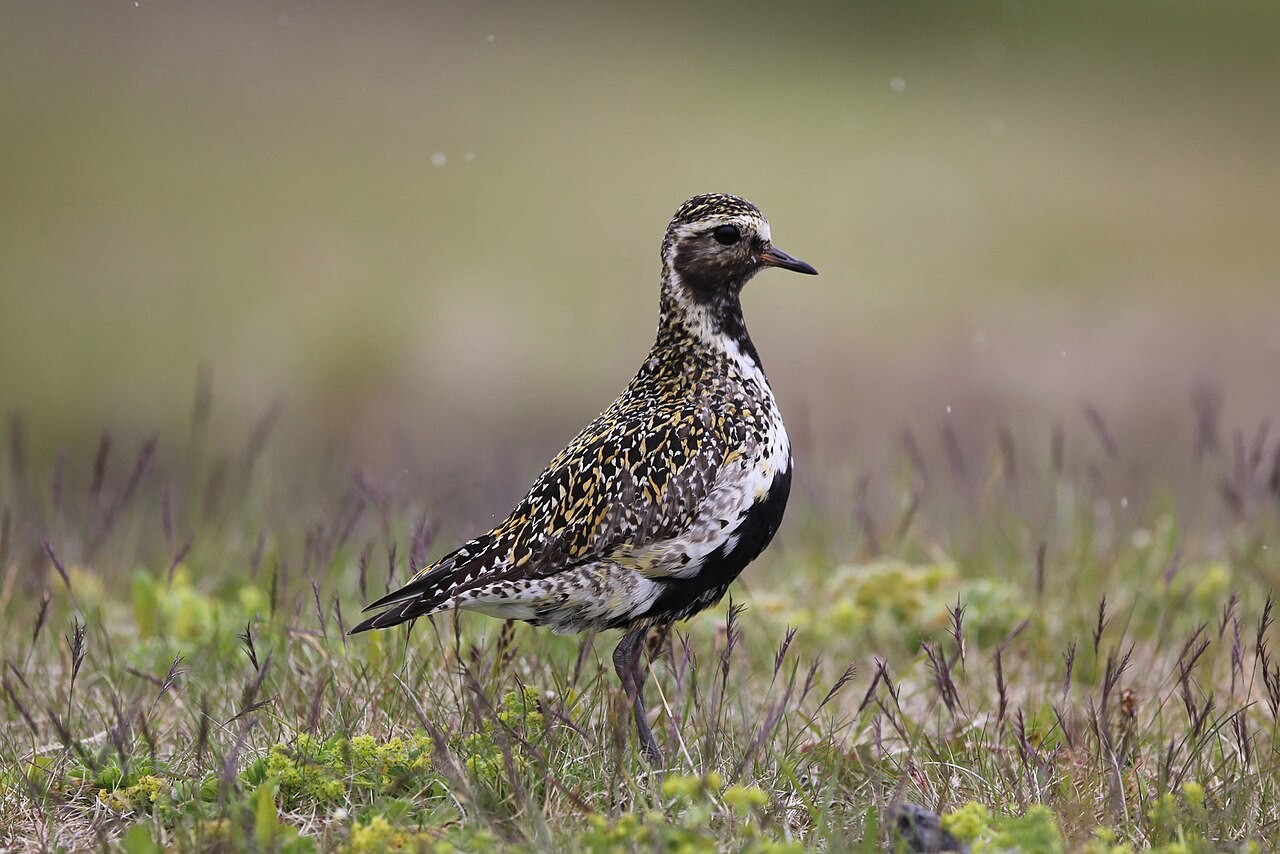
The European Golden Plover is a medium-sized, gold-spangled plover of tundra, moorland and bogs across northern Europe and western Siberia. In breeding plumage it has a black face and belly bordered by a white S-shaped stripe. It winters in western and southern Europe, North Africa and south-western Asia, often in large flocks on farmland and short grass. Some southern breeding populations have declined or disappeared.
Did you know?
- Its scientific name apricaria means “basking in the sun”.
- A pub debate over whether it was Europe's fastest game bird helped inspire the Guinness World Records book.
Voice
About the species
Identification
The breeding male is easy to identify by its black face, throat and belly bordered by a white stripe; the back, wings and crown are spangled gold and black, and the legs grey. Young and winter birds are mottled golden-brown above, with a spotted breast and white belly. In flight the white axillaries and a narrow white wing bar show, separating it from Grey Plover, which has black “armpits”. The call is a melancholy, minor-key “tüü”.
Family
Charadriidae
Size
Medium (thrush)
Colours
black, yellow, white, brown
About the habitat
Breeds on open, treeless tundra, moorland, wet heaths and bogs with short vegetation and pools; outside the breeding season fields, ploughland, short meadows, coastal grassland and estuaries.
Diet
Mainly invertebrates taken from the ground – beetles, flies, craneflies, ants, caterpillars, spiders and earthworms – as well as small snails and berries such as crowberry; chicks rely heavily on flies.
Behaviour
Feeds by running and pausing to pick prey from the surface. Wary, adults stand upright to scan for danger and give a plaintive, slightly descending “tüü”. Outside the breeding season it forms large, cohesive flocks on fields and flats, often with Lapwings. Its flight is fast and powerful.
Sources
Photo: Dagur Brynjólfsson from Hafnarfjordur, Iceland, CC BY-SA 2.0 https://commons.wikimedia.org/wiki/File:Kapustarinta.jpg
Sound: Bushman, XC132878, CC BY-SA 3.0 https://xeno-canto.org/132878
Sound: Sonothèque ADVL, XC776784, CC0 1.0 https://xeno-canto.org/776784
Text: Wikipedia (English) + FinBIF species descriptions, CC BY-SA 4.0; FinBIF: CC BY 4.0 https://en.wikipedia.org/wiki/European_golden_plover