Suomi
 Svenska
 Polski
 Čeština
 Slovenčina
 Norsk
 Dansk
Eurasian Skylark
Alauda arvensis
Identify the Eurasian Skylark by sound or photo and log your sightings with Birdpass.


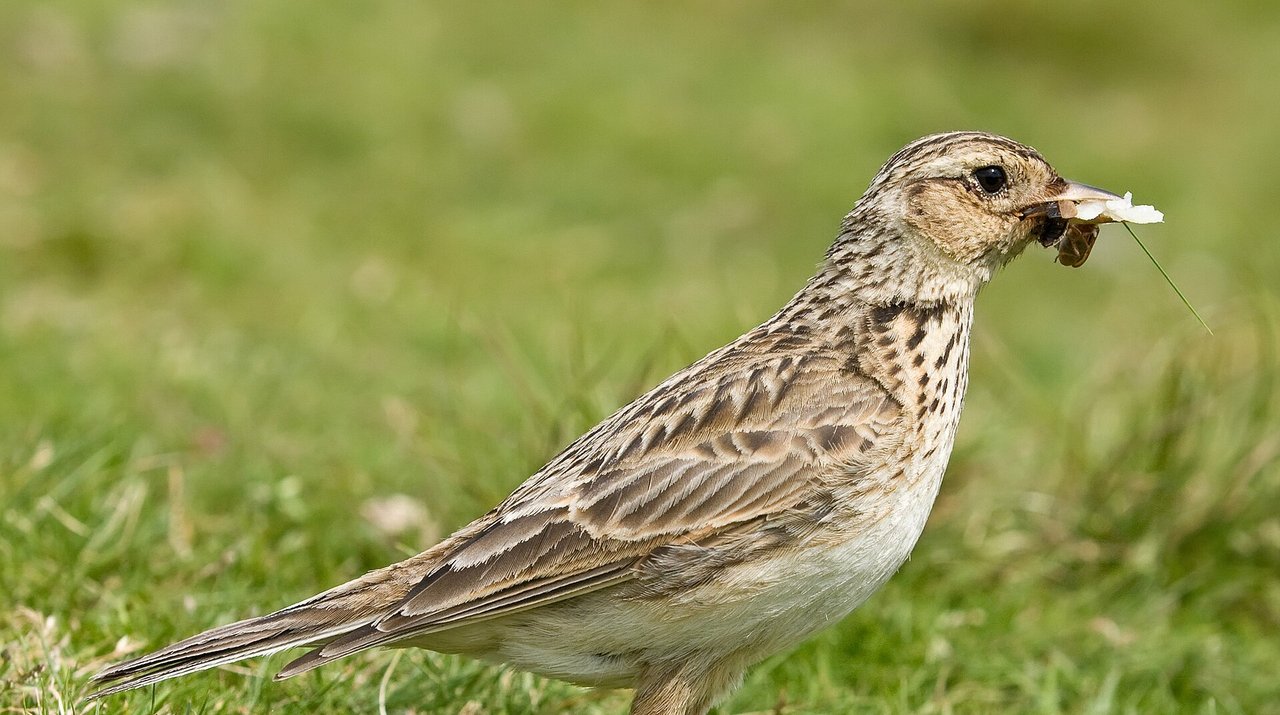
The Eurasian Skylark is a widespread lark of open country across Europe and much of the Palearctic, famous for the male's long, bubbling song delivered high in the sky. Both sexes look alike, with streaked brown upperparts, paler underparts and a small crest. It nests on the ground in farmland, meadows and heath. Western populations are mostly resident, while northern and eastern birds migrate; it has also been introduced to places such as New Zealand and Australia.
Did you know?
- A male can hover and sing without a break for 20 minutes or more.
- Its soaring song inspired Ralph Vaughan Williams's piece The Lark Ascending.
Voice
About the species
Identification
A plain brown, streaked bird with a small crest that it can raise. Strong legs and a very long hind claw. In flight it shows a pale trailing edge to the wing and white outer tail feathers. Its high, continuous song flight over open country helps separate it from other songbirds; compared with Woodlark it has a longer tail and lacks the bold pale eyebrows meeting on the nape.
Family
Alaudidae
Size
Small (sparrow)
Colours
brown, white, grey
About the habitat
Open landscapes with low vegetation: arable fields, meadows, pastures, heaths, coastal dunes and airfields, away from trees and hedges.
Diet
Seeds, grain and green shoots for much of the year; in the breeding season more insects and spiders, which are especially important for the chicks. It swallows seeds without husking them.
Behaviour
The male rises steeply to 50–100 m and hovers or circles while singing continuously, then parachutes back to the ground. Forages by walking and picking food from bare ground or short vegetation. It nests in a shallow scrape hidden in grass; the female incubates, both parents feed the young, and chicks leave the nest before they can fly. Pairs may raise several broods. Outside the breeding season it gathers in loose flocks on stubble and fallow fields.
Sources
Photo: User:Diliff, CC BY-SA 3.0 https://commons.wikimedia.org/wiki/File:Skylark 2, Lake District, England - June 2009.jpg
Sound: Marie-Lan Taÿ Pamart, XC484052, CC BY-SA 4.0 https://xeno-canto.org/484052
Sound: Sonothèque ADVL, XC920756, CC0 1.0 https://xeno-canto.org/920756
Sound: Jochem verweij, XC841783, CC BY-SA 4.0 https://xeno-canto.org/841783
Text: Wikipedia (English) + FinBIF species descriptions, CC BY-SA 4.0; FinBIF: CC BY 4.0 https://en.wikipedia.org/wiki/Eurasian_skylark