Suomi
 Svenska
 Polski
 Čeština
 Slovenčina
 Norsk
 Dansk
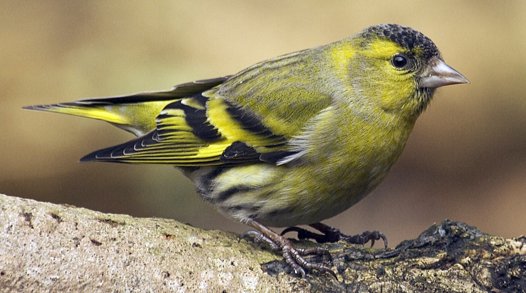
Eurasian Siskin
Spinus spinus
Identify the Eurasian Siskin by sound or photo and log your sightings with Birdpass.


The Eurasian Siskin is a small, lively, yellow-green finch of coniferous and mixed woodland across Europe and northern Asia. Males have a black cap and chin and bright yellow wing bars and tail sides; females are greyer and more streaked. An acrobatic feeder on alder, birch and spruce seeds, it often hangs upside down. Every few years it irrupts south and west in huge numbers, depending on seed crops.
Did you know?
- A German legend says siskins keep a magic stone in their nests that makes them invisible.
- Its breeding can start as early as March in good spruce seed years.
Voice
About the species
Identification
A small, yellow-green finch. The male has a black cap and chin, yellow wing bars and yellow in the tail sides; females and young are greyish-green and clearly streaked below, without the black cap. The bill is slender and pointed, and the tail forked. It is smaller and slimmer than Greenfinch and lacks the red forehead of redpolls.
Family
Fringillidae
Size
Small (sparrow)
Colours
green, yellow, black, brown, white
About the habitat
Coniferous forest, especially spruce, for breeding; alder and birch stands along rivers and forest edges; in winter also parks and gardens with seed-bearing trees.
Diet
Mainly small seeds of spruce, pine, alder and birch, prised from cones and catkins with its slim bill; also weed seeds, and insects in the breeding season, especially for the nestlings. It readily visits garden feeders.
Behaviour
Active and sociable, it forms twittering flocks outside the breeding season, often with redpolls, and feeds acrobatically among catkins. Males perform fluttering song flights with a twittering, wheezy song. Pairs do not defend territories and often nest in loose colonies high in conifers, timing breeding to the spruce seed crop, sometimes as early as March. Its flight call is a clear “tsy-lee”.
Sources
Photo: Sławek Staszczuk (photoss [AT] hotmail.co.uk), CC BY-SA 3.0 https://commons.wikimedia.org/wiki/File:Carduelis spinus male.jpg
Sound: Benoît Van Hecke, XC539301, CC BY-SA 4.0 https://xeno-canto.org/539301
Text: Wikipedia (English) + GBIF regional observations + Wikipedia (Danish) + FinBIF species descriptions + GBIF regional observations + Wikipedia (English), CC BY-SA 4.0; GBIF occurrence data; Wikipedia: CC BY-SA 4.0; FinBIF: CC BY 4.0 https://en.wikipedia.org/wiki/Eurasian_siskin