Suomi
 Svenska
 Polski
 Čeština
 Slovenčina
 Norsk
 Dansk
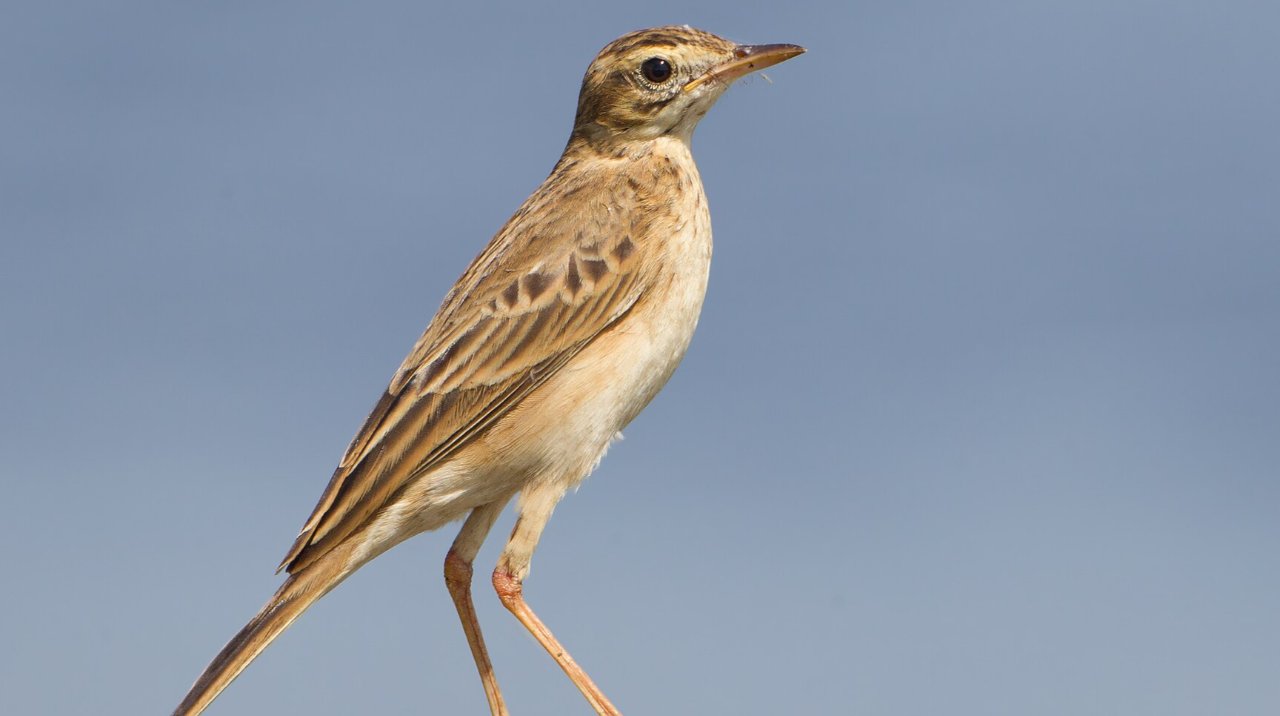
Richard's Pipit
Anthus richardi
Identify the Richard's Pipit by sound or photo and log your sightings with Birdpass.


Richard's Pipit is a large, tall and long-legged pipit of open grasslands that breeds from southern Siberia and Mongolia to northern and eastern China and winters in the Indian subcontinent and South-East Asia. It is noted for its upright stance, strong undulating flight and explosive, sparrow-like “shreep” call. It is a rare but regular autumn vagrant to western and northern Europe, often after easterly winds.
Did you know?
- Its names commemorate Charles Richard, an 18th–19th-century French naturalist.
- Despite breeding in Asia, it appears every autumn at European coastal watchpoints, where its sharp call often gives it away.
Voice
About the species
Identification
A large pipit with clearly long legs and a relatively long, strong bill and a very long hind claw. The flight is deeply undulating and the call a loud, harsh “shreep”. Told from other large pipits, such as Tawny and Blyth's Pipits, especially by leg and bill length and by call; the sexes are alike.
Family
Motacillidae
Size
Small (sparrow)
Colours
brown, white
About the habitat
Open lowland country – grassland, steppe, marshy meadows and cultivated fields; vagrants in Europe often appear on exposed headlands, islands and coastal grasslands.
Diet
Mainly insects and other invertebrates such as beetles, flies, grasshoppers and spiders, picked from the ground or snatched in short flights; also some seeds.
Behaviour
Usually seen alone or in small groups, standing very upright and running or walking to feed. When flushed it flies strongly in deep undulations and gives a loud, harsh “shreep”. It performs a simple, buzzy song in rising-and-falling song flight and nests on the ground under grass tussocks.
Sources
Photo: JJ Harrison (https://www.jjharrison.com.au/), CC BY 3.0 https://commons.wikimedia.org/wiki/File:Anthus richardi - Laem Pak Bia.jpg
Sound: Sonothèque ADVL, XC943898, CC0 1.0 https://xeno-canto.org/943898
Text: Wikipedia (English) + FinBIF species descriptions, CC BY-SA 4.0; FinBIF: CC BY 4.0 https://en.wikipedia.org/wiki/Richard%27s_pipit